
Unbiased headlines. Facts, not spin.
Every story is an unbiased news briefing written from 110+ sources across the spectrum — sources linked so you can verify it yourself.
 energy
Notable (6/10)
June 13, 2026 at 07:07 AM
energy
Notable (6/10)
June 13, 2026 at 07:07 AM
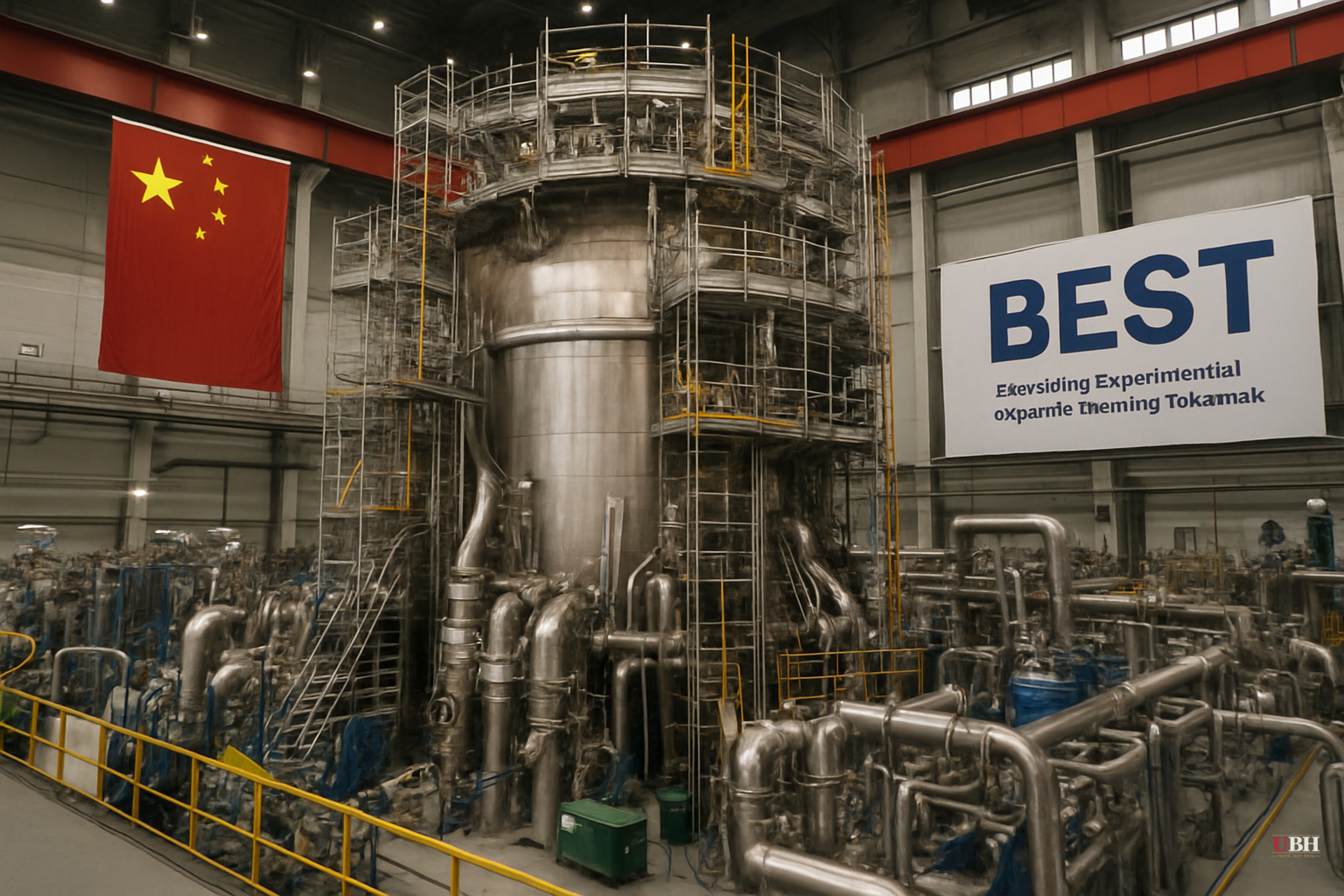
China's BEST Fusion Reactor on Track for 2027 Completion. The U.S. Has a Competing Project in Massachusetts.
Two Countries, One Goal, Zero Guarantees
China is finalizing assembly of the Burning Plasma Experimental Superconducting Tokamak, known as BEST, at a facility in Hefei. The project is expected to be completed in 2027, according to state news agency Xinhua as reported by the South China Morning Post in May 2025. That would make it the world's first fusion reactor designed to produce more energy than it consumes.
The assembly involves tens of thousands of components totaling roughly 6,000 tonnes. Song Yuntao, BEST's chief engineer at the Institute of Plasma Physics, said at a recent construction milestone ceremony that China has "fully mastered the core technologies, both scientifically and technically," according to South China Morning Post. Construction began two months ahead of schedule.
Yan Jianwen, chairman of state-backed Neo Fusion, which is leading the project, described the pace as "China speed" — a phrase Beijing has used repeatedly to signal that its state-directed industrial machine can outrun Western private-sector timelines.
What EAST Has Already Done
BEST is the next step. China's existing reactor, the Experimental Advanced Superconducting Tokamak (EAST), has been racking up records since 2006. In January 2025, EAST sustained a plasma burn for 1,066 seconds at 100 million degrees Celsius, more than doubling its own prior record from 2023, according to BGR's June 6, 2026 reporting by Alec Hively.
Earlier this year, EAST researchers broke through the Greenwald limit, a mathematical threshold describing the maximum plasma density before a reaction destabilizes, according to BGR. This represents a significant engineering milestone.
Beijing now expects EAST to attempt its first fusion ignition experiment in 2027, which would make it the first self-sustained reactor in which plasma burns without needing continuous external heating. That is a separate milestone from BEST's net-energy goal, and both are targeted for the same year.
The Money Behind It
China has invested an estimated $6.5 billion in fusion technology since 2023, according to BGR. Nuclear fusion has also been formally written into China's 15th Five-Year Plan (2026-2030) as one of its "key future growth frontiers," per Global Times reporting from April 29, 2026. The Global Times is a Chinese state media outlet, so treat its framing as an official government communication, not independent journalism. But the policy inclusion itself is independently significant.
China's newest-generation tokamak, HL-3, based in Chengdu, has achieved full independent domestic capability in manufacturing the reactor's "first wall" — the interior barrier that directly faces superheated plasma — according to Global Times. That supply chain independence matters strategically. China no longer needs foreign components for that critical subsystem.
The U.S. Is Not Sitting Still
The strongest counter-argument to a China-is-winning narrative: the United States private fusion sector is enormous and arguably more innovative. Roughly 42 American companies have raised approximately $8 billion in capital for fusion research, constituting about half of total global private investment in the field, according to BGR.
Commonwealth Fusion Systems is building SPARC in Massachusetts, targeting the same net-energy milestone on a timeline similar to China's 2027 goal, according to South China Morning Post. SPARC uses high-temperature superconducting magnets, a different and potentially more compact approach than China's tokamaks. If SPARC works, it could leapfrog reactor designs that require the massive scale China is building toward.
OilPrice.com framed the story primarily as China "threatening U.S. lead," but that framing obscures a more complicated picture: the U.S. leads in private investment while China leads in state-directed infrastructure. They are running different races with different funding models, and the winning model remains unclear given this technology's capital requirements and physics constraints.
What Has NOT Been Proven
Neither BEST nor SPARC has achieved net energy generation as of June 13, 2026. The 2027 completion target for BEST is a construction deadline, not a performance guarantee. Plasma physics at these scales is unforgiving. EAST's record burn lasted 1,066 seconds, but commercial fusion requires sustained reactions measured in months or years, not minutes.
Song Zhongping, a Chinese technology expert quoted by Global Times, noted that balancing plasma size, plasma current, and heating power simultaneously remains "extremely challenging."
The Greenwald limit breakthrough and the EAST records are real milestones. They are also steps on a road that physicists have been walking since the 1950s without reaching the destination.
The Unresolved Question
The 2027 window will be the first genuine test of whether state-directed investment at China's scale can compress decades of physics research into a single Five-Year Plan cycle. If BEST achieves net energy generation and SPARC does the same on a comparable timeline, the more important question becomes commercialization: which country can build a grid-connected fusion plant first, and at what cost per megawatt-hour. Neither government nor private investors have publicly committed to specific commercial deployment timelines yet.
Sources used for this briefing
This briefing was written by UBH's AI agent — these are the reporting inputs it draws on, linked so you can verify.


