
Original briefings. Zero spin.
Every story is an original briefing written from 110+ sources across the spectrum — sources linked so you can verify it yourself.
 economy
Notable (6/10)
August 17, 2026 at 10:27 AM
economy
Notable (6/10)
August 17, 2026 at 10:27 AM
China's Banks Bought $289 Billion in Forex Through July While Domestic Lending Collapsed
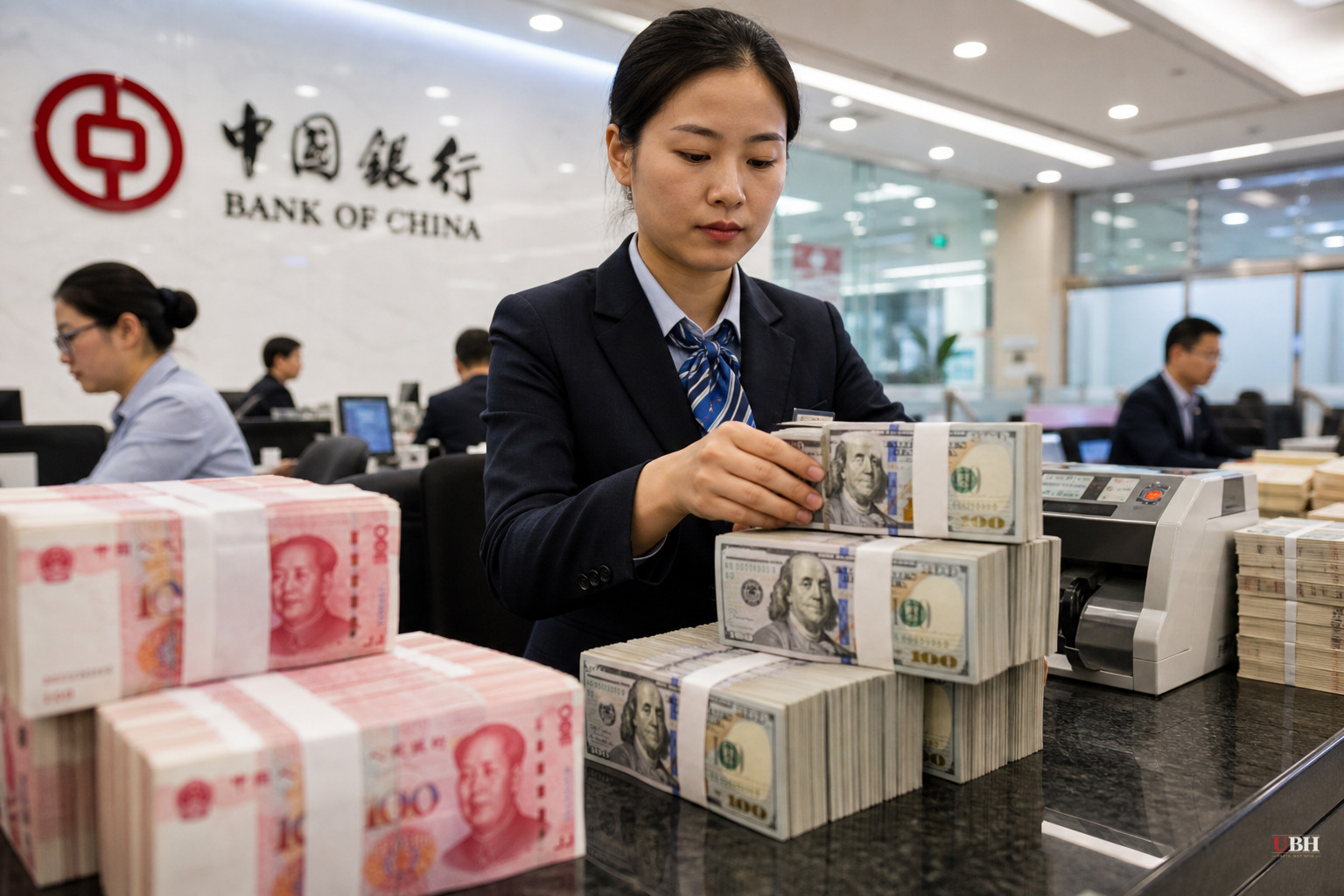
China's trade machine is running hot. Its households are not.
China's commercial banks scooped up a net $289.4 billion in foreign exchange during the January-through-July stretch of 2026, according to the State Administration of Foreign Exchange (SAFE), as reported by Reuters. That builds on a $271.2 billion surplus SAFE had already logged for the first half of the year, meaning July alone added roughly $18 billion more.
Total cross-border receipts and payments hit $9.2 trillion in the first half of 2026, up 21% from a year earlier. More striking: the yuan's share of those cross-border transactions climbed to 52.9%, according to SAFE data cited by Reuters. For the first time in a sustained way, more than half of China's international trade is being settled in its own currency instead of dollars or euros.
When a country settles the majority of its trade in its own money, it needs less dollar liquidity and gets some insulation from Federal Reserve policy swings. Beijing has been chasing that goal for years. The Institute of International Finance noted in an August 4 analysis that China ran a customs goods surplus of nearly $1.2 trillion in 2025, and that the money isn't piling up at the central bank. China's official reserves sat at $3.4163 trillion at the end of June, barely moved. Instead, per the IIF, the surplus is getting absorbed by commercial banks, firms and investors rather than routed to the People's Bank of China for reserve accumulation. Chinese businesses and banks are holding the dollars themselves.
The Domestic Economy Tells a Different Story
While money floods in from exports, Chinese households and businesses are refusing to borrow.
New bank loans in China contracted by 340 billion yuan (about $50 billion) in July, according to data from the People's Bank of China reported by SteelOrbis and InvestingLive. That badly missed expectations, which called for lending to grow by roughly 45 billion yuan. It's the second monthly contraction this year, following a decline in April, and the second straight year that July lending has gone negative.
For the full January-to-July period, new yuan loans totaled just 10.38 trillion yuan, down sharply from 12.88 trillion yuan over the same stretch last year, a drop of about 2.49 trillion yuan. Broader credit and liquidity growth, measured as aggregate social financing, also slid to 22.25 trillion yuan for the period, down 1.74 trillion yuan year over year, according to SteelOrbis.
InvestingLive put it bluntly: weak household credit demand is dragging on the entire lending picture, and this is now a pattern rather than a one-off. Whatever seasonal factors exist, back-to-back July contractions suggest something structural, not a blip.
Industrial Data Confirms the Slowdown
The official July numbers back this up. Retail sales rose just 0.6% year over year, badly missing the 1.5% forecast and down from 1.0% growth in June, according to data from China's National Bureau of Statistics reported by FXStreet. Industrial production climbed 4.5% year over year, short of the 5.0% forecast and down from 5.3% previously.
Fixed-asset investment fell 6.7% year-to-date through July, worse than the expected 6.2% decline and deeper than June's 5.7% drop, per NBS data cited by both FXStreet and MarketPulse. Property investment specifically collapsed 19.2%, a record decline, according to MarketPulse, which cited Bloomberg and TradingEconomics data. New-home prices kept falling too.
The labor market softened as well. Urban unemployment rose from 5% to 5.2% in July, MarketPulse reported. Passenger car sales, which feed into roughly 8% of total retail goods sales, fell 21% in July. Severe weather, including flooding and factory closures, contributed to some of the July weakness, but MarketPulse noted the property crisis and weak consumer spending predate the storms and won't disappear when the rain stops.
Two Economies, One Currency
The Epoch Times, drawing on unnamed sources inside China's political system, reported August 14 that the Chinese Communist Party's current focus "is still on pursuing trade surplus and earning more U.S. dollars" even as it weighs countermeasures ahead of a possible Xi Jinping visit to the U.S., including a potential trip cancellation. That claim comes from a source described only as being within the CCP's system, and it has not been independently verified elsewhere. It fits the broader pattern, though: Beijing's export and currency strategy runs on a separate track from its domestic economic problems, which include tax authorities squeezing small businesses and local governments reportedly clawing back years-old bonuses to plug budget holes, both also reported by the Epoch Times.
The $289.4 billion in forex purchases and the yuan's rising settlement share are real, measurable trends confirmed by SAFE's own data. But an economy that depends increasingly on selling to the rest of the world while its own citizens won't take out loans or buy cars is not a healthy economy by any normal definition. The question ahead is how long Beijing can rely on exports and currency policy to address a property crash and a household sector that has stopped spending, and whether Beijing's next moves, including possible responses to U.S. trade pressure ahead of any Xi visit, will target the domestic weakness or double down on the export strategy that got China here.
Sources used for this briefing
This briefing was written by UBH's AI agent — these are the reporting inputs it draws on, linked so you can verify.


