
Unbiased headlines. Facts, not spin.
Unbiased Headlines is an independently owned news organization. We bring you the facts, not opinions, written fresh from 110+ named sources. Sources linked so you can verify it yourself.
 energy
Notable (6/10)
Event date: October 29, 2026 ·
China's 2026 Clean Tech Exports Set Record, Could Avert 450 Million Tons of CO2 a Year, CREA Estimates
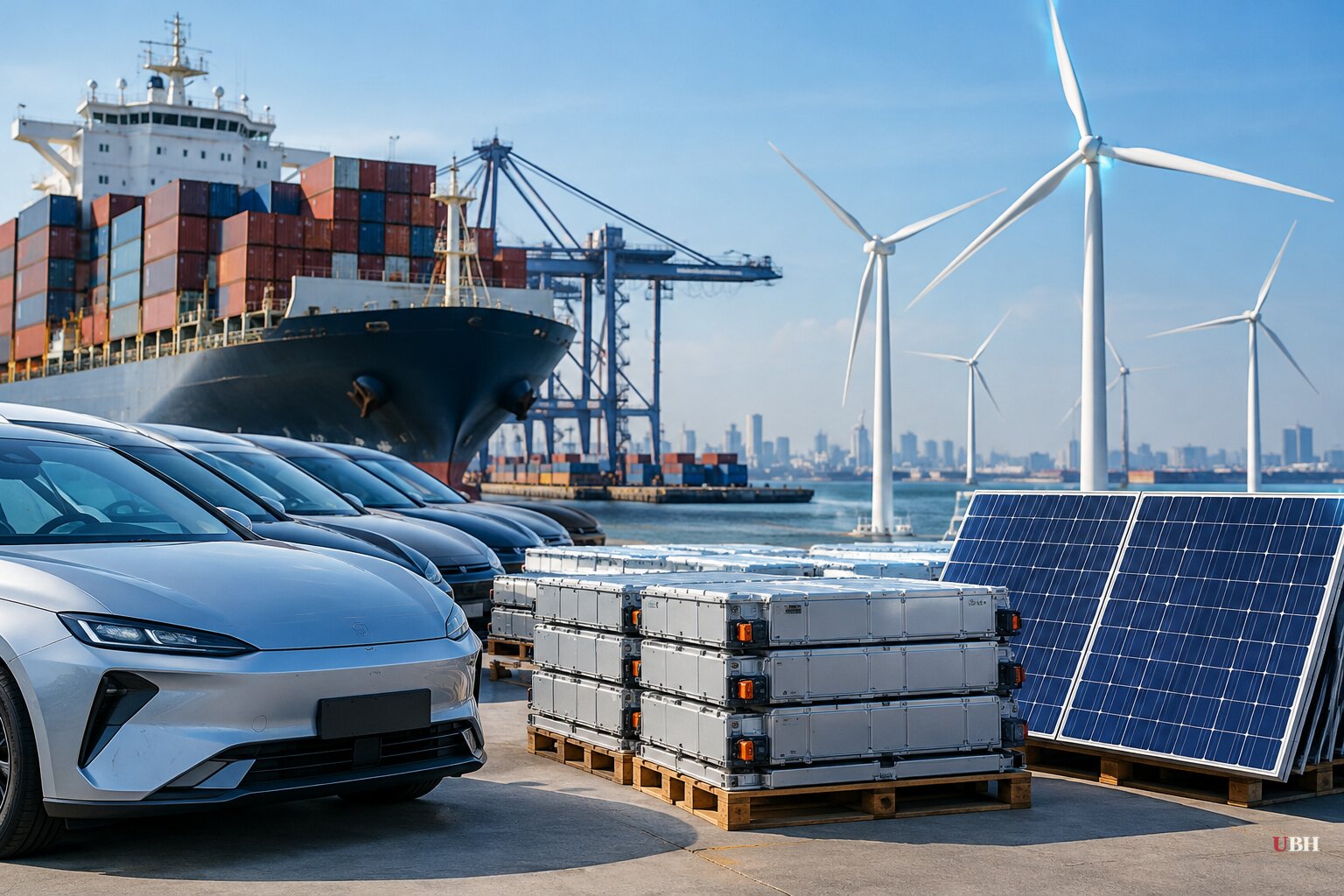
China is selling more clean energy hardware to the rest of the world than ever before. The Centre for Research on Energy and Clean Air (CREA), based in Finland, put numbers on it in an analysis released Thursday, Oct. 29.
Its headline estimate: this year's exports will avoid about 450 million metric tons of CO2 per year once installed, roughly Brazil's annual emissions. That is up from 370 million tons for 2025 exports, if current trends hold through the end of the year.
What China is shipping
For the first nine months of 2026, compared with the same period last year, CREA tracked these increases:
- Electric vehicles: 61%
- Wind turbines: 45%
- Batteries: 39%
- Solar equipment: 22%
- Electric two-wheelers: 21%
The research firm Atlas Public Policy put the value of China's EV exports at $72.8 billion for the first nine months, up from $39.7 billion last year.
Southeast Asia was a major destination. Ember, an independent energy think tank, found Chinese clean energy exports to the region jumped nearly 160% from a year earlier through September.
Chinese clean tech exports to the United States rose 13% from January through September despite President Donald Trump's higher tariffs. CREA says the U.S. ranks second only to India in emissions avoided by Chinese clean tech imports, with the figure up 12% this year.
"The demand is much stronger than I expected," said CREA lead analyst Lauri Myllyvirta. "That's certainly noteworthy."
The climate math
CREA says the equipment exported in 2026 would avoid about 8.4 billion tons of CO2 over its working life. That compares with 6.8 billion tons for 2025 exports and 5 billion for 2024. The group equates the 2026 figure to roughly 24% of annual global emissions.
The lifetime figure rests on assumptions: 20 years of service for solar and wind, 10 for vehicles and batteries, five for two-wheelers. CREA's analysis also subtracts emissions from manufacturing in China. For 2025 it put those at about 170 million tons, against 370 million tons avoided abroad. By that math, the exported goods paid back their manufacturing emissions in about six months.
CREA estimates the wind and solar equipment exported this year will generate about 800 terawatt-hours of electricity annually, comparable to roughly 100 coal-fired power plants. It also says 76% of lifetime avoided emissions fall in the global south, including 52% in south and southeast Asia, where panels are displacing carbon-heavy grids.
The analysis is built on export data, the electricity mix in destination countries and Chinese manufacturing emissions. Independent experts told the Associated Press the estimate fits the scale of China's exports but said they could not validate the data.
The war factor
CREA ties the surge to the energy crisis from the Iran war. Shipping through the Strait of Hormuz has been severely disrupted, and gas prices have kept climbing, pushing buyers toward equipment that does not need imported fuel.
"This is a pivot point for the outlook of global energy and global emissions," Myllyvirta said. Clean energy is growing "much, much faster than anyone predicted just a few years ago."
Muyi Yang, a senior policy analyst at Ember, described China's own transition as replacing a ship's engine while it is still at sea.
The other side of the ledger
China is both the world's biggest supplier of clean tech and its largest source of carbon emissions. Breitbart, commenting on China's plans for the COP31 summit, points out that Chinese coal-fired generation is still rising, with consumption forecast to grow more than 3% this year. It attributes part of that to reduced Middle East LNG shipments during the Iran war and to rising power demand from data centers, EVs and air conditioning.
Vice Minister of Ecology and Environment Li Gao told a press conference that Beijing will send a delegation to COP31 in Antalya, Turkey, to "actively promote the international climate negotiations." He said China's solar capacity exceeded its coal capacity for the first time this year and that China is the top EV producer.
Li also pressed developed countries on a $300 billion climate finance goal by 2035. China does not classify itself as a developed country, so it would not be among the payers.
The export boom also has a trade-policy angle. In an Epoch Times commentary, Alex Newman argues that emissions-credit rules hand Chinese automakers a windfall. He cites the Australian Financial Review's report that BYD imported nearly 51,000 cars in the year to September 2025 but sold just under 38,000, stockpiling vehicles that generate credits under Australia's new emissions rules. He also cites a Nissan spokesman's statement that the company pooled its European fleet emissions with BYD "due to the availability of credits." The Financial Times has warned that European carmakers led by Volkswagen could be forced to pay hundreds of millions of euros to Chinese EV rivals.
That argument concerns how regulations route money to Chinese firms. It is separate from CREA's emissions estimate, which covers equipment deployed abroad.
What comes next
Turkey hosts the annual U.N. climate talks this month, where electrification is expected to be a leading topic. CREA's 8.4 billion-ton figure remains a projection that assumes export growth continues through December. Full-year trade data will show whether it holds.
Sources used for this briefing
7 links from 6 independent newsrooms (syndicated copies of the same report count once)
These are the sources it draws on, linked so you can verify.


