
Unbiased headlines. Facts, not spin.
Unbiased Headlines is an independently owned news organization. We bring you the facts, not opinions, written fresh from 110+ named sources. Sources linked so you can verify it yourself.
 energy
Notable (6/10)
DOE Approves Radiant's Kaleidos Safety Analysis for Full-Power Microreactor Testing in Idaho
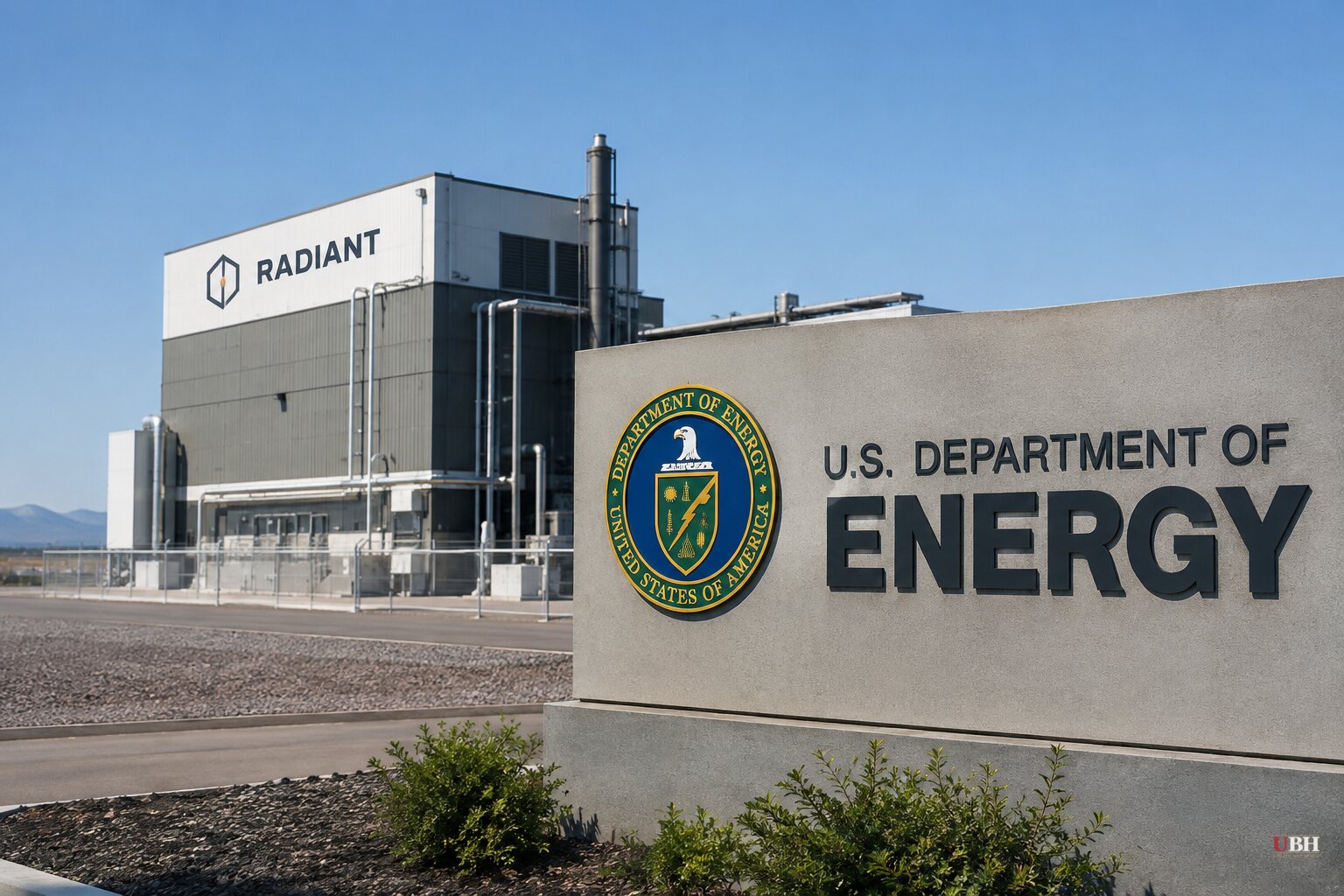
The Department of Energy has approved the Documented Safety Analysis (DSA) for Radiant's Kaleidos microreactor. Radiant announced the approval on Thursday, Oct. 29.
The El Segundo, California, company says it is the final safety document a reactor needs before operating in a DOE facility. It covers running at power, not only reaching first criticality.
Kaleidos must still pass a DOE Readiness Review before fuel can be loaded and nuclear operations can begin.
What Kaleidos is
Kaleidos is a helium-cooled, high-temperature gas reactor that runs on TRISO fuel. It is rated at about 1 megawatt of electricity (3 megawatts thermal) and sized to fit in a single shipping container.
Radiant built the unit in El Segundo and shipped it to Idaho National Laboratory (INL) in August. It now sits in the DOME test bed run by the National Reactor Innovation Center.
DOE approved Radiant's earlier Preliminary Documented Safety Analysis in February 2026.
What comes next
Radiant is now queued for DOE's Readiness Review. That review checks whether the reactor and the crew operating it are prepared to begin nuclear operations.
If Radiant passes, it will fuel the reactor and start a five-phase test campaign. The campaign runs from first criticality through progressively higher power and ends with at least 150 hours of continuous full-power operation with no operator intervention.
Radiant also plans to run the same unit for 60 effective full-power days over several months. The company says the unit uses a similar design and custom fuel as the ones it plans to deliver to customers.
"This approval for full-power demonstration is a first within the microreactor industry," said Rita Baranwal, Radiant's chief nuclear officer.
Chimi Zacot, DOE's acting Deputy Assistant Secretary for Nuclear Reactors, called the approval "another important step forward in President Trump's vision for an American nuclear renaissance." DOE says it is providing technical oversight to help companies like Radiant move through testing.
The timeline for completing the test phases and the results of the Readiness Review have not been announced, and no date has been published for the review.
The "first" claim and its limits
The claim that Kaleidos is the only microreactor design with DOE safety approval covering operation at power is Radiant's own.
DOE also approved a safety analysis for Last Energy's PWR-5 pilot reactor at Texas A&M-RELLIS on Oct. 7, through a separate program. That approval is staged. The pilot's first phase is capped at 100 kilowatts thermal, and each later phase needs its own authorization.
Kaleidos is on a similar gated path. The Readiness Review is the next gate before nuclear operations.
The other microreactor developers in DOE's pilot program have so far run zero-power tests. Antares, Valar Atomics, Deployable Energy and Aalo reached criticality at INL ahead of President Trump's July 4 deadline. ZeroHedge reports that Oklo's Groves test reactor in Texas followed on Aug. 5. Those tests were zero-power demonstrations: proof the physics works, with nothing plugged into the other end.
A DOE test authorization is not a Nuclear Regulatory Commission license. Commercial units will still need one, and any commercial availability depends on whether DOME test results support later licensing applications.
The commercial pipeline
Radiant plans to manufacture Kaleidos at its R-50 facility in Oak Ridge, Tennessee, which ZeroHedge describes as a 300,000-square-foot campus that will also handle fueling, refueling and spent-fuel storage. It plans to deliver its first commercial units to Buckley Space Force Base and Fort Benning in 2028.
Earlier in October, the U.S. Navy selected Radiant to deploy Kaleidos at Naval Weapons Station Crane in Indiana.
A full-power, multi-month test of a factory-built unit would give the category its first real operating data. Microreactors have been promised for years without it.
Where the stocks stand
The public nuclear names are not trading like the industry is on the verge of a breakthrough. ZeroHedge reports that Oklo closed Friday at $25.25, down 86% from its October 2025 peak and at its lowest since April 2025. It reports NuScale is down 89% and at a price last seen in April 2024.
ZeroHedge also reports that from Oct. 1 to Oct. 30, Oklo lost 30%, NuScale 28%, NANO Nuclear 26% and Centrus 26%, while the S&P 500 slipped about 1%. It attributes the weakness mostly to rates, pointing to a hotter-than-expected September CPI report on Oct. 14 that pushed the 10-year Treasury yield to 5.26%.
Radiant is not a publicly traded company in these sources, and the share-price declines are separate from the DOE approval.
The program's central constraint is operational. No date has been published for the Readiness Review, and Kaleidos cannot be fueled or begin nuclear operations until it passes.
Sources used for this briefing
7 links from 5 independent newsrooms (syndicated copies of the same report count once)
These are the sources it draws on, linked so you can verify.


