
Unbiased headlines. Facts, not spin.
Unbiased Headlines is an independently owned news organization. We bring you the facts, not opinions, written fresh from 110+ named sources. Sources linked so you can verify it yourself.
 energy
Breaking / Critical (9/10)
Event date: October 27, 2026 ·
IMO Chief Says 6,000 Seafarers Remain Trapped Near Hormuz as IRGC Claims Mine Strikes on Three More Tankers
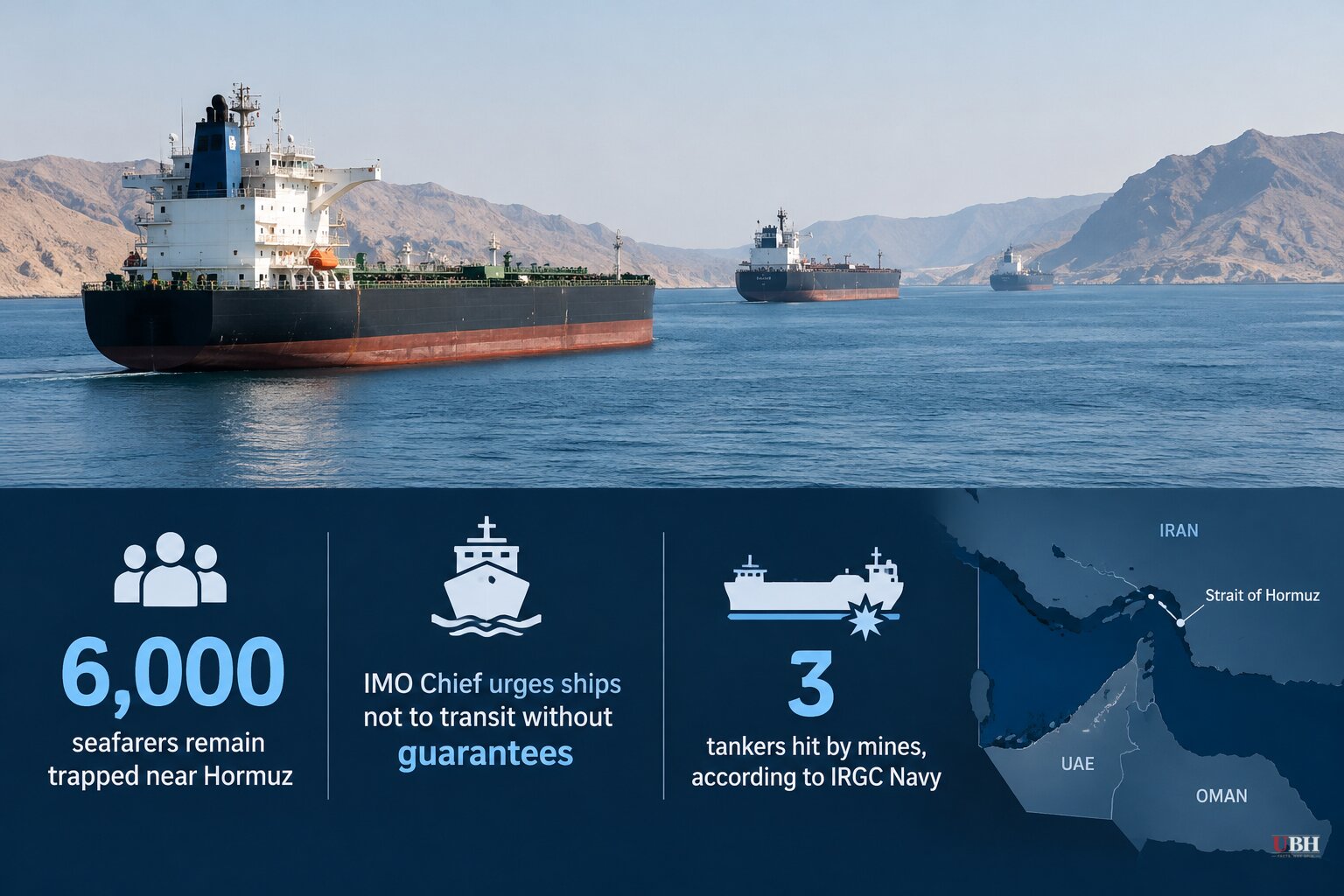
Since the U.S.-Israeli war with Iran began on Feb. 28, the Strait of Hormuz has gone from the world's busiest oil chokepoint to a waterway where the question is no longer how fast ships move, but whether they move at all. The latest week added a new warning from the top U.N. maritime official and a new claim of mine strikes from Tehran.
The IMO's warning
International Maritime Organization Secretary-General Arsenio Dominguez told Fox News Digital the situation "continues to be severe and critical."
"There is a double blockade and too many vessels have been attacked, particularly in recent days," he said. About 6,000 seafarers "remain trapped since the beginning of the conflict."
His advice to shipowners was blunt: do not transit the strait or put crews at risk "until we have guarantees." He also said seafarers "have continued to perish in these attacks."
By September the IMO had counted at least 22 seafarers killed in 80 verified attacks around Hormuz since the end of February. The Financial Times has reported 24 ships attacked over roughly the past two weeks.
Three more tankers, by Iran's account
The IRGC Navy claimed that three oil tankers struck naval mines and caught fire on Oct. 30 while using the IMO's Traffic Separation Scheme. The IRGC calls that route "unauthorised." Oman's Maritime Security Centre rescued 25 crew from one of them, the crude tanker RITI.
The IRGC's version has not been independently confirmed in full. What is documented is the broader pattern. A day earlier, a small boat attached limpet mines to the Panama-flagged tanker Louise 1 about 25 nautical miles northeast of Khasab, Oman. UKMTO issued Warning 187-26. The crew put out the engine-room fire and the ship kept going.
Brent crude was above $117 after that attack, according to the House of Saud briefing. OPEC ministers are scheduled to meet today, Nov. 1. The same briefing says Saudi output is running 4.5 million barrels per day below its 10.5 million quota because export routes are blocked, not because of voluntary cuts.
Two rival rules for one strait
Washington tells merchant ships to use the southern corridor. Tehran says every vessel must coordinate with Iran and use only Iranian-authorized northern routes. Ships are stuck between the two.
Iran formally rejected the traffic separation scheme on June 24, calling it "unacceptable and completely dangerous," according to Lloyd's List. The House of Saud briefing says Iran and Oman co-proposed the scheme and that the IMO adopted it in the late 1960s. If that history holds, the lane Iran now declares off limits is one Iran itself helped design.
Iran's Persian Gulf Strait Authority said it will take "legal action" against the Sinokor fleet starting Nov. 1. It claims Sinokor vessels have committed the most violations of its transit rules. No court or international body has recognized that authority's jurisdiction in any source reviewed for this story, and the specifics of the proposed action have not been laid out.
Iran's case at the IMO
Tehran is making its own argument through the IMO. In an Oct. 9 letter submitted by its ambassador, Seyed Ali Mousavi, Iran alleged that U.S. forces repeatedly occupied VHF Channel 16, the international distress and safety frequency, "for prolonged periods." The letter says Iranian seafarers were addressed in Persian "with threatening, abusive and provocative language" and, in some cases, urged to abandon their vessels.
Iranian state media separately reported that Iran gave the IMO documents and photographs of U.S. and Israeli attacks on its ports, civilian vessels and maritime infrastructure. Iran warned that damage to traffic-control systems and rescue facilities raises the risk of collisions and endangers foreign crews.
U.S. Central Command rejected the radio allegation. "The U.S. naval blockade has been in place for months and is professionally communicated to all international mariners," CENTCOM said. It added that vessels refusing to comply "receive multiple warnings, with ample opportunity to comply." The command did not address the specific claim about Channel 16 being tied up.
The mine-clearance promise
In late August, CENTCOM chief Adm. Brad Cooper said internationally recognized transit routes were free of Iranian sea mines "thanks to the incredible work of the U.S. military." President Trump gave shippers similar assurances.
The IRGC's spokesman, Brig. Gen. Abolfazl Mohebi, has since demanded independent verification of those claims rather than public statements. He wrote on X that the strait's reality is decided "in the skies, on land and at sea."
The Louise 1 incident cuts against the August message in a specific way. Limpet mines are placed by a small boat that gets close to a moving ship. That is a different problem from clearing drifting or moored mines, and it is the kind of close approach a U.S. naval presence was supposed to discourage. Martin Kelly of EOS Risk Group told gCaptain the attack was another step in Iran's evolving campaign.
The U.S. military has said the "vast majority" of Iran's attempted attacks on the strait fail. Shipping data shows a different picture: the Washington Institute for Near East Policy counted 28 confirmed and reported attacks in October, the most of any month in its records, and 113 since the war began. A Reuters review found more than 30 very large crude carriers damaged, 11 of them in October.
What comes next
Traffic is a trickle. IMF PortWatch recorded four transits on Oct. 18, and about two on Oct. 25 according to the House of Saud briefing. Freight rates above $1 million a day, reported by Reuters, are still pulling some tonnage into the Gulf.
The next concrete tests are today's OPEC meeting and the start of Iran's announced action against Sinokor. Dominguez's condition for resuming transits is guarantees, and neither Washington nor Tehran has offered any that the other side accepts.
Sources used for this briefing
6 links from 6 independent newsrooms (syndicated copies of the same report count once)
These are the sources it draws on, linked so you can verify.


