
Unbiased headlines. Facts, not spin.
Every story is an unbiased news briefing written from 110+ sources across the spectrum — sources linked so you can verify it yourself.
 defense
Notable (5/10)
September 19, 2026 at 09:46 AM
defense
Notable (5/10)
September 19, 2026 at 09:46 AM
China Tests More J-36 Stealth Fighter Prototypes as Trade War and Taiwan Tensions Escalate
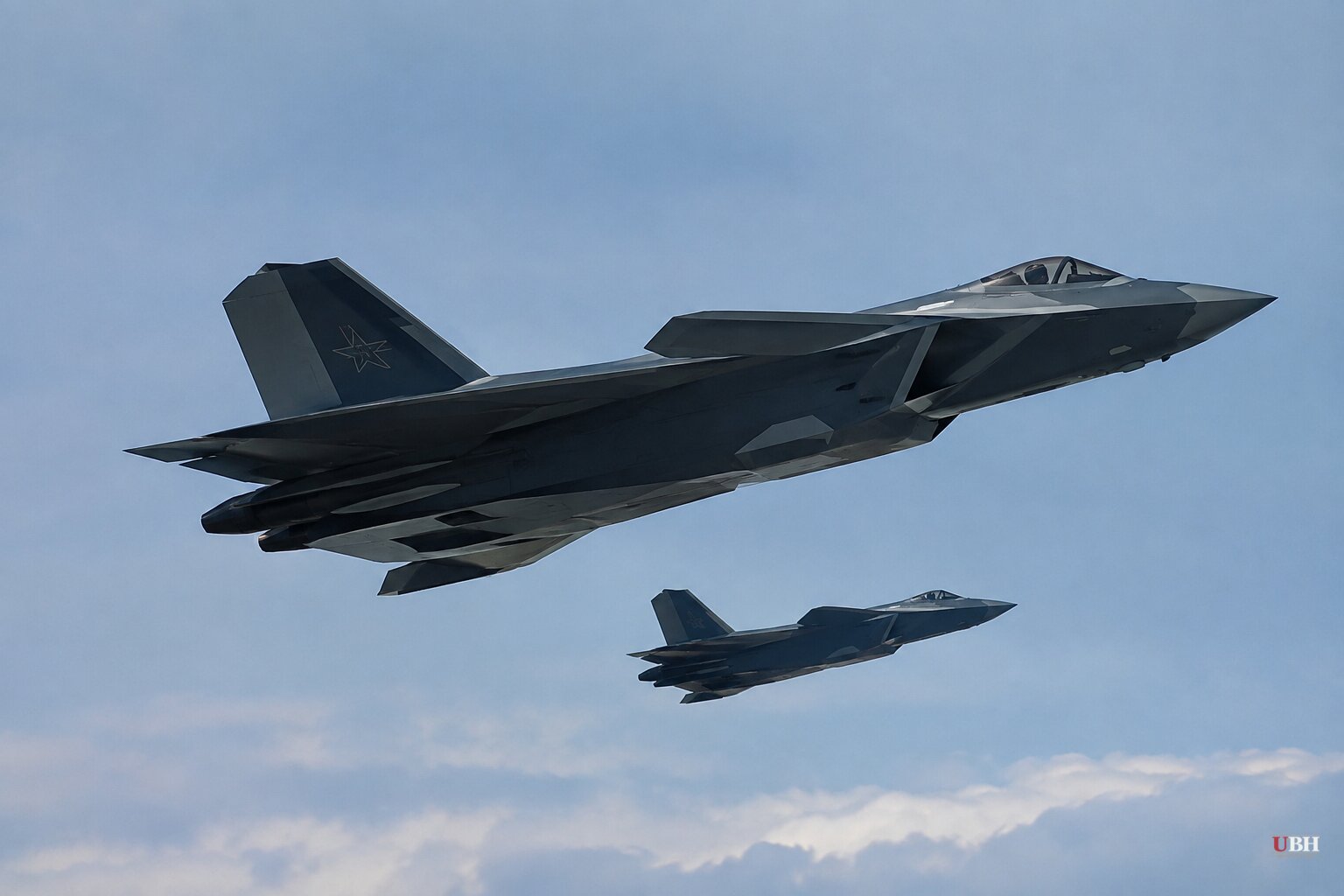
China's next-generation fighter program is moving past the mystery-jet stage. Aviation researcher Andreas Rupprecht, who tracks Chinese military aviation, posted an update on LinkedIn saying testing of Beijing's so-called "next-generation" fighters has entered a new phase, with photographs offering fresh clues about how China intends to use them.
The aircraft in question, the J-36, made a surprise maiden flight in December 2024. It has an unusual three-engine layout and a tailless, diamond-shaped double-delta design that immediately drew speculation from Western analysts about its role and capabilities.
According to Rupprecht, at least four and possibly five prototypes are now flying. He says prototype No. 04 was spotted this summer sporting a light-grey radome, which suggests an installed fire-control radar rather than a placeholder nose cone. Separately, a poster displayed at a Chinese defense electronics exhibition in Beijing showed an Acquisition, Tracking, and Pointing system built by the AVIC Beijing Precision Engineering Institute for use beneath a J-36 airframe, according to the same reporting.
Rupprecht is notably cautious about labels. He says he avoids the term "sixth generation" entirely, arguing there's no industry consensus on what that even means, and that terms like "5.5th" or "6th gen" function more as marketing shorthand than serious technical classification. This caveat is missing from much breathless coverage of Chinese stealth programs. The people closest to the data are often telling audiences not to overclassify what they're looking at.
Still, Rupprecht lays out a theory. He suggests the J-36 could represent a Chinese vision of future air warfare built around extreme range, a large weapons payload, and heavy sensor integration for long-range missions in contested airspace, either as an interceptor or a deep-penetration strike aircraft.
He also cites Yang Wei, a Chinese aviation figure, who reportedly argues the new fighter can penetrate heavily defended airspace that China's own J-20 and Western jets like the F-22 and F-35 would have to avoid, putting it a generation ahead of those aircraft. Yang's assessment, as relayed by Rupprecht, suggests the jet could serve as a low-observable command node, directing drones and other aircraft while striking high-value targets from standoff range. This is a claim from a Chinese source about China's own hardware, and it hasn't been independently verified by Western defense officials.
The Bigger Picture
The J-36 sightings aren't happening in a vacuum. Beijing has surrounded Taiwan with what ZeroHedge describes as a record number of ships, raising the risk of a blockade. A trade war between Washington and Beijing continues, and President Trump has pushed back against the BRICS bloc's efforts to reduce reliance on the dollar.
On the resource front, China spent roughly the last year and a half restricting Western access to rare earths and other critical materials, according to ZeroHedge's reporting. The U.S. military has responded by working to cut off China's access to discounted crude oil from Venezuela and Iran. Neither of those oil-supply moves has been independently confirmed by named U.S. officials in these reports, so they should be read as part of an emerging economic pressure campaign rather than a confirmed, formal policy.
A Hudson Institute analysis argues the confrontation is already further along than most Americans realize, describing what it calls a Chinese Communist Party strategy to erode U.S. power through supply-chain dominance, espionage, and intellectual-property theft, without ever triggering a direct U.S. military response. Hudson points to Beijing's control of choke points in rare earths, battery components, pharmaceutical ingredients, and solar components as evidence of a deliberate, decades-long strategy rather than ordinary market competition.
This framing merits consideration, but it's an interpretation, not a settled fact. Reasonable analysts disagree about whether Beijing's economic maneuvering reflects a coordinated war strategy or simply aggressive industrial policy pursued by a rising power protecting its own interests. Hudson's piece is explicitly an argument, not a straight intelligence assessment, and no U.S. government body cited in these reports has formally declared the two countries to be at war, economic or otherwise.
What's verifiable: China has multiple stealth fighter prototypes in active flight testing, at least one recently fitted with new radar hardware. What's unverified: whether that program, combined with the broader economic friction over oil, rare earths, and Taiwan, meaningfully raises the odds of a military clash in the near term. Rupprecht himself signals more clarity is likely as further J-36 flight data emerges, which means the next real test of these theories comes from the next round of sightings, not from analysts speculating in advance of the evidence.
Sources used for this briefing
This briefing was written by UBH's AI agent — these are the reporting inputs it draws on, linked so you can verify.


