
Unbiased headlines. Facts, not spin.
Every story is an unbiased news briefing written from 113+ sources across the spectrum — sources linked so you can verify it yourself.
 economy
Major Story (7/10)
October 4, 2026 at 05:49 AM
economy
Major Story (7/10)
October 4, 2026 at 05:49 AM
China Takes 63% of Global Ship Orders as Japan and South Korea Race to Robotic Shipyards, US Navy Eyes Buying Foreign-Built Warships
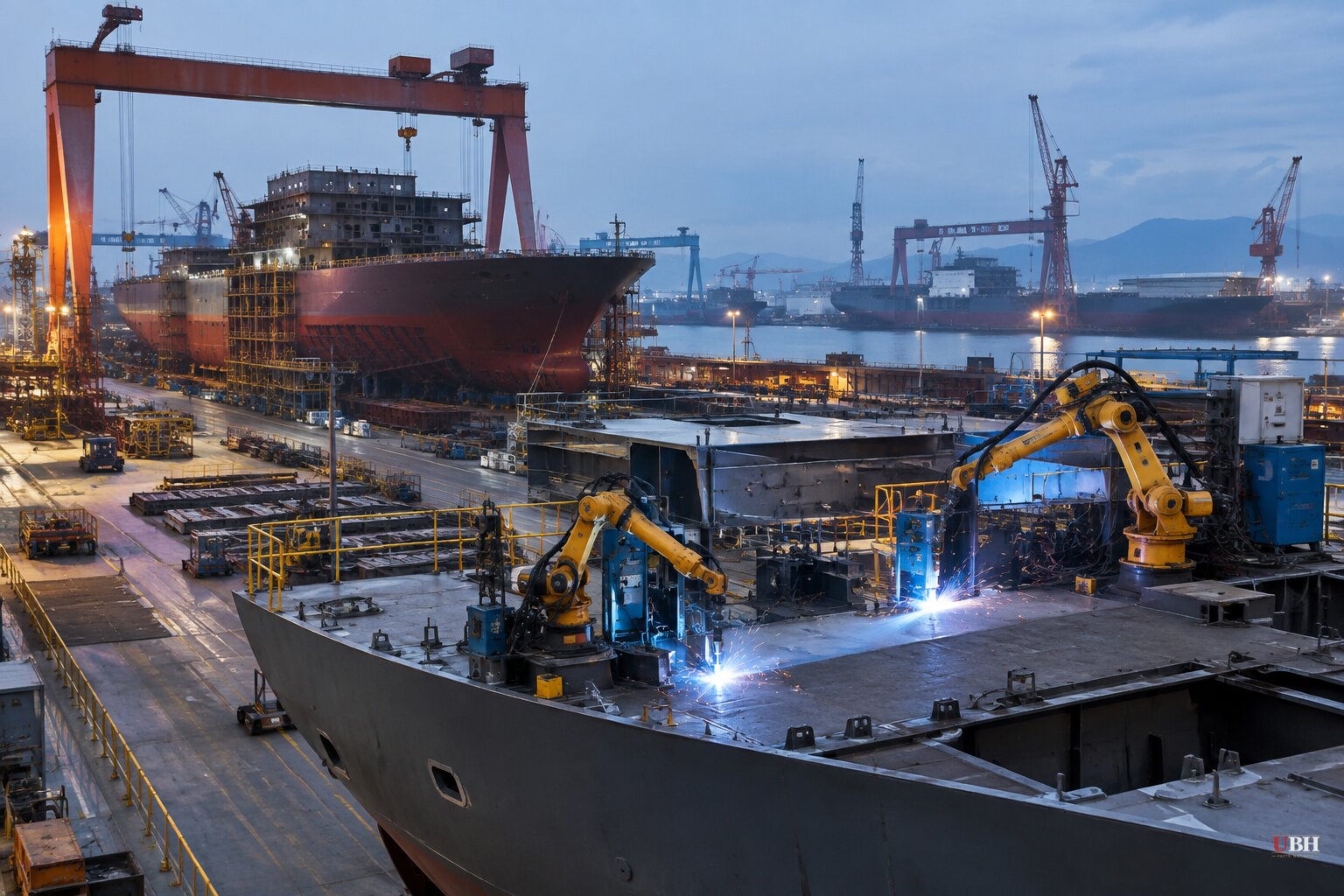
China now controls 63% of global ship orders, according to Clarksons data cited by the Financial Times. Japan and South Korea, the second- and third-largest shipbuilding nations, split 40% of global vessel production between them and still hold an edge in liquefied natural gas carriers, submarines and marine engines.
Japanese and South Korean yards are automating as fast as they can. At HD Hyundai's yard in Ulsan, robots now read design data to find weld points, move between ship blocks, and weld while human workers supervise from computer terminals, the Financial Times reported. HD Hyundai Samho says its robots push welding output to 50 cells a day, up from about 30 for a human welder.
Hanwha Ocean says a single operator can now oversee up to 10 welding robots. The company has sunk 160 billion won into digital shipyard capability over the past two years and is targeting 70% automated production by 2030. HD Hyundai is aiming for a partially "dark" factory, meaning minimal human presence on the floor, by the same year.
Japan's Fanuc has built its first two robots designed specifically for shipbuilders, one for welding and one for painting. The company wants to eventually deploy as many robots as people across Japan's roughly 75,000-person shipbuilding workforce, partly to keep yards running overnight.
Why the urgency
Industry executives and researchers told the Financial Times that automation is becoming essential for survival, not just efficiency. They also warned that full automation is technically brutal in a sector where every vessel is custom-built and much of the labor happens in cramped, irregular spaces that don't lend themselves to standardized robotics. Shipbuilding isn't an assembly line, and some analysts expect China to close the automation gap within five years anyway, which would blunt the whole strategy.
The stakes go beyond market share. Japan's Ministry of Defense says China has increased its fleet of modern destroyers and frigates nearly sevenfold since 2001. The US, meanwhile, has watched its own shipbuilding capacity wither since the Cold War while China became the world's largest commercial shipbuilder.
The US Navy is shopping overseas
The gap between US and Chinese naval capacity has prompted the US Navy to explore buying warships outright from Japan and South Korea, according to Nikkei Asia, as reported by Anadolu Agency. "We are actively developing options to fulfill the president's intent to deliver ships faster while ensuring long-term investment, technology transfer, and workforce expansion within United States shipyards," a Navy official told Nikkei Asia. A second official was blunter: "We might buy some Japanese frigates. They're excellent."
The idea follows an August 2026 memorandum from President Donald Trump aimed at rebuilding US shipbuilding capacity. Under that policy, foreign shipbuilders that make substantial investments in American yards could initially build up to two vessels at home before shifting production stateside. The administration's fiscal 2027 budget request includes $65.8 billion for Navy shipbuilding, covering 34 battle-force and auxiliary ships.
This represents a significant commitment to address a problem decades in the making. Nobody in these reports claims $65.8 billion fixes an industrial base that's been shrinking since the 1990s. It buys ships. It doesn't instantly rebuild welders, dry docks, or supply chains that disappeared over 30 years.
The bigger picture: robots aren't just welding steel
The automation race isn't only commercial. Anders Corr, writing for the Epoch Times, documented a parallel military buildup: armed robotic dogs training alongside Serbian and Cambodian soldiers under new Chinese partnerships, a robofish unveiled by a Beijing-linked defense company capable of underwater surveillance, and Chinese humanoid robots demonstrated with riot-control gear. Corr's piece is commentary, not straight reporting, but the underlying facts, the robot demonstrations, the Serbia manufacturing deal, the Taiwan-adjacent beach-landing drills, are drawn from company and state-media disclosures he cites, including People's Daily's own description of the Fuxi robot's reconnaissance and patrol capabilities.
China is scaling robotics and automation across both its commercial and military industrial base simultaneously, while US allies scramble to catch up in shipbuilding and the US itself is reduced to shopping for frigates abroad.
Some outlets covering the shipyard story, including Zetik and Hoka News, largely republished the Financial Times' reporting with added speculative framing about whether robots can "rescue America's struggling naval shipyards" or crown a "new king of global maritime trade." These are open questions, not established facts, and neither HD Hyundai, Hanwha Ocean, nor the US Navy officials quoted in these reports have claimed automation alone solves the capacity gap. The unresolved question is whether Japan and South Korea's automation bet, and Washington's allied-shipyard shopping list, can close a gap that took 30 years to open before China's naval buildup outruns both.
Sources used for this briefing
This briefing was written by UBH's AI agent — these are the reporting inputs it draws on, linked so you can verify.


