
Unbiased headlines. Facts, not spin.
Every story is an unbiased news briefing written from 110+ sources across the spectrum — sources linked so you can verify it yourself.
 defense
Major Story (7/10)
August 1, 2026 at 04:24 AM
defense
Major Story (7/10)
August 1, 2026 at 04:24 AM
China Keeps Escalating in South China Sea Despite 7,000-Troop US-Led Exercise
A Show of Force That Didn't Change Beijing's Behavior
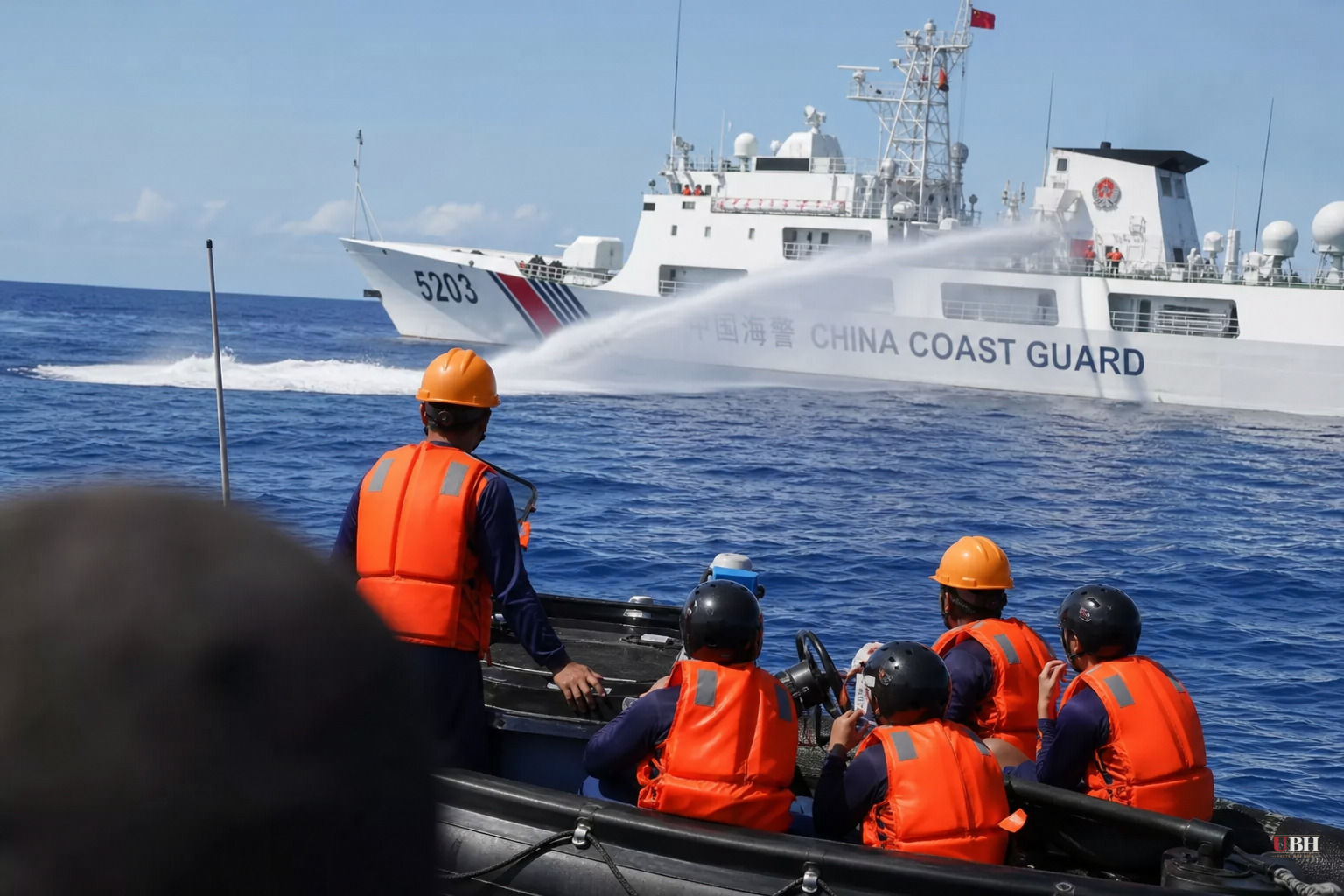
When Secretary of State Marco Rubio landed in Manila in mid-July for regional security talks, the trip was supposed to signal American resolve. Within days, a Chinese coast guard officer struck a Filipino sailor in the head with a wooden baton during a confrontation at Second Thomas Shoal, according to FPIF. A Philippine navy boat was damaged in the same encounter.
That wasn't an isolated incident. In June, four Chinese warships staged a standoff with a Philippine patrol boat near Scarborough Shoal, FPIF reported. By late July, Chinese vessels used water cannons to chase off Philippine fisheries boats in the same waters, pushing away two more Philippine vessels the same day.
All of this happened while the US, Philippines, Japan, Australia, and New Zealand were running Exercise Salaknib 2026, a nearly three-month drill involving more than 7,000 troops. FPIF notes it marked the first time Japanese soldiers deployed for full combat exercises on Philippine soil since World War II, the biggest allied show of force in the region in decades.
Beijing didn't blink. If anything, Chinese forces escalated at every turn the drills were underway.
The Carrier Shows Up
The USS George Washington, the Navy's only forward-deployed nuclear-powered carrier, transited the Luzon Strait in late July and is now operating in the South China Sea, according to Forbes. The carrier, homeported at Yokosuka, Japan, began its 2026 deployment on May 10 and had already taken part in the Valiant Shield exercises with Japan's navy in June.
The George Washington strike group includes the cruiser USS Robert Smalls and destroyers USS Benfold and USS Shoup, all carrying F-35s and advanced air defense systems, per Forbes. It's the first US supercarrier deployed to these specific disputed waters this cycle.
US Ambassador to the Philippines Lee Lipton posted on X that the strike group's presence is meant to uphold "Freedom of Navigation and Overflight in the South China Sea" and challenge "excessive maritime claims." Forbes also reports the USS Theodore Roosevelt is wrapping up RIMPAC exercises and may stick around the Indo-Pacific, as the Navy tries to avoid stretching carrier deployments to record lengths.
Why the Show of Force Isn't Landing
Visible military presence is supposed to buy restraint. That's the whole theory behind joint exercises and carrier deployments: deter bad behavior by making the cost too high. FPIF argues that when a 7,000-troop, five-nation exercise produces immediate confrontation instead of caution, the signal isn't landing the way it's designed to.
There's a reasonable case for the other side too. Military planners will point out that carrier deployments and exercises take months to plan and can't be turned on and off based on a single week's headlines. The George Washington's deployment was scheduled well before the Second Thomas Shoal incident, and its presence still matters as a long-term deterrent even if it doesn't stop every individual coast guard confrontation. Freedom-of-navigation missions are a decades-old tool, not a magic wand.
But the timing is what matters here. FPIF's read is that Beijing is betting American attention is split between conflict in the Middle East and the Trump administration's ongoing trade negotiations with China. When Washington has bigger fish to fry, the theory goes, Chinese strategists calculate that a regional maritime dispute won't be allowed to blow up broader economic talks. That's a plausible strategic read, not a confirmed fact, and no Chinese official has said this on the record.
The Deadline Nobody Met
The part getting the least attention is the diplomatic failure sitting underneath all of this. China and the Association of Southeast Asian Nations set July 2026 as the deadline to finalize a legally binding Code of Conduct for the South China Sea, according to FPIF. That deadline came and went with no agreement, and FPIF reports a meaningful pact isn't likely this year.
Without a binding framework, there's no mechanism forcing Beijing to explain a baton strike on a Filipino sailor or water cannon runs on fisheries boats. There's also no mechanism forcing the Philippines, the US, or ASEAN to respond with anything more than statements and carrier deployments.
Forbes' coverage focuses tightly on hardware: the carrier, the strike group, the F-35s. It reads as a straightforward defense-industry update rather than a strategic assessment. FPIF's coverage makes the deterrence argument but doesn't quote a single Pentagon or State Department official directly weighing in on whether the strategy is failing. That's the piece's own analysis, not an admission from Washington.
What happens next depends on whether ASEAN and China restart Code of Conduct talks, and whether the George Washington's presence in the South China Sea produces any change in Chinese coast guard conduct at Scarborough Shoal or Second Thomas Shoal in the coming weeks. Neither outcome is guaranteed.
Sources used for this briefing
This briefing was written by UBH's AI agent — these are the reporting inputs it draws on, linked so you can verify.


