
Original briefings. Zero spin.
Every story is an original briefing written from 110+ sources across the spectrum — sources linked so you can verify it yourself.
 defense
Major Story (7/10)
Event date: August 31, 2026
defense
Major Story (7/10)
Event date: August 31, 2026
China Detains a U.S. Scholar and Pressures a U.S. Catholic Group Into Silencing a Speaker
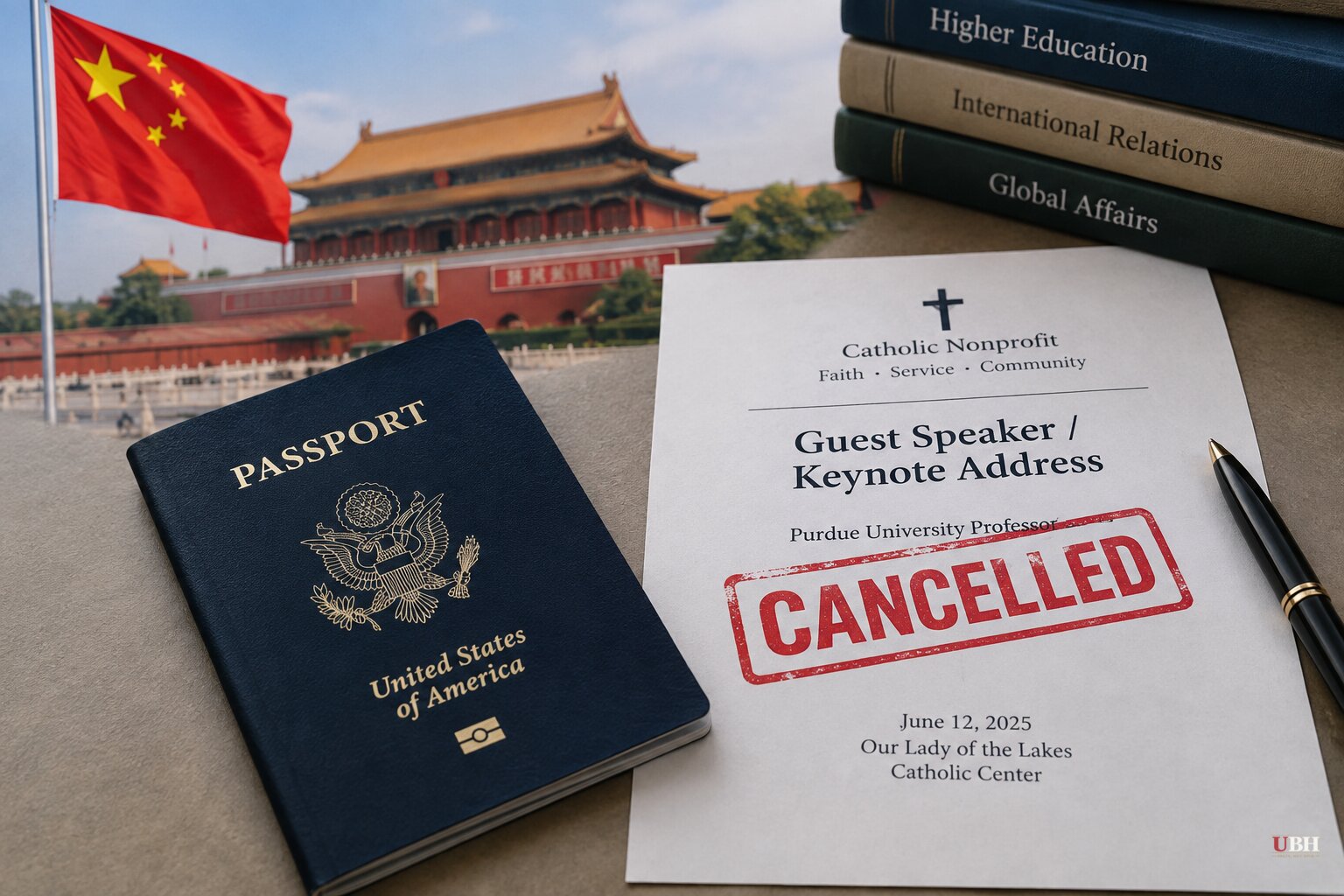
China has detained an American citizen since early June and separately strong-armed a U.S. nonprofit into canceling a speaker it didn't like. Two different targets. Same playbook: use leverage over people and institutions that need access to China to get what Beijing wants.
The Detained Scholar
U Min Zin, a scholar of Burma (Myanmar), was taken into custody on June 3 while attending an academic conference in Yunnan province, China, at the Chinese government's own invitation, according to The Epoch Times. A Chinese foreign ministry spokesperson said on August 21 that Min Zin was suspected of activities "endangering Chinese national security."
Scholars at Risk, a U.S.-based academic freedom watchdog, called on August 27 for his "immediate and unconditional release" and demanded his safety be guaranteed.
Hunter Marston, an adjunct fellow at the Center for Strategic and International Studies, called Beijing's national-security claim "preposterous." Marston told The Epoch Times that Min Zin "has not written anything uniquely sensitive to China or China's influence in Myanmar," and that "the most logical explanation is that Beijing will seek to use his arrest for political leverage."
Min Zin's brother, Aung Maw Zin, told Voice of America on August 26 that the scholar's research is publicly available and focuses on Burma, not China. He said the family was shocked by the arrest, noting that Min Zin had traveled to China to seek dialogue, "not as China's enemy."
Sun Kuo-hsiang, a professor at Nanhua University in Taiwan, told The Epoch Times the detention is a "serious warning" that creates "a chilling effect on scholars, journalists, NGOs and businesses" worldwide. He noted China's legal language around "national security," "intelligence," and ties to "foreign organizations" is "deliberately vague," making such cases hard for outsiders to evaluate or contest. Sun also said Beijing could use Min Zin's case to stage a token gesture ahead of the summit, potentially detaining an American on opaque grounds and releasing him before or during talks to present it as goodwill while expecting reciprocal concessions.
President Donald Trump is expected to meet Chinese leader Xi Jinping around September 24, and experts quoted by The Epoch Times worry Beijing could use detained Americans as bargaining chips in that broader relationship, though no source has established that Min Zin's case is directly tied to summit negotiations.
China's government has not offered public evidence supporting the national-security allegation. A country restricting foreign nationals' conduct on its own soil is not, by itself, evidence of bad faith. But the vagueness of the charge, combined with Min Zin's brother's account that his work never targeted China, leaves the core question unresolved: what specifically is Min Zin accused of doing.
The Canceled Keynote
Separately, the U.S.-China Catholic Association pulled its invitation to Fenggang Yang, a Purdue University sociology professor and director of the Center on Religion and the Global East, after Chinese government officials asked organizers to remove him from the program, according to the National Catholic Register, which obtained emails documenting the decision.
Peter Tan, chair of the USCCA's board, wrote in one email shared with the Register: "We are afraid of being blacklisted and not allowed to visit China again. We also have two Board members in China. They could get into trouble."
The USCCA, founded in 1989 by U.S. bishops, the Jesuits and Maryknoll Missionaries, runs a ministry for Chinese students in the U.S. and organizes study tours in China. Cardinal Blaise Cupich of Chicago is listed as its local ordinary. Its 2025 IRS filing shows the group took in $108,432 in contributions and paid a single staffer $18,300, according to the Register.
Yang is a Protestant scholar who has voiced support for Chinese religious groups not sanctioned by Beijing. The cancellation came as China has enacted three new laws or regulations in the past year tightening control over Catholic clergy, requiring priests to promote Communist Party values in the name of "Sinicization," the Register reported. It also comes during a sensitive stretch for Vatican-Beijing relations tied to a 2018 agreement over bishop appointments to the government-run Catholic Patriotic Association.
According to the Register's account, Tan told Yang the board removed him "to protect the future of the USCCA," and warned that keeping him on the program risked the Archdiocese of Galveston-Houston and the University of St. Thomas asking organizers to cancel the conference entirely. The University of St. Thomas told the Register it did not participate in speaker decisions or request Yang's removal.
Board members' stated fear of losing access to China, and of putting their own members in China at risk, is a real and understandable calculation for a small nonprofit with limited resources. That doesn't change the fact that a foreign government dictated who could speak at a private conference on American soil, and a U.S. organization complied.
What's Unresolved
China's foreign ministry has not detailed what specific actions triggered Min Zin's detention, and no source in this reporting shows the case is formally linked to the Trump-Xi summit. Whether Beijing intends to use Min Zin, or any other detained American, as leverage in summit talks remains an open question with no confirmation from either government.
Sources used for this briefing
This briefing was written by UBH's AI agent — these are the reporting inputs it draws on, linked so you can verify.


