
Unbiased headlines. Facts, not spin.
Unbiased Headlines is an independently owned news organization. We bring you the facts, not opinions, written fresh from 110+ named sources. Sources linked so you can verify it yourself.
 finance
Major Story (7/10)
Event date: October 12, 2026 ·
finance
Major Story (7/10)
Event date: October 12, 2026 ·
China Builds Out Yuan Bond and Hedging Tools as US-China Yield Gap Stays Above 3.5 Points
China's campaign to spread the yuan around the world is moving past trade settlement and into the harder business of finance.
Beijing is focused on building the infrastructure for global financing and investment in the currency, and on strengthening its role as a reserve currency, according to Bloomberg's reporting. That means a wider range of investment products, along with derivatives and hedging tools. It also means making it easier for foreign borrowers to issue dim sum bonds (yuan-denominated debt sold in Hong Kong) and panda bonds (yuan debt sold inside mainland China).
The logic is simple. Nobody wants to hold a currency they can't hedge, borrow in, or park in deep, liquid markets.
The yield gap
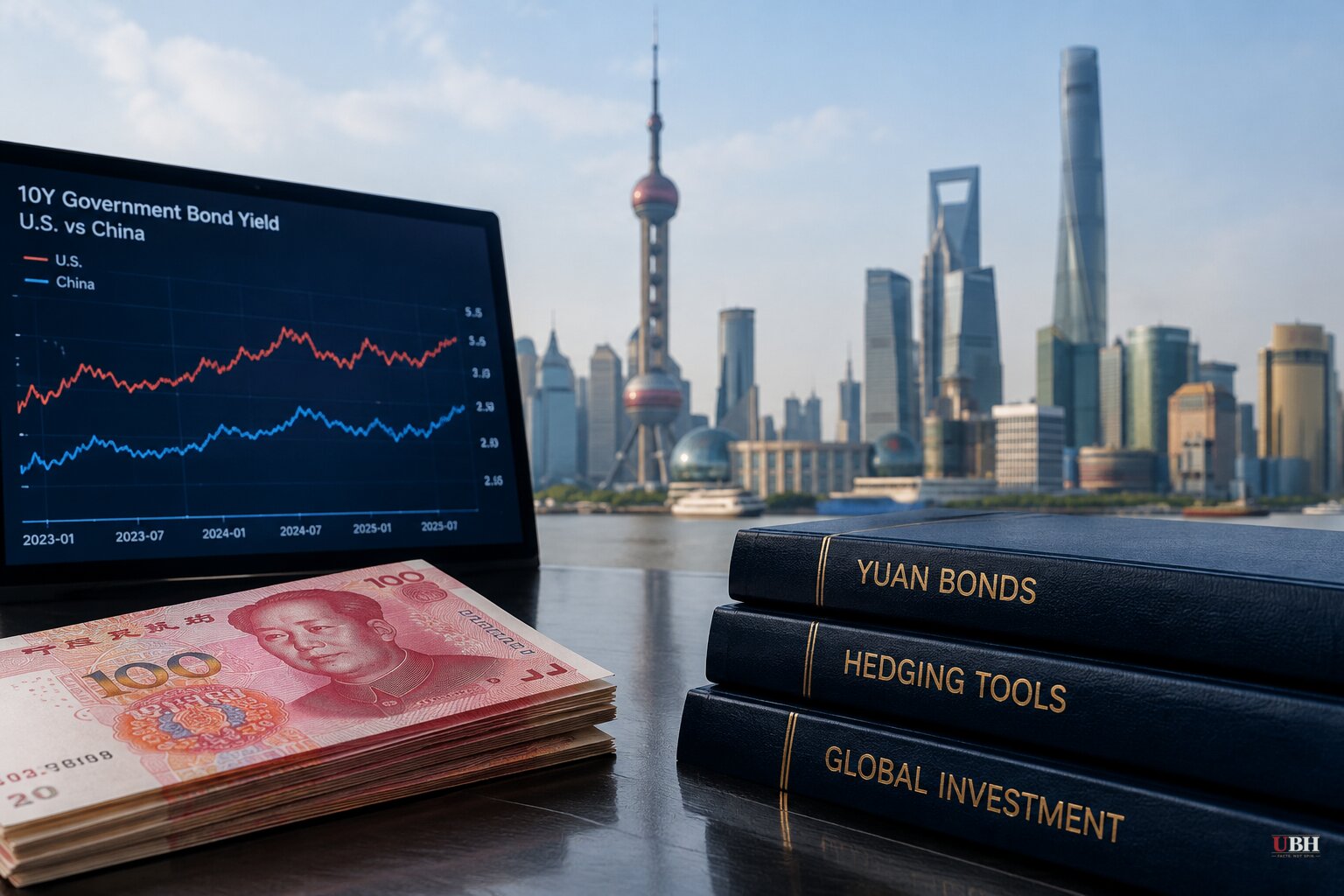
The interest-rate gap between the two economies is large. The 10-year U.S. Treasury yield was 5.22% on Thursday, Oct. 8. Chinese government bonds yielded 1.69% on their first trading day after the National Day holiday, a gap of about 3.5 percentage points. The record gap was 3.7 points on Sept. 9.
Jiang Zhenlong, an associate research fellow at the Chinese Academy of Social Sciences' Institute of Finance and Banking, says Beijing should use that window. He wrote in China Money Market, a central bank-affiliated magazine, that the inversion has an "asymmetric effect: pressure on the asset allocation side and benefit on the financing side."
In his reading, higher U.S. yields make yuan assets less attractive and add pressure on the exchange rate and capital flows. They also raise dollar funding costs. His prescription is to strengthen the financing, hedging and asset-absorption systems behind the yuan, turning a cyclical low-rate advantage into lasting global use. Jiang works for a government think tank, so this is a policy argument from inside the system, not an outside assessment.
Hong Kong's role
Hong Kong Monetary Authority chief executive Eddie Yue addressed the question of China's slowing growth directly. Speaking at an Institute of International Finance event in Bangkok on Oct. 14, he said China's growth situation will not affect efforts to increase international use of the yuan.
Yue said Hong Kong is the world's largest offshore renminbi hub and processes more than 70% of the global share of all payments in the currency. He is the official who runs that hub, so his confidence is also a sales pitch.
The weak spot at home
The domestic backdrop is the complication. Commentator James Gorrie, writing in The Epoch Times, points to a property market that held nearly 70% of household wealth. Existing-home prices had fallen roughly 22% from their 2021 peak in inflation-adjusted terms by the first quarter of 2026, he writes. New-home prices across 70 cities were still falling as of June, extending a decline of well over two years.
Bloomberg Economics estimates that every 5% drop in home values erases about 19 trillion yuan, roughly $2.7 trillion, in household wealth.
Gorrie argues the stock market is no refuge either. He cites at least 21 controlling shareholders, chairmen and senior executives placed under investigation in the first half of 2026, and a record 661 penalty decisions last year that collected more than 15 billion yuan in fines and illicit profits. He adds that the probes reached a former chairman of China's securities regulator.
His conclusion is that Chinese households are buying gold because they have run out of safe places for their money. He also argues Beijing "may be quietly preparing gold as a weapon against the dollar itself." That second claim is his opinion. He offers no document or official statement showing such a plan. Gorrie writes that the People's Bank of China has bought gold for nearly two years running.
Trade friction abroad
Gorrie also cites European Union figures showing its goods trade deficit with China widening from 306 billion euros in 2024 to 360 billion euros in 2025. He says it is on pace to reach 400 billion euros this year. Those figures suggest foreign governments are increasingly resistant to Chinese exports, which sits awkwardly with a strategy that needs foreigners to hold and use yuan.
China's capital controls remain the core issue behind any reserve-currency ambition. Of the sources reviewed, only Yue's remarks and the Bloomberg report address Beijing's actual rollout, and neither details specific new rules, timelines or product launches.
What to watch
The test is uptake. Panda and dim sum issuance by non-Chinese borrowers, the depth of yuan hedging markets, and whether foreign central banks add yuan to reserves will show whether the plumbing gets used. The yield gap, which was 3.7 points on Sept. 9, will help decide whether international borrowers find yuan funding cheap enough to try.
Sources used for this briefing
4 links from 4 independent newsrooms (syndicated copies of the same report count once)
These are the sources it draws on, linked so you can verify.


