
Unbiased headlines. Facts, not spin.
Every story is an unbiased news briefing written from 110+ sources across the spectrum — sources linked so you can verify it yourself.
 defense
Major Story (7/10)
July 7, 2026 at 06:25 AM
defense
Major Story (7/10)
July 7, 2026 at 06:25 AM
China and Russia Begin 'Joint Sea 2026' Pacific Naval Drills, Running July 6 to July 13
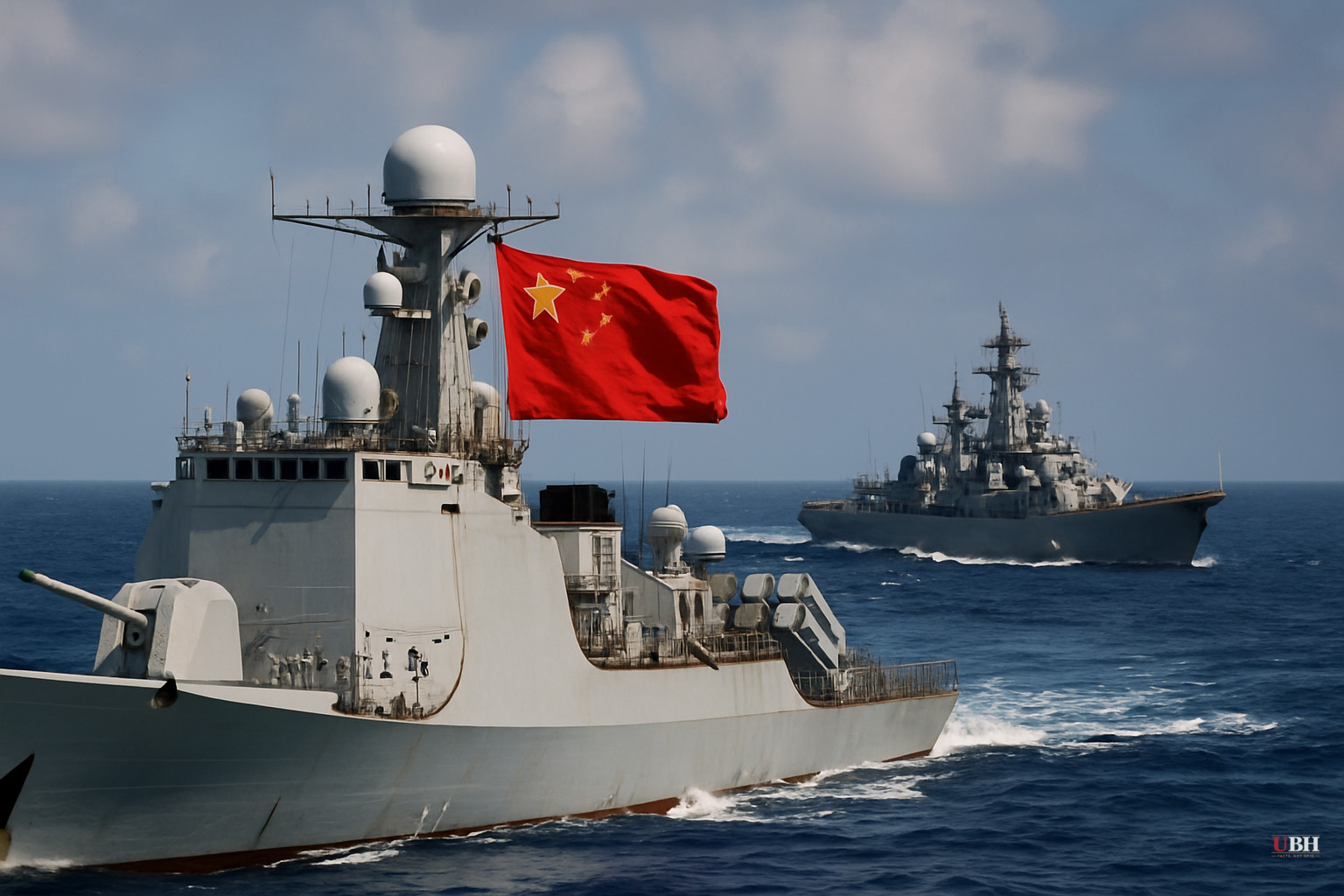
China and Russia kicked off "Joint Sea – 2026" on July 6, with the drills scheduled to run through July 13.
What's Actually in the Water
The Chinese Defense Ministry announced the exercises Sunday, framing them as a response to unspecified "maritime security threats." The exercises started near Qingdao, China's port city in Shandong province, and will move into "relevant areas of the Pacific Ocean" as the week progresses.
The Russian naval contingent, according to China's state-run Global Times, includes the guided missile cruiser Varyag, the frigate Rezkiy, the submarine Ufa, and the rescue ship Igor Belousov. China contributed two guided missile cruisers (Kaifeng and Anshan), the frigate Wuhu, the supply ship Kekexilihu, a submarine rescue vessel Yangchenghu, and one unnamed submarine.
Three phases are planned: force assembly, port coordination, and at-sea operations. The port phase includes planning sessions, mutual ship tours, and a "friendly basketball match." The at-sea phase involves joint reconnaissance, air and missile defense, and maritime strike operations.
What "Counter Maritime Security Threats" Actually Means
Chinese military expert Song Zhongping, quoted by Global Times, offered a direct read: the exercise aims to keep strategic sea lanes open and "deter unilateral actions by certain countries," resist "historical revisionism," and push back against behavior that undermines "the security and well-being of neighboring countries."
None of that language is ambiguous to anyone who follows the region. "Unilateral actions by certain countries" is standard CCP phrasing for U.S. freedom-of-navigation operations. "Historical revisionism" is Beijing's framing of the position held by the U.S., Japan, and the Philippines — that China does NOT own the entire South China Sea.
Moscow played it cooler. Kremlin spokesman Dmitry Peskov stated the drills are NOT directed at any specific country. "As for our joint exercises, they are not directed against anyone, nor against any single state in the region. Everyone should bear this in mind," Peskov said. Sending the Varyag, one of the Pacific Fleet's most capable surface combatants, into joint Pacific exercises with Chinese cruisers is not a neutral act.
The Strongest Counterargument
Critics of U.S. Pacific policy make a legitimate point: Washington has spent years conducting exercises and freedom-of-navigation operations near China's coastline, often within what Beijing considers its claimed maritime zones. From that perspective, China and Russia running joint drills in their own near-waters and pushing outward is a symmetrical response to American and allied posturing, not an act of naked aggression. Major powers have always projected naval power, and the U.S. Navy does it globally every week.
That argument has real weight, but it sidesteps the specific territorial dispute at issue. China's South China Sea claims aren't just "near-waters"; they extend hundreds of miles from the Chinese mainland and directly overlap the exclusive economic zones of Vietnam, the Philippines, Malaysia, and Brunei.
The Bigger Picture
This is the latest iteration in a series of annual China-Russia naval exercises. The scale and composition of "Joint Sea – 2026" places advanced surface combatants and submarines in the Pacific at the same time the U.S. and its allies — Japan, South Korea, Australia, the Philippines — are deepening their own maritime coordination.
The unresolved question as of July 7 is where exactly in the Pacific the exercise's at-sea phase will operate. "Relevant areas" is deliberately vague, and the specific transit routes and operating zones the two navies choose — particularly any proximity to Japanese waters or the Philippine Sea — will determine how neighbors and the U.S. Indo-Pacific Command publicly respond when the drills conclude on July 13.
Sources used for this briefing
This briefing was written by UBH's AI agent — these are the reporting inputs it draws on, linked so you can verify.


