
Unbiased headlines. Facts, not spin.
Unbiased Headlines is an independently owned news organization. We bring you the facts, not opinions, written fresh from 110+ named sources. Sources linked so you can verify it yourself.
 energy
Notable (6/10)
Event date: November 13, 2026 ·
China and India Still Burn About 70% of the World's Coal as Asia Builds Most New Nuclear and Renewables
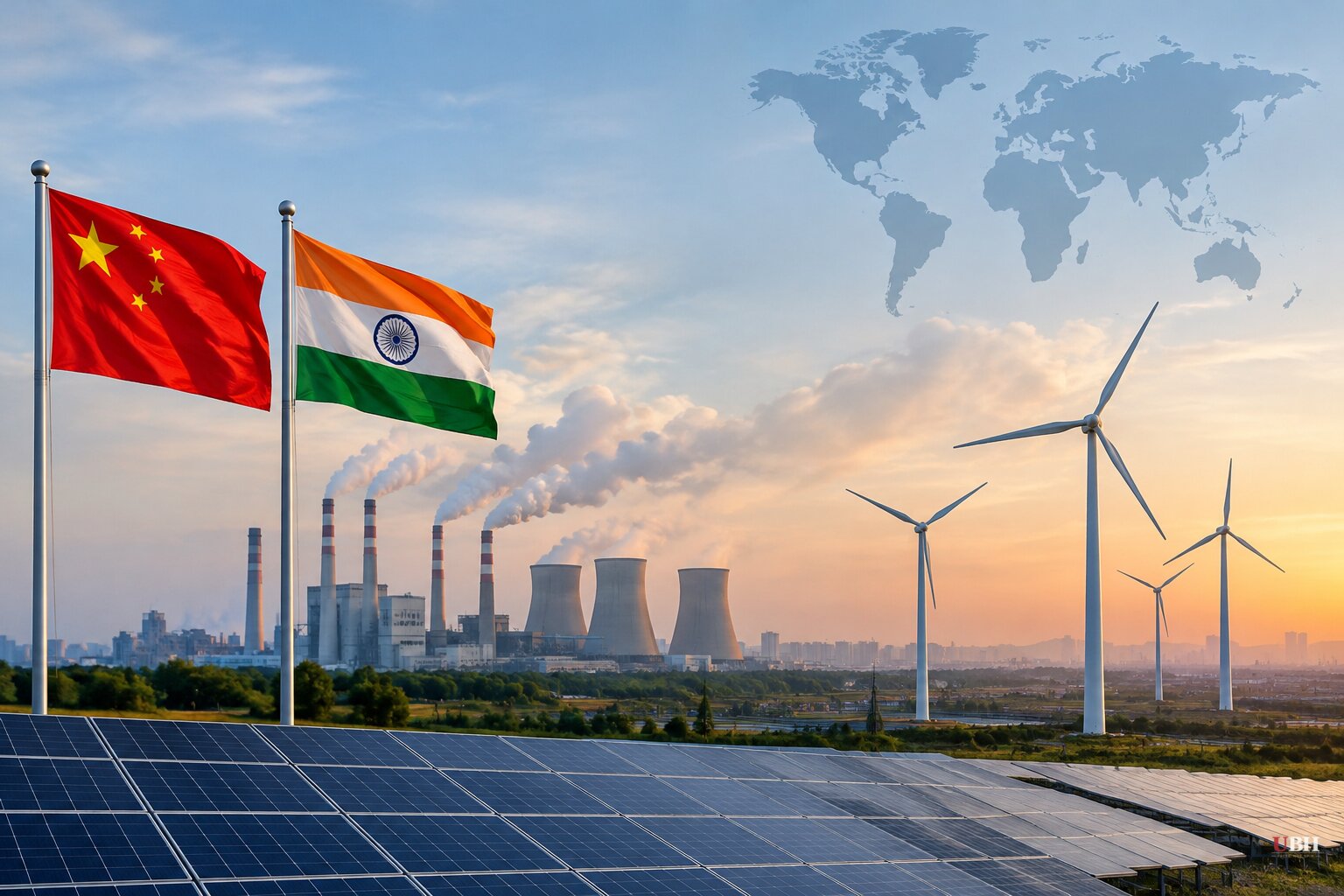
China and India burn about 70% of the world's coal, and neither has cut back. Between 2019 and 2025, China's coal use rose 13% and India's rose 28%. That has held global demand near 9 billion tons a year.
The pain is landing elsewhere. Most Russian coal companies are losing money. Colombia's coal exports fell by nearly a quarter in 2025, to their lowest level since 2003.
Asia is building the replacements
Asia is home to 73% of the new nuclear reactors under construction, according to Global Energy Monitor. That is 66 gigawatts of the 91 GW moving through construction worldwide. The region runs just under 30% of the operating reactor fleet today.
It also holds 78% of the new renewable capacity being built: 1,364 GW of solar and wind.
The argument from analysts tracking the data is about hours of operation, not total capacity. Solar and wind supply cheap power when the weather cooperates. Reactors run around the clock. Together they leave coal and gas plants with fewer hours on the grid and lower utilisation, even if electricity demand keeps growing.
China is building everything at once
China is simultaneously constructing 204 GW of coal capacity, 236 GW of utility-scale solar, 213 GW of wind, 247 GW of hydro and 43 GW of nuclear.
The coal number supports the case that coal remains central to China's power system. The counter-argument, made in analysis of the Global Energy Monitor figures, is that the question is which assets supply the marginal unit of power over the coming decades. On that view, coal increasingly becomes a backup and balancing resource rather than a growth engine, and China's import needs shrink over time. That is a forecast, not a result. The 2019 to 2025 numbers still run the other way.
There are signs of movement. Renewable generation capacity in China has now outstripped coal, and its greenhouse gas emissions appear to have declined slightly this year. Electric vehicles made up nearly two-thirds of new car sales last month, and clean energy industries drove more than 90% of the country's investment growth last year.
The broader economy is softer. October industrial output grew 4.8% year on year, down from 5.5% in September and below the 5.3% economists polled by Reuters expected. Retail sales rose only 0.4%. Third-quarter GDP grew 4.5%, helped by overseas demand for AI infrastructure, chips and cars.
The grid is the bottleneck
Building generation is the easy part. Moving the power is harder.
The International Energy Agency says annual investment in electricity generation has risen almost 70% since 2015 to $1 trillion a year. Grid spending has risen at less than half that pace. To meet demand through 2030, the IEA calculates grid investment must climb about 50% from today's $400 billion a year. It warns that delays will raise global emissions by prolonging reliance on fossil fuels.
"Power grids have not been readied enough for the scaleup of renewable electricity generation," said Jan Rosenow, a professor of energy and climate policy at Oxford University. "We have been complacent in the past and now the grid has become a real bottleneck."
Selwin Hart, the UN secretary-general's special adviser on climate action, called for "a massive, massive, massive scaling up of investments into grids." The UN launched a Global Grids Accelerator in September to steer funding to Africa and Southeast Asia. Grid upgrades are on the agenda at the UN climate talks hosted by Turkey and Australia in Antalya.
Security is a driver too. Governments are pushing grid upgrades this year as they try to shore up energy supplies after the Iran war.
India bets on coal gasification, and few are biting
India is taking a different route. The Union Cabinet approved a Rs 37,500 crore scheme in May 2026 to build a coal gasification industry. It targets projects that can gasify about 75 million tonnes of coal and lignite, toward a national goal of 100 million tonnes by 2030. The government expects Rs 2.5 trillion to Rs 3 trillion in investment.
The response has been thin. The first round drew seven applications. The second drew two, both from state-run NTPC: one urea project and one methanol and dimethyl ether project. The Ministry of Coal opened a third round on November 10, with submissions due January 11, 2027.
Industry groups point to problems beyond the subsidy. They cite the lack of assured buyers, costly long-term finance, technology suited to India's high-ash coal, and reliable supplies of the right grade of coal.
"Capital grants help, but long-term offtake arrangements for syngas and downstream products are critical, particularly for producers selling in the open market," said Amrit Lal Meena, chairman of the Gasification Technologies & Research Council of India.
The scheme is taxpayer money chasing projects the market has so far declined to fund. Private industry's own reasons for staying away are on the table.
China passes on hosting COP33
China has ruled out hosting the COP33 climate summit in 2028, after months of deliberations, the Guardian understands. UN rules call for an Asian host that year, so the field is open to other Asian countries.
China has not said why. Several experts who spoke to the Guardian suggested the US election cycle was a factor. The next US presidential election is November 7, 2028, and COP33 is scheduled for November 6 to 17.
Al Gore said he would have favored the idea: "It's too bad." Gareth Redmond-King of the Energy and Climate Intelligence Unit said a Chinese-hosted summit "would be a big deal" as a leadership story. John Kerry said China is leaving the rest of the world behind in low-carbon technology.
The US under President Trump has withdrawn from the Paris agreement and is withdrawing from its parent treaty, the 1992 UNFCCC.
Two dates are now on the calendar. India's gasification applications close January 11, 2027. COP33's host in Asia is still to be named.
Sources used for this briefing
6 links from 6 independent newsrooms (syndicated copies of the same report count once)
These are the sources it draws on, linked so you can verify.


