
Unbiased headlines. Facts, not spin.
Unbiased Headlines is an independently owned news organization. We bring you the facts, not opinions, written fresh from 110+ named sources. Sources linked so you can verify it yourself.
 defense
Major Story (8/10)
Event date: November 26, 2026 ·
CENTCOM Says US Aircraft Disabled Palau-Flagged Ship Leaving Iran's Bandar Abbas Port
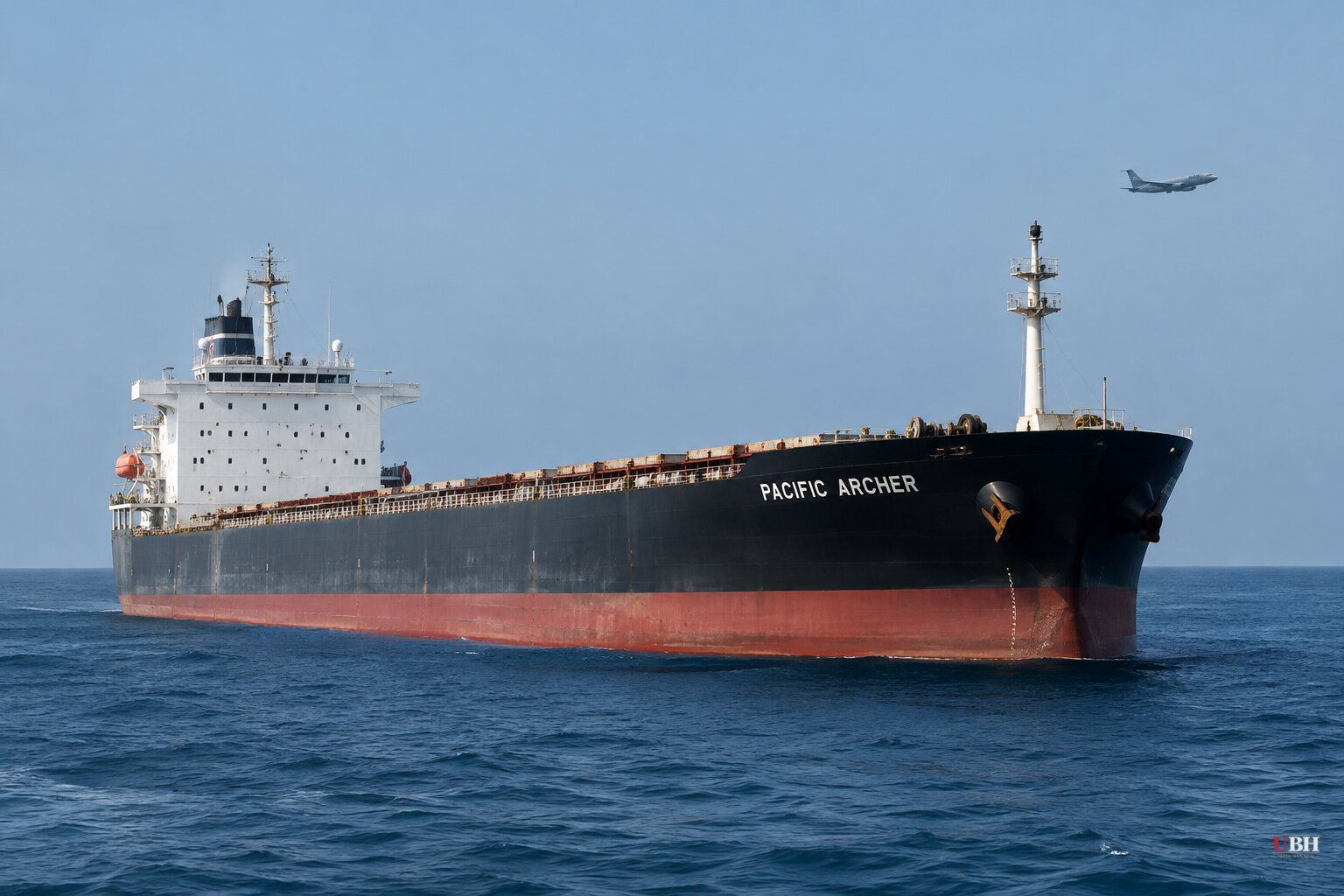
Since the U.S. resumed its naval blockade of Iranian ports in mid-July, American forces have disabled a string of merchant ships that refused to turn back. The latest came Thursday, Nov. 26, and CENTCOM disclosed it Friday, Nov. 27.
According to CENTCOM, the crew of the Palau-flagged bulk carrier M/V Pacific Archer "attempted to run the U.S. naval blockade, despite multiple warnings" after leaving Bandar Abbas. A U.S. military aircraft then fired precision munitions at the ship's stern. The command said the propulsion was ultimately disabled and the civilian crew was unharmed.
CENTCOM released an eight-second unclassified video of a munition hitting the vessel. Ship-tracking websites list the Pacific Archer's destination as Singapore.
The running tally
CENTCOM says its forces have now redirected 158 commercial vessels that complied with the blockade and disabled six that did not. That is up from 147 redirected and five disabled when the command announced the strike on the St. Kitts-flagged M/V Huda on Nov. 7.
The Pacific Archer is at least the 15th disclosed vessel disabled by U.S. forces since the blockade first began in mid-April. The earlier phase ran until late June. The Huda was the previous ship hit this fall, 19 days ago.
CENTCOM has also said it destroyed 10 Iranian commercial oil tankers that it believes were part of a Revolutionary Guard shadow network.
Adm. Brad Cooper, who commands CENTCOM, said on Oct. 16 that the blockade had cost Iran $25 billion in oil revenue. "With the exception of the humanitarian assistance we've allowed in, Iran has no exports and no imports by sea," he said. CENTCOM marked 130 consecutive days of the current blockade last weekend.
The June deaths
The enforcement method has drawn objections before. In June, a U.S. strike on the Palau-flagged tanker M/T Settebello, which was trying to evade the blockade, killed three Indian sailors, according to Indian officials. The head of the International Maritime Organization, a U.N. agency, condemned the attack.
CENTCOM's position is that U.S. forces issue multiple warnings before firing on merchant ships. The command said no one was hurt on the Pacific Archer.
A war with no settlement
The war began in late February with joint American and Israeli strikes that killed Supreme Leader Ayatollah Ali Khamenei, among other Iranian officials and commanders. It reaches the nine-month mark Saturday, Nov. 28.
The U.S. and Iran signed a memorandum of understanding in June meant to end the fighting. Talks since have stalled. The two sides keep trading strikes, though not at the intensity of the opening weeks.
Trump said Thursday the conflict will end "sort of whenever" he decides to wind it down. He has swung between threatening large-scale strikes and saying the war "militarily is effectively over." On Nov. 6 he described recent action as "minor strikes," including the destruction of an Iranian anti-aircraft system.
On Nov. 13, Pentagon budget official Arthur Miller told Sen. Richard Blumenthal (D-Conn.) that the war has cost taxpayers $48.3 billion. Miller said that figure covers munitions, equipment replacement and operations. It does not include the total damage Iranian forces did to U.S. military facilities in the Middle East.
Regional pressure
Earlier this month, regional officials told The Associated Press that Israeli Prime Minister Benjamin Netanyahu was pressing Washington to restart the war or let Israel strike Iran's nuclear and missile sites. Officials from the Gulf states, Pakistan and Turkey have been calling senior U.S. officials to head off a return to full-scale war.
The U.S. keeps a constant presence of two aircraft carriers in the region.
On the Iranian side, the Revolutionary Guard said Friday that two tankers tried to transit the Strait of Hormuz by an "unauthorized" route. It claimed one hit a naval mine and the other turned back. Those claims have not been independently verified. Iran also denies launching the drone attack on Kuwait that Kuwait says killed two Italians.
CENTCOM urged all mariners in the Gulf of Oman and the approaches to the Strait of Hormuz to heed its blockade warnings. Whether Trump uses the post-midterm window to resume large-scale strikes, as he has said he is weighing, remains undecided.
Sources used for this briefing
8 links from 8 independent newsrooms (syndicated copies of the same report count once)
These are the sources it draws on, linked so you can verify.
More coverage: Iran


