
Unbiased headlines. Facts, not spin.
Unbiased Headlines is an independently owned news organization. We bring you the facts, not opinions, written fresh from 110+ named sources. Sources linked so you can verify it yourself.
 defense
Major Story (7/10)
Five NATO Nations Sign $6 Billion Deal for 400+ CV90 Fighting Vehicles From BAE Hägglunds
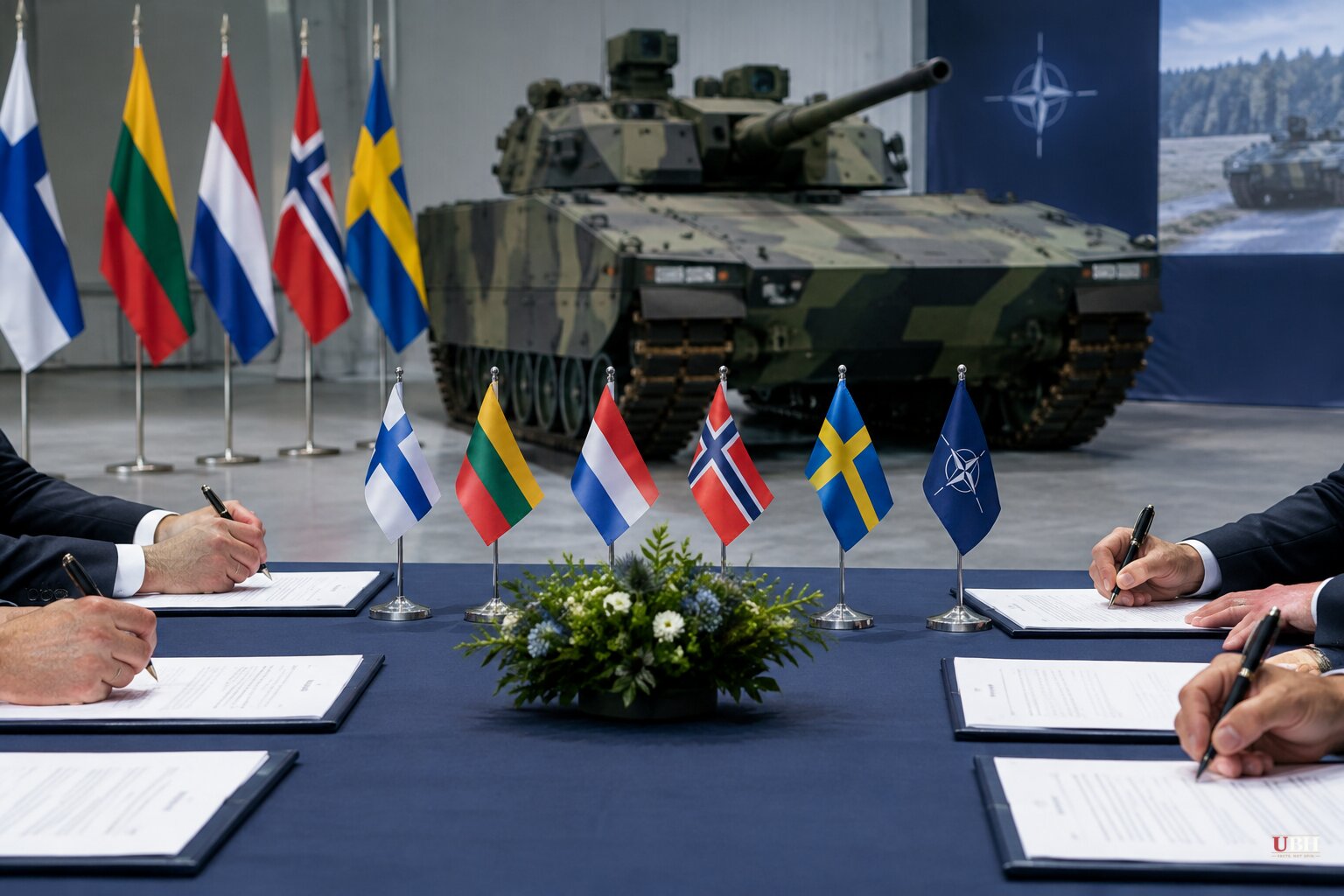
Five European NATO members signed contracts today, Nov. 27, in Stockholm for more than 400 CV90 infantry fighting vehicles. BAE Systems valued the package at $6 billion (€5.5 billion, about £4.5 billion).
The buyers are Finland, Lithuania, the Netherlands, Norway and Sweden. The signing took place at the Swedish Army Museum.
"It's the biggest deal we [have] ever done, and actually number two in Swedish history of signing international contracts," Tommy Gustafsson-Rask, general manager of BAE Systems Hägglunds, said at the ceremony.
How the deal works
Sweden's Defense Material Administration (FMV) signed the main contract with BAE Systems Hägglunds. Each country then signed its own purchase order agreement under a single framework that fixes the vehicle design, the CV9035 MkIV Nordic Edition.
Finland's Ministry of Defence said the contract only takes effect once all five purchase orders are signed together. That ties the five national programs to each other tightly.
The orders also cover technical publications, crew and maintenance training, spare parts, special tools and test equipment. BAE did not publish a country-by-country breakdown, and the vehicle count depends on who is asked. BAE says "more than 400." Finland's ministry puts the joint buy above 430.
What each country is getting
Finland is the biggest buyer. Defence Minister Antti Häkkänen authorized 160 vehicles on Nov. 26 under a €1.955 billion base contract before VAT, with an option for 100 more. The contract sits inside a €2.835 billion Infantry Fighting Vehicle 2030 project, partly funded by EU Security Action for Europe (SAFE) loans.
The Finnish vehicles will replace 110 Soviet-designed BMP-2MDs from 2030. Finnish industry, led by Patria, is to take more than 30 percent of the contract value.
Sweden is buying about 60 vehicles at an estimated 8 to 10 billion kronor ($700 million to $970 million), according to Defense Minister Pål Jonson. "This is going to be very important for our mechanised brigades to get this capability," Jonson said. Sweden donated 50 of its older CV90s to Ukraine in 2024 and later restocked.
Lithuania becomes a new CV90 operator and is building an armored division around Leopard 2A8 tanks and the new vehicles. The Dutch and Norwegian volumes have not been broken out publicly.
On Finland's figures, the base price works out to roughly €12 million per vehicle before VAT. That number is not a clean unit price, because the contracts also bundle training, spares and support.
The vehicle
The Nordic Edition is a military off-the-shelf version of the fifth-generation CV90 MkIV. It pairs an upgraded chassis with the turret developed for the Royal Netherlands Army's CV90 mid-life upgrade.
The main gun is the 35 mm Bushmaster III. That moves the group to one caliber. Finland and Norway currently run 30 mm variants, and Sweden's older Strf 9040 carries a 40 mm Bofors gun.
BAE lists an engine of up to 1,000 hp and a gross vehicle weight rating raised from 35 to 38 tonnes. The vehicle carries up to eight personnel and reaches about 70 km/h.
BAE calls the MkIV the first Western infantry fighting vehicle with a qualified active protection system. The company has not said whether the Nordic Edition buyers will fit one or integrate a guided missile.
Production and timeline
Hull structures will all be welded at BAE Hägglunds' Örnsköldsvik plant in Sweden. Chassis assembly, turret welding and turret assembly will be done in the buyer nations.
Countries keep selectable options, including their own radios, soldier equipment and some technical add-ons. Communications, electronic warfare and battle management systems will differ from country to country.
BAE's account of when deliveries start is not uniform. Gustafsson-Rask pointed to 2029. BAE's statement, as relayed in British press, said 2030, and Finland says its vehicles arrive from 2030. Gustafsson-Rask would not give exact annual output, saying only "we talk many hundreds [per year]" once production ramps up.
Why it took 18 months
Six governments signed a statement of intent on June 5, 2025. A technical arrangement followed on Nov. 12, 2025. BAE submitted its best and final offer on June 16, 2026.
Estonia was the sixth signatory but dropped out in 2026. It said it needs to prioritize air defense and unmanned aerial vehicles, and will upgrade its roughly 50 existing CV90s instead.
BAE says a common fleet means crews can move between national vehicles with little retraining, spare-parts waits shrink, and training costs fall across the group. Europe has a long record of failing at exactly this kind of commonality. Cold War attempts at a shared European tank, including Franco-German and U.S.-German efforts, collapsed over competing national requirements and industrial shares. Whether the CV90 group holds together will show up in delivery schedules and cost overruns, not in the signing ceremony.
BAE's other news this month
BAE shares rose about 2 percent on the announcement. The deal lands just over a week after the company said it plans to cut up to 1,070 jobs in its UK head office and air sector. BAE employs about 50,000 people in Britain. The CV90 work is centered in Sweden.
The next concrete marker is Finland's option for 100 additional vehicles, which would take its total to 260 if exercised. Whether any of the five buyers fit an active protection system is also still undisclosed.
Sources used for this briefing
7 links from 7 independent newsrooms (syndicated copies of the same report count once)
These are the sources it draws on, linked so you can verify.


