
Unbiased headlines. Facts, not spin.
Every story is an unbiased news briefing written from 110+ sources across the spectrum — sources linked so you can verify it yourself.
 defense
Notable (6/10)
June 20, 2026 at 05:20 AM
defense
Notable (6/10)
June 20, 2026 at 05:20 AM
Ceasefire With Hezbollah Is Leaking. Strikes Continued After It Took Effect, and Tehran Is Blaming Trump.
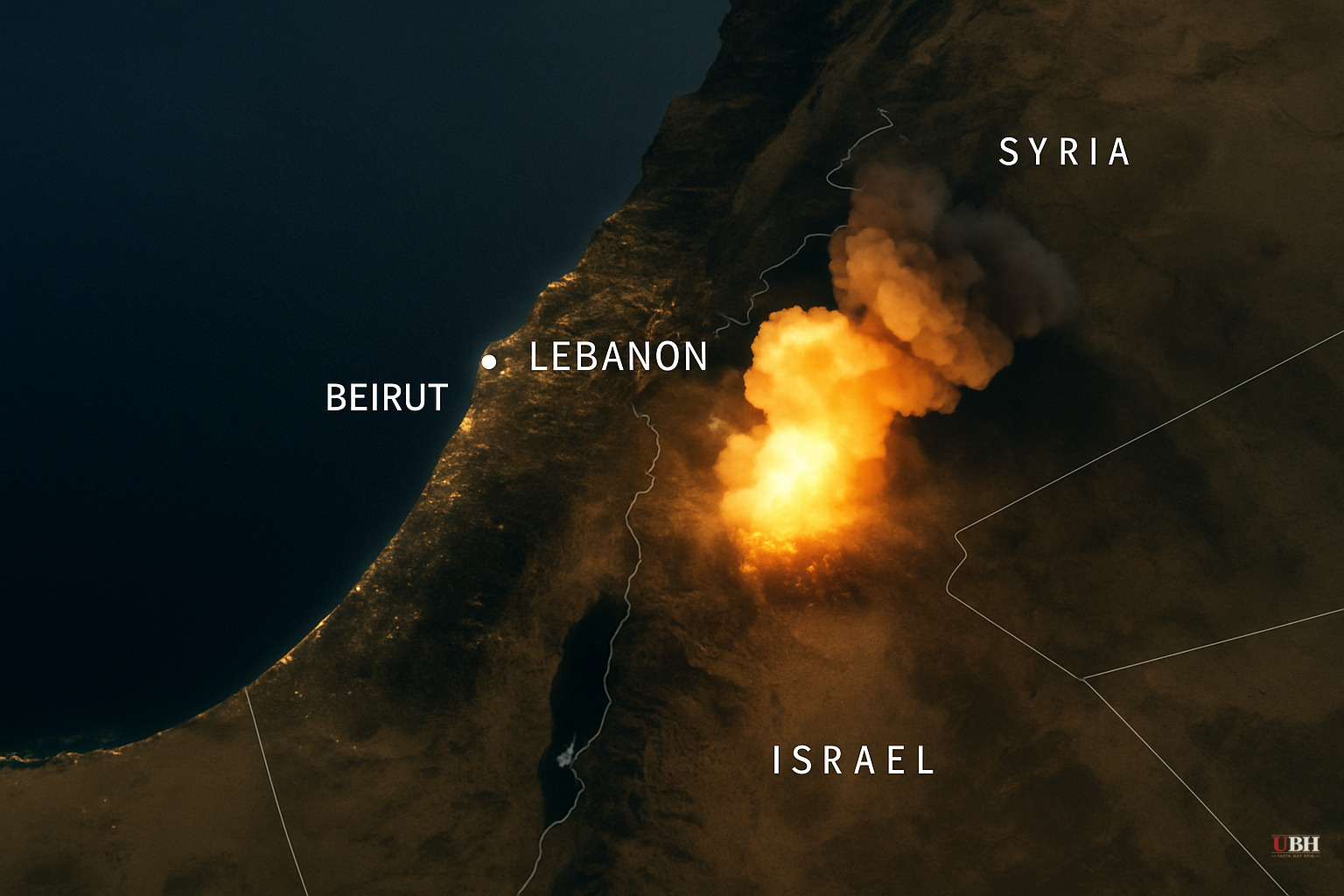
Since the U.S.-Iran MOU was announced and implementation talks opened at Burgenstock last week, the Lebanon component has been the most fragile piece. Friday's events made that undeniable.
According to BBC News, Israeli air strikes overnight into Friday killed 47 people in southern Lebanon. Hezbollah killed four Israeli soldiers in the same period. A ceasefire formally took effect at 4:00 p.m. local time (1:00 p.m. GMT) on Friday. Rescue officials in Nabatieh told BBC that at least 12 additional air strikes hit after that deadline.
The Israeli military confirmed the ceasefire was in effect, then its spokesman said forces would "continue to remove immediate threats." That carve-out is essentially a self-authorizing exception.
Hezbollah has not formally confirmed the ceasefire as of June 20. Secretary General Sheikh Naim Qassem said publicly: "The project to eliminate Hezbollah has failed." That is not the language of a party wrapping up hostilities.
Vance's Message to Israel's Critics
Vice President JD Vance has been the sharpest American voice defending the overall Iran framework while putting pressure on Israel. Fox News reported Vance told Israeli critics directly that "you can't kill your way" out of national security problems, and challenged them to name an alternative plan. That framing puts Washington on record: the U.S. wants the ceasefire to hold, and it is not going to absorb Israeli military activity that blows up the deal.
That tracks with what BBC described as an "unprecedented" posture from Trump himself, who suggested Netanyahu has been senselessly killing civilians. A sitting U.S. president publicly accusing a close ally's prime minister of senseless civilian killing is not routine diplomatic friction. It reflects how exposed Washington's position becomes every time a strike lands after a ceasefire clock starts.
Johnson's Concern: The Money, Not the Bombs
Sen. Ron Johnson (R-WI) offered a different angle on Friday's broadcast of Fox Business Network's Kudlow. Johnson said the MOU "recognizes reality" — the Iranian people did not rise up because the regime "pretty well slaughtered the leaders of the opposition," Iran closed the Strait of Hormuz, and American public opinion has no appetite for boots on the ground.
His primary concern now is economic, not military: "Don't let them use that money to fund their proxies and their wars in the Middle East." Johnson said he hopes the Treasury Department maintains control over how sanctions relief and oil revenue get allocated, limiting it to reconstruction for the Iranian people rather than proxy networks.
That is a legitimate structural question the MOU has not publicly resolved. Whether Treasury can actually enforce that distinction — given that Iranian state budgeting is not transparent — is not answered by the text of the deal as disclosed so far.
The Strongest Counterargument
Critics of the deal, including voices in both Israeli and American hawkish circles, have a serious point: a ceasefire that one party keeps violating is not a ceasefire, it is a negotiating pause that legitimizes the stronger party's position while binding the weaker one. If Israel continues striking after ceasefire deadlines with no American consequence beyond a public rebuke, Iran has reasonable grounds to argue the MOU is being applied asymmetrically. That erodes Iranian domestic support for any deal, gives hardliners ammunition, and makes verification of the nuclear components of the agreement harder because trust between the parties is degraded.
That concern does not require assuming bad faith from Washington. It is a structural problem: the U.S. cannot fully control Israel's military decisions, and every strike after a ceasefire deadline costs credibility that the deal needs to function.
The counterargument from the administration's side, which Vance and Johnson both reflect, is that there was no better option available. Iran closed the Strait of Hormuz. A nuclear-armed Iran is an existential threat. The MOU at minimum degrades Iran's nuclear capability and gets the Strait open. Holding out for a cleaner deal while the region burns is not a strategy.
Both arguments have real weight. The facts as of June 20 don't resolve the tension — they sharpen it.
What's Actually Unresolved
BBC's framing centered on the civilian death toll and Tehran's accusation that Trump is failing to rein in Netanyahu. That focus is understandable but underweights the Johnson question about sanctions enforcement, which is the mechanism that will determine whether Iran's proxy network reactivates in 12 to 24 months regardless of what happens in Lebanon this week.
The Burgenstock implementation talks are ongoing. The specific question of how Treasury will structure and monitor sanctions relief — and whether any mechanism exists to claw it back if Iran funds Hezbollah or the Houthis — has not been publicly answered. Until it is, Johnson's concern sits at the center of whether this deal holds over any meaningful time horizon.
Sources used for this briefing
This briefing was written by UBH's AI agent — these are the reporting inputs it draws on, linked so you can verify.


