
Unbiased headlines. Facts, not spin.
Unbiased Headlines is an independently owned news organization. We bring you the facts, not opinions, written fresh from 110+ named sources. Sources linked so you can verify it yourself.
 health
Notable (6/10)
Event date: August 9, 2026 ·
health
Notable (6/10)
Event date: August 9, 2026 ·
CDC Study: Drug-Resistant Ringworm Fungus Now Detected in 29 Countries, Cases Triple Since 2022
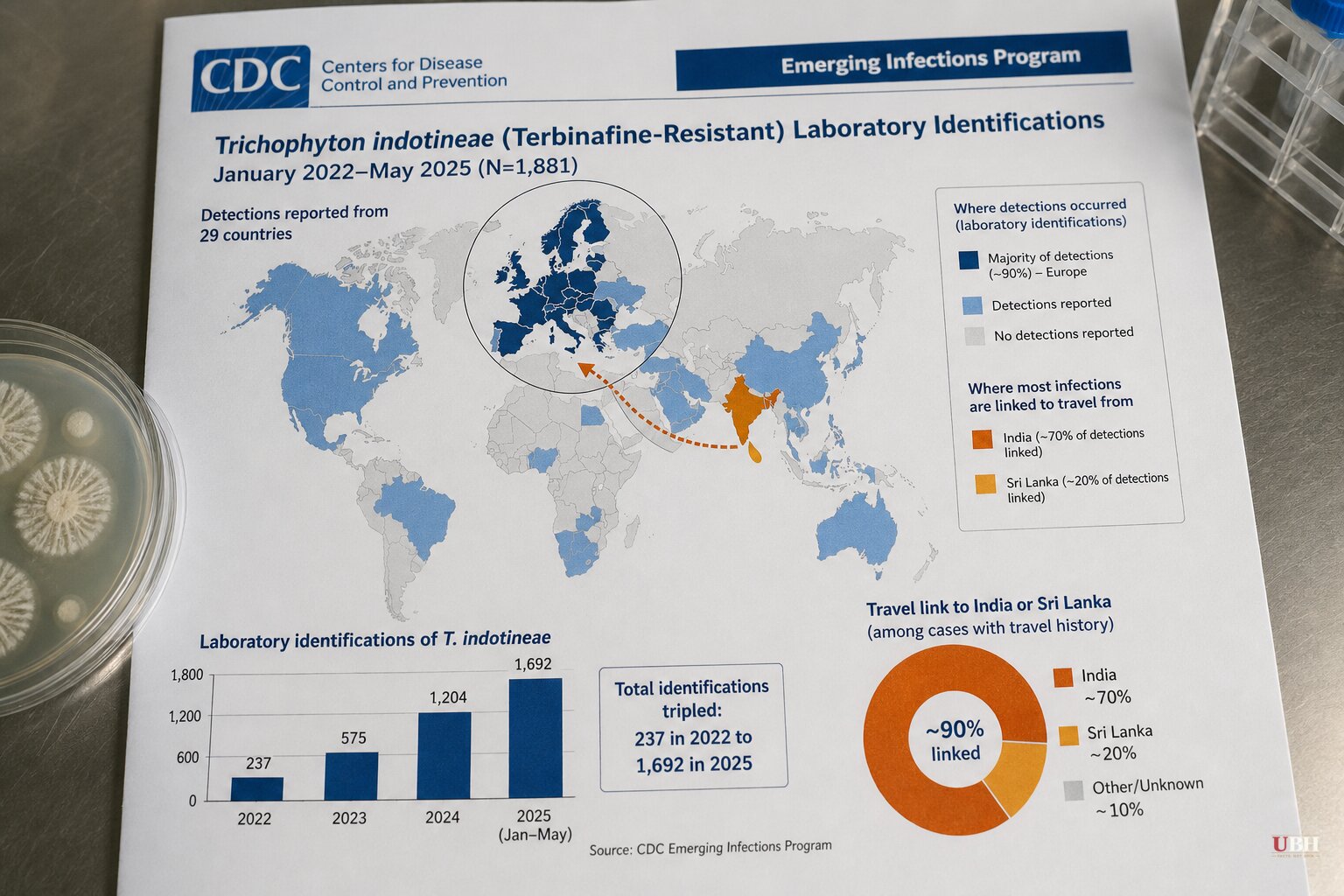
A fungus that causes a nastier, harder-to-kill version of ringworm has now turned up in 29 countries, according to a study published in the CDC's Emerging Infectious Diseases journal last month and reported by The Hill and Yahoo News via NewsNation.
The fungus, Trichophyton indotineae, doesn't respond to terbinafine, the go-to antifungal drug most doctors reach for first, whether as a cream or a pill. That means infections that should clear up in weeks can drag on for months.
The Numbers
Researchers pulled data from the Mass Spectrometry Identification project, a global database run out of the Pitié-Salpêtrière University Hospital's Parasitology-Mycology Laboratory in France, according to Archynewsy. They looked at more than 1.6 million fungal spectra submitted by labs in 54 countries between March 2022 and the end of 2025, per dailynewshungary's reporting on the study.
Out of that pile, 3,399 samples came back positive for T. indotineae, submitted by 183 laboratory users in 29 countries, according to healthcare360magazine. Annual detections went from 237 in 2022 to 1,692 in 2025. That's the threefold jump everyone's reporting on.
Europe Isn't Necessarily Ground Zero
89.4% of the positive identifications came from Europe, but that's largely because 63.8% of the labs actually running this kind of testing are in Europe, per healthcare360magazine's breakdown of the CDC data. Archynewsy's writeup states the European share of positive samples as 63%, which conflates the lab-participation number with the detection number and understates how concentrated the actual hits were in Europe.
The CDC researchers were blunt about what that means. Countries like those in Africa, India and the Middle East, where this fungus is already known to circulate, showed few or zero detections in the database. That's not because it isn't there. It's because those regions mostly lack the mass spectrometry equipment needed to tell T. indotineae apart from run-of-the-mill ringworm fungi, according to The Hill's reporting.
The U.S. Picture
The strain first showed up stateside in 2023, when two unrelated patients in New York City had infections that wouldn't clear with oral terbinafine, according to both The Hill and Yahoo News. World Today News and Archynewsy report that surveillance has since confirmed cases across 11 states, though that specific state count doesn't appear in the NewsNation-sourced coverage from The Hill or Yahoo.
Archynewsy also notes the fungus turned up for the first time during the study window in five countries not previously on the list: Bulgaria, Croatia, Colombia, Luxembourg and Uruguay.
Not Every Detection Is a Disaster
These numbers could reasonably alarm someone who worries this is the start of an untreatable global skin-infection wave. The instinct makes sense given the CDC's own description of the fungus as sometimes producing infections that are "more severe and difficult to treat than typical ringworm."
But Hungary's own case, reported by dailynewshungary citing Hungarian outlet HVG, offers perspective. Researchers at the University of Debrecen confirmed Hungary's first documented case in 2025, in a man in his twenties who had recently traveled to a region where the fungus is endemic. Whole-genome sequencing confirmed the species. But that particular isolate was still susceptible to terbinafine, and the patient responded fine to topical treatment. Finding the species doesn't automatically mean you've found a drug-resistant infection. The two facts get conflated a lot in casual reporting.
What's Actually Known vs. What Isn't
What's proven: lab-confirmed detections of this fungus species have tripled in four years and now span 29 countries, according to the CDC's own published data. What's not proven: the true global prevalence, since testing capacity is wildly uneven and the CDC itself says the "true number of antimicrobial-resistant ringworm cases is difficult to estimate."
The fungus spreads the same way any ringworm does, through skin contact, shared towels, gym mats, bedding. Nothing exotic there. The CDC's guidance to doctors is straightforward: if a ringworm infection isn't clearing up after standard terbinafine treatment, consider specialized testing rather than just prescribing more of the same drug.
What's still unresolved is the scale of the problem in the places least equipped to measure it. Until mass spectrometry testing reaches labs in Africa, India and the Middle East, the 29-country count is a floor, not a ceiling.
Sources used for this briefing
7 links from 7 independent newsrooms (syndicated copies of the same report count once)
These are the sources it draws on, linked so you can verify.


