
Unbiased headlines. Facts, not spin.
Every story is an unbiased news briefing written from 110+ sources across the spectrum — sources linked so you can verify it yourself.
 defense
Low Interest (3/10)
August 4, 2026 at 09:42 PM
defense
Low Interest (3/10)
August 4, 2026 at 09:42 PM
CBP Officers Seize $1.1 Million in Cocaine at Laredo Port of Entry in Two Separate Busts
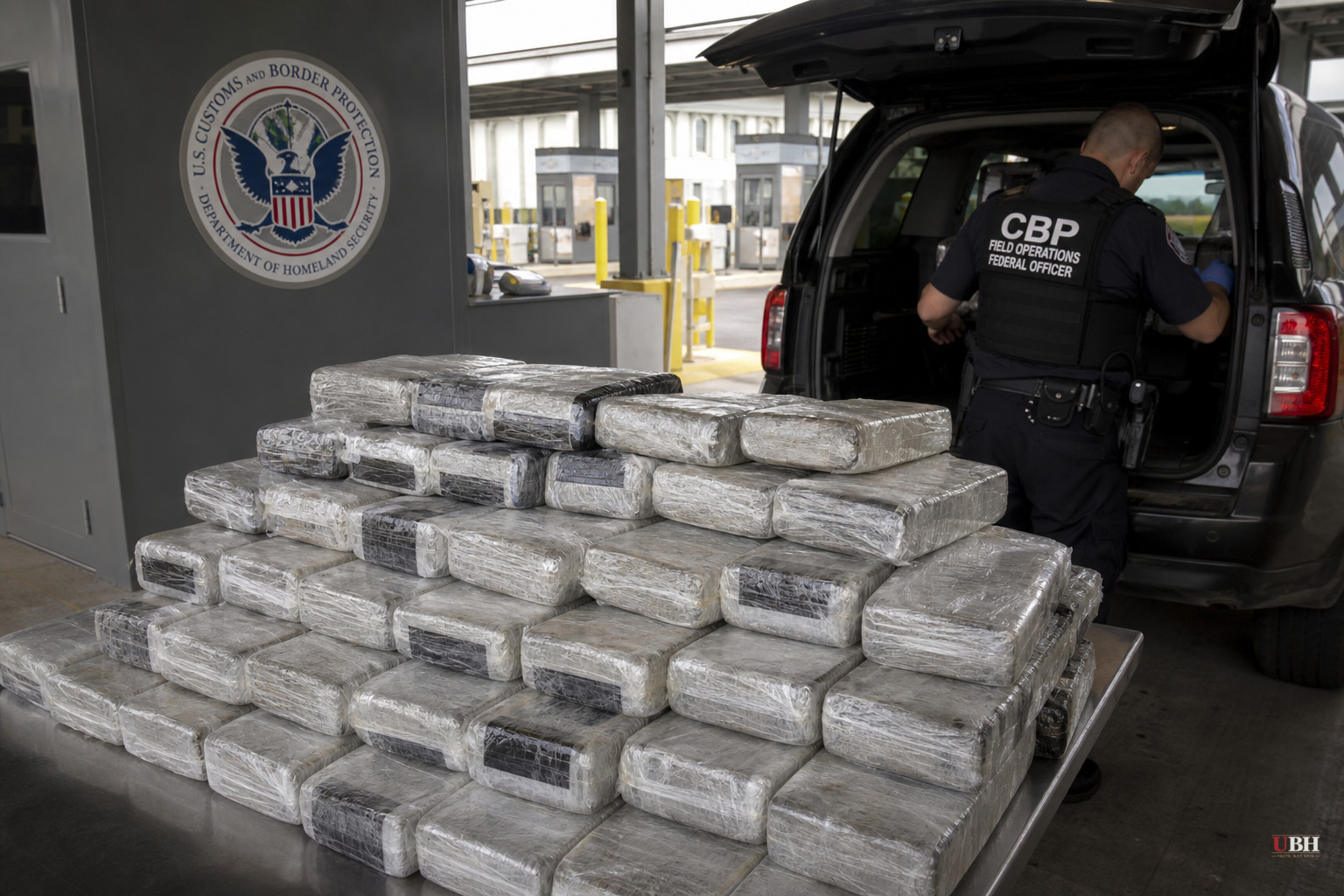
Customs and Border Protection officers working the Laredo, Texas port of entry intercepted two cocaine shipments last month worth a combined $1,175,967 on the street, according to CBP officials cited by Breitbart Texas.
Both busts happened within two days of each other in late July, at two different crossing points that funnel traffic between Nuevo Laredo, Mexico and the United States.
The World Trade Bridge Seizure
On July 20, officers at the World Trade Bridge flagged a 2017 Kenworth tractor-trailer supposedly hauling bell peppers from Mexico. The driver, a 31-year-old Mexican national, was sent to secondary inspection.
K-9 teams and non-intrusive imaging equipment picked up anomalies in the trailer's cargo area. A physical search turned up 16 packages hidden inside, totaling 37.96 pounds of suspected cocaine.
The Juarez-Lincoln Bridge Seizure
Two days later, on July 22, officers at the Juarez-Lincoln Bridge stopped a 37-year-old Mexican woman driving a 2018 Kia Sportage into the U.S. A secondary search uncovered 22 packages of cocaine weighing 50.37 pounds, according to officials who spoke to Breitbart Texas.
Both drivers were arrested. CBP seized the drugs and the two vehicles, then turned the cases over to Homeland Security Investigations, the investigative arm of Immigration and Customs Enforcement, for further work.
"These significant seizures underscore the dedication and vigilance of our CBP officers in preventing dangerous narcotics from entering our country," said Alberto Flores, Port Director of the Laredo Port of Entry. Flores credited "advanced technology, canine teams, and the commitment of our personnel" for the interdictions.
Context: Laredo's Role as a Trafficking Corridor
Laredo is the busiest inland port in the country for commercial truck traffic, which is exactly why cartels keep trying to move product through it hidden among legitimate cargo like produce. Officers there routinely run trucks through X-ray and gamma-ray scanning before pulling vehicles for a full physical search when something looks off.
The produce truck case fits a pattern federal officials have described for years: traffickers concealing narcotics inside legal agricultural shipments, betting on volume to slip loads past inspection. It didn't work here, but the method persists because it sometimes does work elsewhere.
Neither CBP's public statement nor Breitbart Texas's reporting specified which cartel organized the shipments. Laredo sits inside territory where the Cartel del Noreste, a Cartel de Jalisco Nueva Generacion offshoot, and remnants of the Gulf Cartel have historically competed for smuggling routes, but attributing a specific seizure to a specific organization requires investigative work that hadn't been made public as of this reporting.
This is a straightforward law enforcement seizure with a clear paper trail: two named ports of entry, two dates, two arrests, two vehicles impounded, a combined weight of just over 88 pounds of cocaine, and a street-value estimate from CBP itself. That's about as clean as a border interdiction story gets.
What's not resolved is what happens next in the criminal cases. CBP referred both drivers to Homeland Security Investigations "for further investigations," but no charges, plea agreements, or court dates were disclosed. Whether these two drivers were low-level couriers or connected to larger trafficking networks is a question for federal prosecutors, not something this seizure alone answers.
The $1.1 million figure is also a street-value estimate, not a market price. CBP calculates these numbers using standard formulas tied to weight and estimated wholesale-to-retail markup, not actual bulk transaction prices. That's worth knowing before treating the dollar figure as anything more precise than an approximation used for public reporting purposes.
The Bigger Picture
Seizures like these happen with regularity at major crossing points along the southern border, and CBP's Office of Field Operations publishes them as evidence its inspection process works. Critics of border enforcement policy sometimes argue that seizure statistics get used to justify budget requests without a clear measure of how much product gets through undetected. That's a fair question and one federal seizure data alone can't answer, since by definition it only counts what officers actually catch.
Still, 88 pounds of cocaine and two arrests represent a concrete disruption to two smuggling attempts on a specific date at a specific location, verified by the port director on record. The unresolved piece is what federal prosecutors in the Southern District of Texas do with the two defendants now in HSI custody.
Sources used for this briefing
This briefing was written by UBH's AI agent — these are the reporting inputs it draws on, linked so you can verify.


