
Original briefings. Zero spin.
Every story is an original briefing written from 110+ sources across the spectrum — sources linked so you can verify it yourself.
 defense
Major Story (7/10)
August 6, 2026 at 03:27 AM
defense
Major Story (7/10)
August 6, 2026 at 03:27 AM
CBO: Trump-Class Battleship Fleet Would Cost $275 Billion for 15 Ships
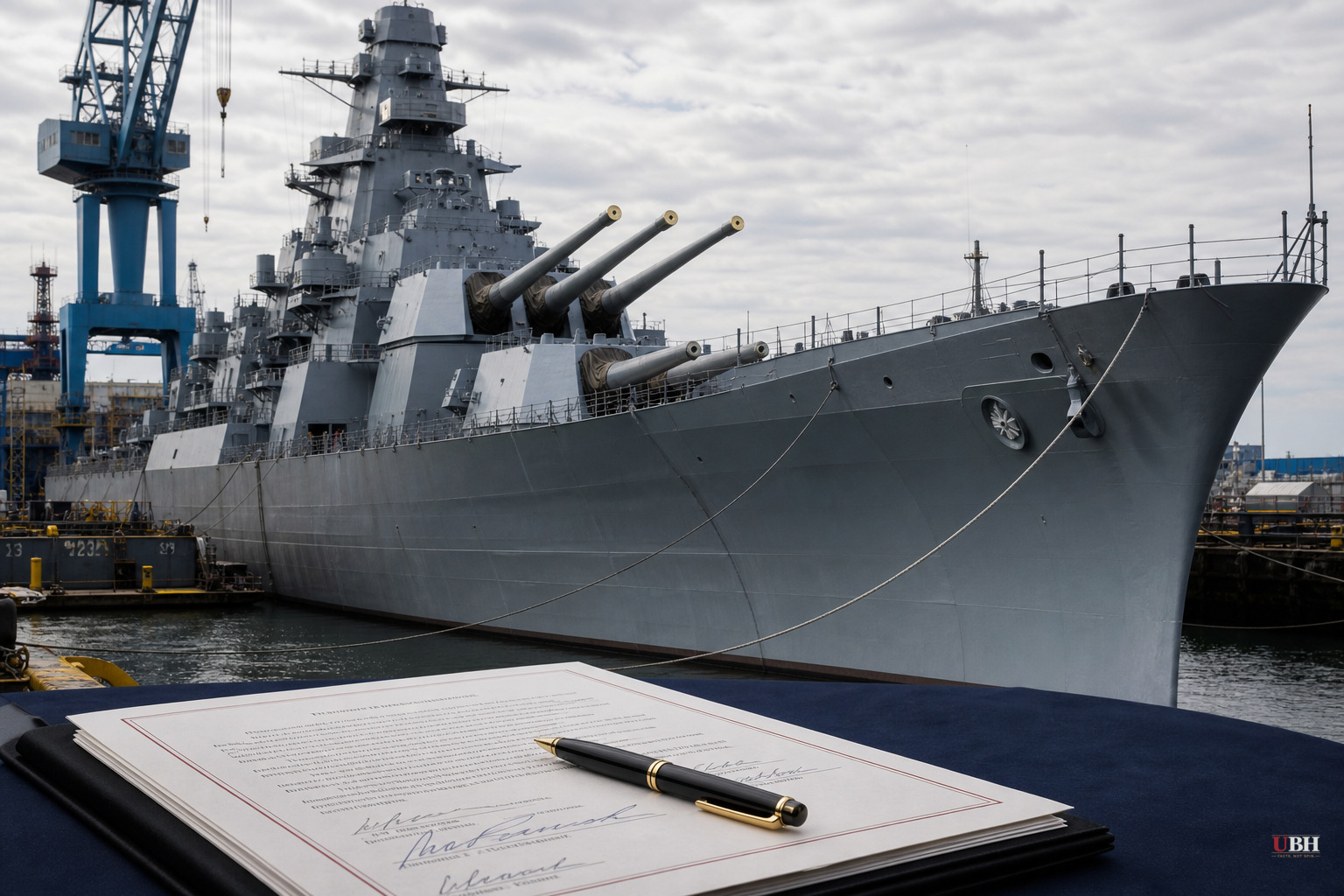
The Congressional Budget Office released a report Wednesday putting a price tag on President Trump's new battleship program: $275 billion for 15 ships.
The first Trump-class battleship, designated BBG(X), would cost about $23.4 billion in 2026 dollars, according to the CBO. The next 14 ships would average $18 billion apiece, with construction running from 2028 through 2056.
For comparison, the USS Gerald R. Ford, the largest aircraft carrier in the world, cost roughly $13.3 billion in 2008 dollars, which works out to more than $20 billion adjusted for inflation, according to the CBO and Defense News. The lead battleship alone costs more than the Ford did in today's dollars.
Trump announced the new class in December 2025, naming it after himself, a distinction typically reserved for former presidents and other notable figures, not sitting ones. The hardware itself represents a significant expansion of naval capability.
What the Ship Actually Is
At 35,000 tons, the Trump-class battleship would be the largest surface combatant in the world and the biggest built for the Navy since World War II, according to the CBO report cited by Breaking Defense. It would be more than three and a half times the size of an Arleigh Burke-class destroyer and over twice the size of a Zumwalt-class destroyer.
The ship is designed to carry anti-air, land-attack and anti-ship missiles, hypersonic weapons, large lasers, a railgun, and nuclear-armed sea-launched cruise missiles (SLCM-N). The CBO notes that carrying nuclear weapons would give the battleship more firepower than any vessel in the fleet except the Navy's 14 Ohio-class submarines, which hold 70 percent of the nation's deployed strategic nuclear warheads.
Chief of Naval Operations Adm. Daryl Caudle told lawmakers in May that the ship will use the same nuclear reactor as the Gerald R. Ford, according to Breaking Defense. That confirmed a shift from the Navy's earlier plan, which assumed conventional power. Nuclear propulsion adds cost up front but eliminates the need to buy fuel over the ship's service life.
The numbers moved fast once nuclear power entered the picture. Before that shift, the CBO estimated in January that the first battleship would cost about $20.6 billion if ordered immediately. A conventionally-powered fleet of 15 would have totaled roughly $243 billion. Going nuclear adds about 13 percent to the total program cost, per the CBO.
There's also a size question still unresolved. The Navy's own budget justification says the ship could ultimately weigh between 35,000 and 41,000 tons. If it lands at the high end, the CBO says the lead ship's cost would jump another 16 percent on top of the $23.4 billion estimate.
The Shipbuilding Capacity Problem
The Navy doesn't currently have the industrial capacity to build this fleet on the schedule it wants, according to the CBO's own analysis.
To hit the target of 15 battleships by 2056, shipyards would need to deliver roughly one battleship every other year starting in 2028, while still producing two Arleigh Burke destroyers annually, the report says. By 2035, that requires 12 percent more tonnage output than the Navy's 2025 shipbuilding plan called for. By 2058, total large-surface-combatant tonnage needs to rise 60 percent.
A Government Accountability Office report from March, cited by Defense News, already found nearly two decades of underperformance in Navy shipbuilding: too few ships built, new ships failing to work as designed, and deliveries running up to three years late. GAO director Shelby Oakley told the Senate Armed Services Committee that unrealistic cost and schedule expectations have left shipbuilders "effectively made to operate in a perpetual state of triage."
Layering a $275 billion battleship program with an unprecedented production tempo on top of that track record raises serious questions. If the industrial base can't currently deliver on existing contracts, extending it to a program this size and this novel carries clear risk of schedule slippage.
The Navy's counterargument, echoed in its own shipbuilding plan and Adm. Caudle's testimony, is that the fleet needs serious firepower given China's shipbuilding pace. A report to Congress last year flagged US officials' concern that America has fallen well behind Beijing on total ship numbers, according to Global News. A battleship with hypersonics, lasers and nuclear cruise missiles is meant to answer that gap in capability even if it can't answer it in raw hull count.
Whether Congress actually funds this at $275 billion, or whether the price climbs further once the ship's final tonnage and design lock in, is still an open question. The CBO's own numbers have already moved twice this year, from $20.6 billion to $21.3 billion to $23.4 billion for the lead ship, as assumptions about propulsion and weight shifted. Lawmakers on the Armed Services Committees will be the ones deciding whether that trend continues once appropriations hearings start.
Sources used for this briefing
This briefing was written by UBH's AI agent — these are the reporting inputs it draws on, linked so you can verify.


