
Unbiased headlines. Facts, not spin.
Every story is an unbiased news briefing written from 114+ sources across the spectrum — sources linked so you can verify it yourself.
 economy
Major Story (7/10)
Event date: October 9, 2026
economy
Major Story (7/10)
Event date: October 9, 2026
CBO Director Says Stabilizing U.S. Debt Takes 5%-6% Real Growth, Not the 3% Bessent Cites
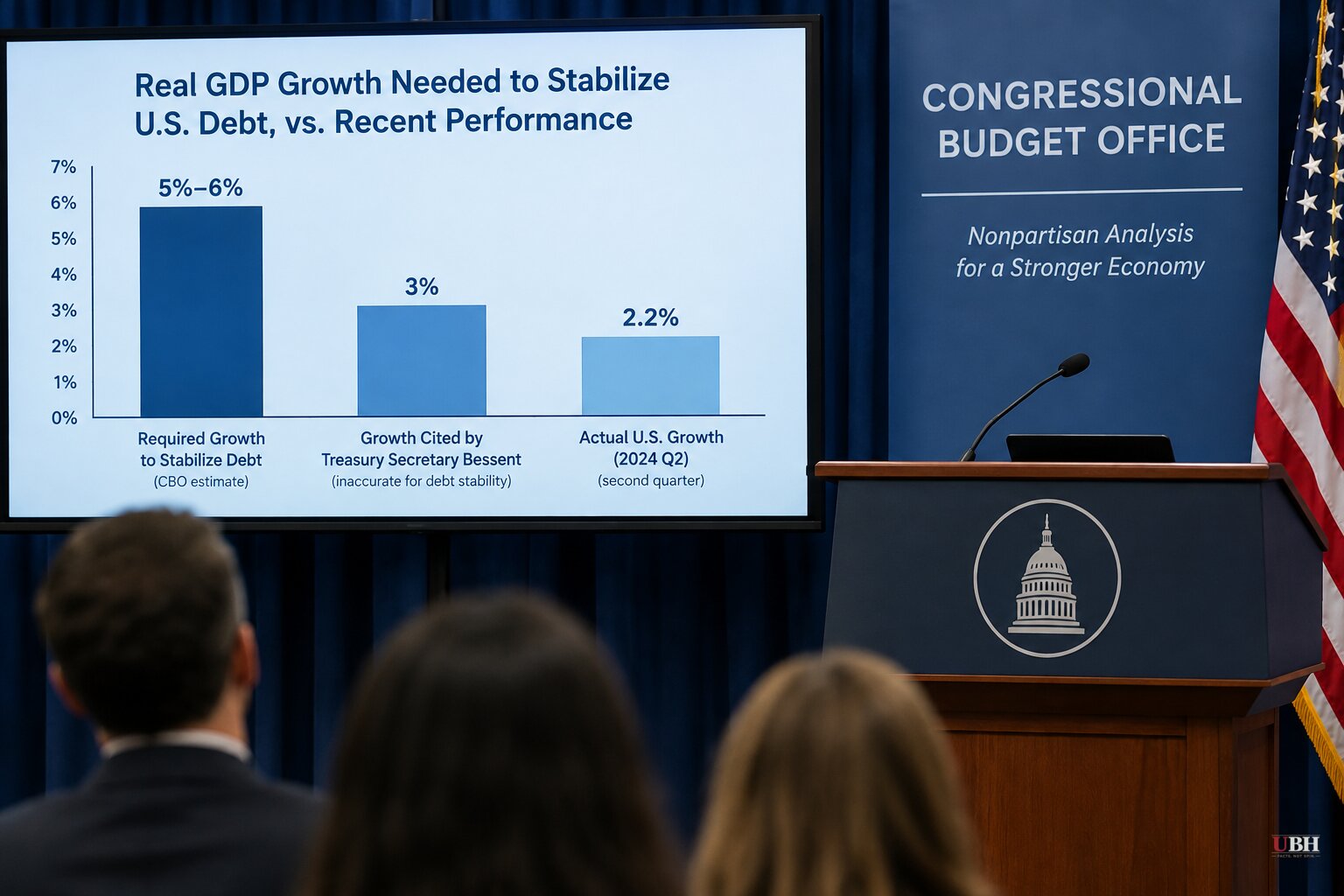
The head of Congress's own budget scorekeeper just put a number on the "grow our way out" theory. It is roughly double what the administration has been saying.
Speaking Thursday, Oct. 8, at a Minneapolis Fed conference, CBO Director Phillip Swagel said: "Growth will help, but it's probably not plausible that growth alone will stabilize our fiscal trajectory." He added that the remaining options, "changes in revenues and changes in spending," are "inherently political choices."
The arithmetic
Minneapolis Fed President Neel Kashkari asked how much faster the economy would have to grow. Swagel cautioned against doing math on the fly, then offered back-of-the-envelope figures.
With interest rates of 4%-5%, he said, nominal GDP growth would need to hit 7%-8%. Real growth would need to reach 5%-6%. "It's pretty challenging," he said.
The latest real GDP reading is 2.2% for the second quarter. Bessent said last month at Southern Methodist University: "With 3% growth, we grow our way out of this." President Trump told reporters in August that growth would "very easily" take care of the $40 trillion national debt.
Other estimates land in between. The Penn Wharton Budget Model says growth would have to average 3.5%-4% over a decade to hold the debt-to-GDP ratio steady. The Committee for a Responsible Federal Budget has said cutting the deficit to 3% of GDP would take 4.5% growth.
Why growth doesn't close the gap
Swagel laid out the mechanics. More growth brings in more revenue. But federal spending also lifts growth, higher wages feed into Social Security outlays, and a hotter economy tends to push interest rates up, which raises the government's borrowing costs.
A Sept. 24 CBO letter to Senate Budget Committee Ranking Member Jeff Merkley makes the same point with the agency's long-term numbers. Publicly held debt is 101% of GDP in fiscal 2026. It is projected to reach 120% by 2036 and 175% by 2056.
CBO's baseline assumes nominal GDP growth averaging 3.8% against an average interest rate of 4% on the debt. Primary deficits, which exclude interest, average 2.1% of GDP. Under those conditions the debt ratio keeps climbing.
To hold debt at its 2026 share of GDP, the letter says, primary deficits would have to average just 0.2% of GDP over 2026-2056. CBO does not say which taxes or programs would change to get there.
The agency also found that the 2025 reconciliation law boosts growth and revenue, but the resulting higher interest rates dominate. The net effect is a slightly larger deficit.
AI is not a rescue in the agency's current numbers. CBO includes about 0.1 percentage point a year of productivity growth from generative AI and still projects real growth of roughly 1.8% a year from 2027. Swagel said CBO has detected a rise in total factor productivity and that its next forecasts, due early next year, will fold in its AI views and show stronger growth. Even so, he warned, the deficit is too deep for that extra growth to be enough.
The deficit and the bond market
The CBO estimated the fiscal 2026 deficit, for the year ended Sept. 30, at about $2 trillion, $218 billion more than a year earlier. Revenue rose $169 billion, or 3%, to $5.4 trillion. Outlays rose $386 billion, or 6%, to $7.4 trillion.
Corporate income tax collections fell $70 billion, or 16%, due in large part to the more generous investment write-offs in the 2025 Republican reconciliation bill. Net interest on the debt rose $115 billion, or 11%, to a record $1.1 trillion. Spending on Social Security, Medicare and Medicaid rose $217 billion, or 7%. Defense rose $48 billion, or 5%.
"Running $2 trillion deficits in a growing economy with low unemployment and no major emergency situation going on is an unsustainable trend," Shai Akabas of the Bipartisan Policy Center told The Wall Street Journal. Carolyn Bourdeaux, executive director of Concord Action, said net interest now consumes over 20% of federal tax dollars and repeated her group's call for a fiscal commission.
Lenders are already charging more. The 10-year Treasury yield briefly neared 5.35% on Monday, Oct. 5, a level BigGo Finance describes as the highest since 2002. Pimco Chief Investment Officer Dan Ivascyn said that from the current 5.29%, a further sharp rise toward 6% is "feasible" as hedge funds dump losing bond bets.
A new CBO analysis found the 10-year yield closed more than 100 basis points above the agency's February 2026 projections. CBO estimates that rates averaging 50 basis points above its projections through 2036 would add nearly $2 trillion to deficits, and 150 basis points would add $6 trillion. Swagel described the feedback loop as a "turbocharger": a rate shock feeds the deficit, the deficit feeds the debt, and the debt feeds back into rates.
The administration's case
Bessent has not backed off. On Oct. 5 he said the administration inherited "a mountain of debt" from the Biden administration and is responding by "restraining spending and driving economic growth." He said sustained growth above 3% would reverse the debt-to-GDP ratio and noted that tariff revenue has recovered after a one-time payout of $180 billion in tax refunds.
He has also pointed to the Iran conflict. He said last month that once it is behind the country, "the underlying economy is very, very strong, and I think reaccelerating." In an interview the previous Saturday he conceded, "I can't control the bond market," and attributed the yield surge to oil prices driven up by the conflict rather than to structural problems.
Brown Brothers Harriman strategist Elias Haddad called Bessent's remarks an attempt to talk down long-end yields through verbal intervention. Strategists cited by BigGo also noted that fiscal policy is set by Congress, not Treasury.
Both parties share the problem. The deficit exceeded $2 trillion in a year with low unemployment and no recession, with a Republican president, a Republican-passed tax law that cut corporate collections, and spending that grew faster than revenue.
The next concrete marker is Nov. 4, when Treasury issues its quarterly refunding announcement. Investors expect the department may signal less reliance on long-dated debt.
Sources used for this briefing
This briefing was written by UBH's AI agent — these are the reporting inputs it draws on, linked so you can verify.


