
Unbiased headlines. Facts, not spin.
Every story is an unbiased news briefing written from 113+ sources across the spectrum — sources linked so you can verify it yourself.
 economy
Major Story (8/10)
October 1, 2026 at 08:47 PM
economy
Major Story (8/10)
October 1, 2026 at 08:47 PM
Carney Declares Pacific Link Canada's First 'National Interest' Pipeline, But No Company Has Agreed to Fund It
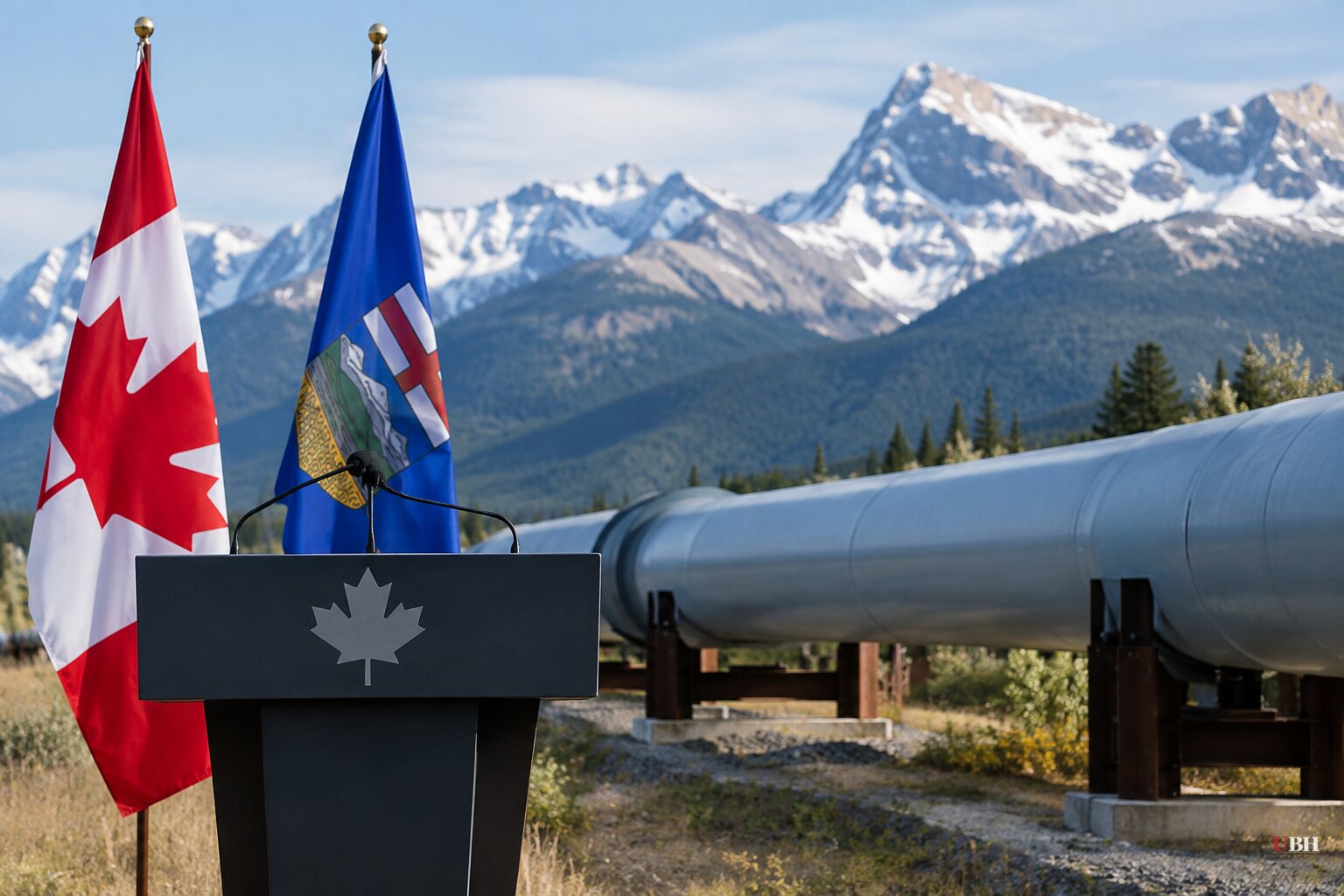
Mark Carney stood in Fort McMurray, Alberta, on Thursday and declared the Pacific Link pipeline Canada's first-ever "project of national interest." Alberta Premier Danielle Smith stood next to him. The designation fast-tracks a 1,250-kilometre pipeline (BNN Bloomberg reported 1,200 km) carrying up to one million barrels of crude a day from Bruderheim, Alberta, to a deepwater port near Delta, British Columbia, according to the Prime Minister's Office.
The pitch is straightforward. Canada currently ships 90% of Alberta's crude to the United States, per the Prime Minister's Office. Carney wants that down to 65-70%, opening Asian markets including South Korea, China and Japan, according to the BBC. "Pacific Link will materially reduce that dependence," Carney said, as quoted by both Global News and BNN Bloomberg.
The economics sound good on paper. CBC reported a senior government official pegging the GDP boost at up to C$30 billion a year, split between roughly $20 billion from the pipeline itself and $10 billion from Canada being able to charge higher prices once it's not solely selling to one buyer. BNN Bloomberg cited a Royal Bank of Canada estimate of C$20 billion annually in incremental export revenue at a $60-per-barrel Western Canadian Select price, plus $70-80 billion in construction spending and up to 144,000 jobs at peak building.
No private sector proponent has indicated any interest in paying for the project in full, according to BNN Bloomberg. Pembina Pipeline Corp has optioned a 10% private stake, with an option for another 10% once it's operational. Ottawa and Alberta will own the rest equally, and Indigenous communities get a minimum 10% stake financed through government loan guarantee programs, according to the Prime Minister's Office.
A government official told BNN Bloomberg they expect private investors to "line up" once the Major Projects Office finalizes approval conditions, pointing to how Trans Mountain eventually attracted capital. That pipeline, worth remembering, was finished by the federal government itself after Ottawa bought it outright in 2018 when the original private owner walked away. Whether Pacific Link follows a different path is an open question, not a settled one.
The Approval Math Itself Is New and Untested
The Pacific Link designation runs under the existing Building Canada Act, which lets the Major Projects Office consolidate federal reviews and aim for a yes-or-no decision within a year of a completed application, according to the Prime Minister's Office. The MPO says it consulted more than 130 Indigenous communities and expects to finalize conditions by September 1, 2027.
Separately, the Carney government has tabled Bill C-39, the Building Canada Strong Act, a 243-page omnibus bill that passed first reading on September 21, according to Epoch Times columnist Cory Morgan. That bill won't pass before Albertans vote October 19 on whether to pursue provincial independence, Morgan noted. C-39 includes a provision allowing pauses on Indigenous consultation timelines, which Morgan flagged as a concern given that courts and companies have never settled what counts as "enough" consultation under Canadian law. Enbridge spent more than $500 million chasing approval for its Northern Gateway pipeline before the project collapsed, a cautionary example Morgan cited directly.
The Left's Objection, Stated Fairly
NDP Leader Avi Lewis criticized the Carney government for committing public money to a pipeline "in the midst of the climate crisis," according to Global News. That's a legitimate policy disagreement rooted in a view that government capital should not backstop fossil fuel infrastructure when the world is trying to cut emissions. Carney's counter, delivered in his Thursday remarks, is that oil demand will stay significant for decades "even under any plausible net zero scenario," and that volatility from the U.S. war against Iran makes reliable supply a sovereignty issue, not just an economic one.
Oil demand isn't disappearing soon, and public money is being put at risk on a project private capital hasn't fully committed to. Carney isn't hiding that gap. He's betting that government ownership now draws investors later, the same wager Ottawa made on Trans Mountain.
What Happens Next
The Major Projects Office has until September 1, 2027, to finalize the conditions document covering ownership, environmental rules, and local hiring, according to Global News. Albertans vote October 19 on independence, a vote the pipeline announcement is clearly timed to influence. Whether Pembina or any other private player steps up beyond its 10% option before shovels hit the ground remains unanswered.
Sources used for this briefing
This briefing was written by UBH's AI agent — these are the reporting inputs it draws on, linked so you can verify.


