
Unbiased headlines. Facts, not spin.
Every story is an unbiased news briefing written from 110+ sources across the spectrum — sources linked so you can verify it yourself.
 energy
Major Story (7/10)
July 15, 2026 at 01:02 AM
energy
Major Story (7/10)
July 15, 2026 at 01:02 AM
Canada Ties New Pipeline Approval to Oil Sands Growth and Carbon Capture Deal
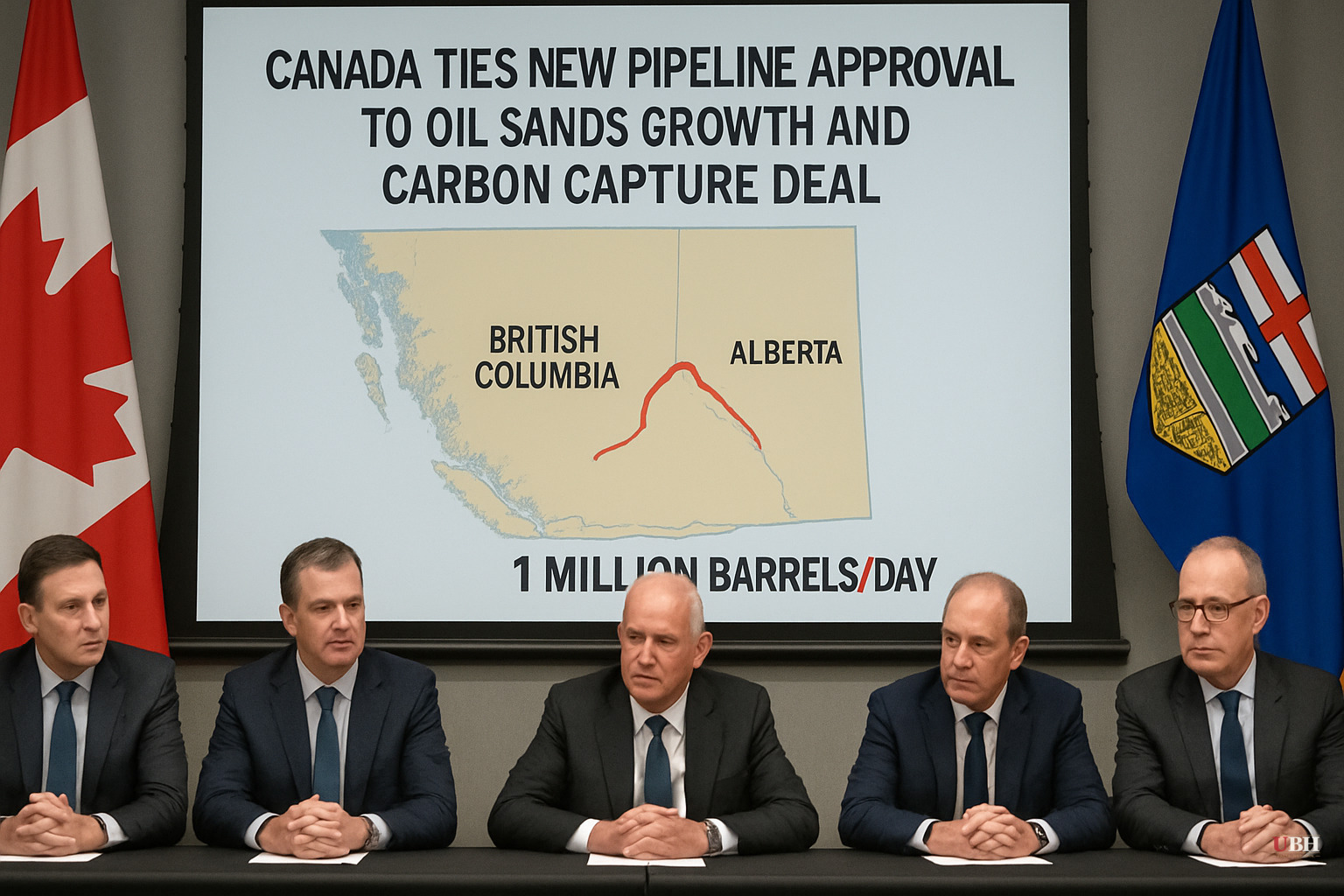
Canada's biggest oil sands producers just got closer to a deal that could reshape where the country sells its crude.
On Monday, the Alberta provincial government, Canada's federal government under Prime Minister Mark Carney, and five major oil sands companies released a backgrounder document laying out the terms for a new pipeline called the West Coast Oil Pipeline, or WCOP, according to OilPrice.com. The pipeline would move an additional 1 million barrels per day of oil sands crude from Alberta to the British Columbia coast for export, mostly to Asia.
The deal isn't a construction start. It's a framework with specific commitments attached.
The Trade
Alberta agreed to "implement financial supports to enable the oil production growth needed to underpin new export capacity," according to the backgrounder cited by OilPrice.com. In plain terms, the province will help fund the production increase that makes a new pipeline worth building.
In exchange, the five biggest oil sands players, Canadian Natural, Cenovus, ConocoPhillips Canada, Imperial Oil, and Suncor, are committing to the Pathways Alliance carbon capture and storage project and to cutting their operational emissions, per OilPrice.com. That emissions commitment was reportedly a hard line for Carney's government before it would sign off on a pipeline that lets Alberta roughly double its oil output.
Ottawa gets a climate commitment on paper. Alberta and the producers get a green light to grow production and build export capacity they've wanted for years.
Why Now
This project didn't happen in a vacuum. It happened because of Donald Trump.
Before Trump's second term, roughly 90% of Canada's oil exports went to the United States, according to OilPrice.com. That's not diversification, that's dependency. One customer, one pipeline system, one set of political risks.
When Trump returned to the White House and started threatening tariffs and questioning Canada's economic independence, it forced Canadian politicians across party lines to take energy export diversification seriously. Carney's government has been pushing the idea that Canada should become what OilPrice.com describes as an "energy superpower" by expanding oil and LNG exports into Asia.
The logic is sound. A country that sells 90% of a strategic export to a single buyer has handed that buyer enormous leverage. Diversifying customers is basic risk management. Any American who's watched a supplier get squeezed by one customer's whims should recognize the problem immediately.
The Environmental Pushback
Environmental groups aren't buying the carbon capture angle. OilPrice.com reported that campaigners called the backgrounder document "a master class in greenwash."
Doubling oil sands production while promising emissions cuts through a not-yet-built carbon capture system asks the public to trust a technology that hasn't been proven at this scale, on this timeline, with this kind of expansion happening alongside it. Carbon capture and storage projects have a track record of running behind schedule and over budget across the industry globally. If Pathways doesn't deliver, Canada ends up with double the oil production and none of the promised emissions offset.
Whether Pathways Alliance actually captures and stores the volumes it promises, on time, is an open question that won't be answered for years. Alberta's oil sands producers are getting a real, enforceable commitment attached to project approval, not just a vague promise. If the emissions targets are written into the deal with teeth, that's more accountability than oil sands expansion has typically carried in the past. Whether the final agreement has actual enforcement mechanisms or just aspirational language is the detail worth watching once the full contract, not just the backgrounder, becomes public.
What Happens Next
The WCOP is nowhere near operational. OilPrice.com noted the project still needs additional years of permitting, including approvals in British Columbia, before oil sands companies can actually ship crude through it.
British Columbia has its own political history of resisting pipeline projects, and nothing in Monday's backgrounder guarantees the province signs off quickly. The Trans Mountain Expansion pipeline, which the WCOP deal also references for "optimization," took over a decade and cost billions more than originally budgeted before it finally started moving oil.
The real test isn't the announcement. It's whether Alberta's production growth, the financial supports, and the Pathways carbon capture commitments all actually materialize on the timeline these parties just agreed to, and whether British Columbia's permitting process moves as smoothly as Ottawa and Edmonton are hoping.
Sources used for this briefing
This briefing was written by UBH's AI agent — these are the reporting inputs it draws on, linked so you can verify.


