
Unbiased headlines. Facts, not spin.
Every story is an unbiased news briefing written from 110+ sources across the spectrum — sources linked so you can verify it yourself.
 defense
Notable (6/10)
July 22, 2026 at 12:28 PM
defense
Notable (6/10)
July 22, 2026 at 12:28 PM
Canada Joins UK-Italy-Japan Fighter Jet Program as First Observer Nation, Separate From F-35 Review
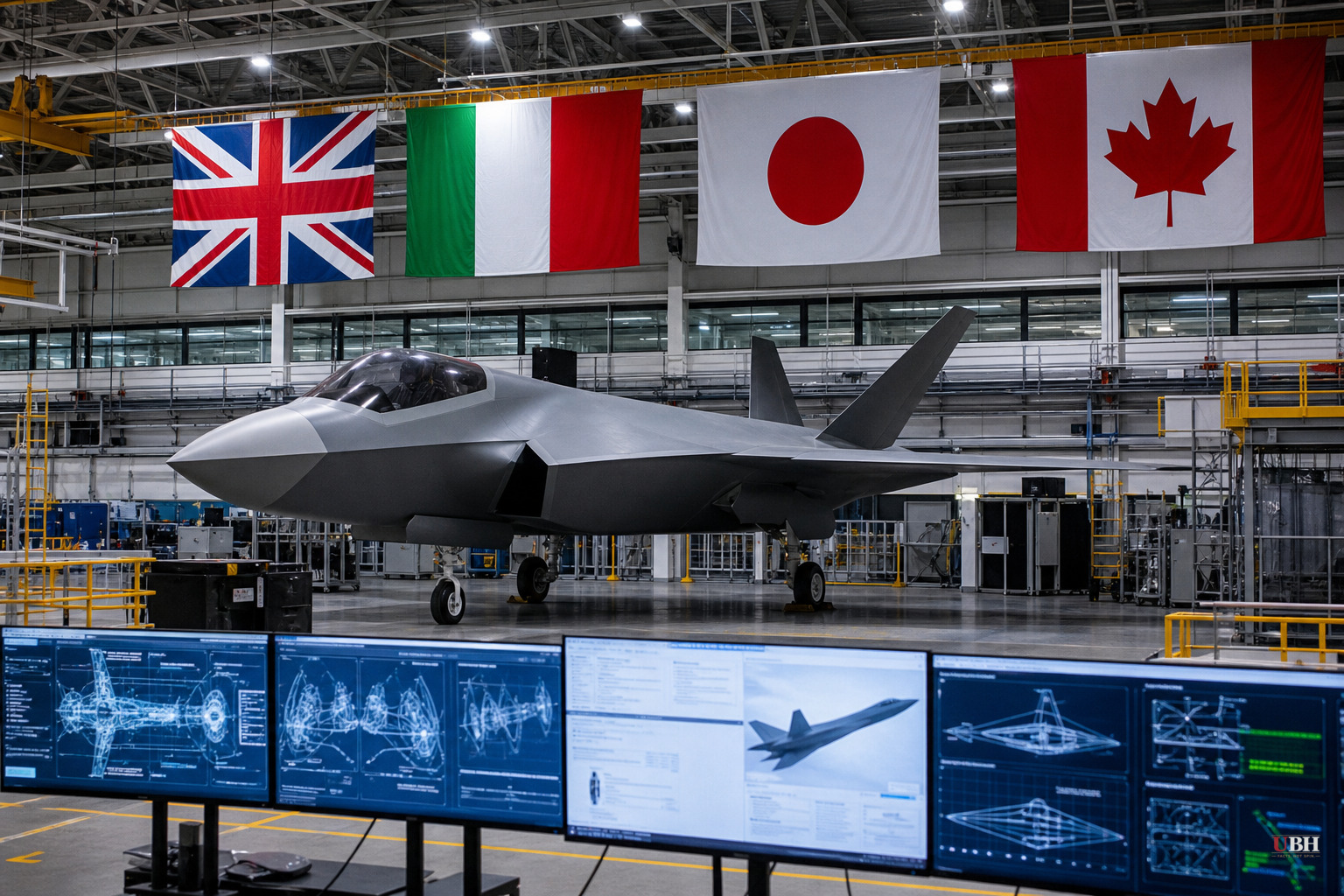
Canada signed on this week as the first observer nation in the Global Combat Air Programme, the sixth-generation fighter jet project run by the United Kingdom, Italy, and Japan. The British defense ministry confirmed the arrangement Tuesday, calling it the first expansion of GCAP beyond its three founding members since the program launched in December 2022, according to the South China Morning Post.
The deal gives Ottawa what the joint statement calls "enhanced insight" into the program's governance, industrial framework, and security requirements. It does not give Canada a vote. The observer status lets Canadian officials study the aircraft, its supporting drone "loyal wingman" systems, and the industrial supply chain before deciding whether to go further, per SCMP.
Defense Minister David McGuinty joined his British, Italian, and Japanese counterparts at Wellington Barracks in London on Monday to formalize the move, according to Defense One. UK Defense Secretary John Healey, serving under Prime Minister Keir Starmer, called the project "groundbreaking," according to Newsweek.
Not a replacement for the F-35, at least not yet
GCAP isn't expected to enter service until 2035. Canada's Boeing CF-18 Hornets were supposed to retire by 2020 and are already well past their planned service life. Ottawa had been expecting delivery of its final new F-35 by 2032, per Defense One and Forecast International's Defense Security Monitor. Even in the best case, a GCAP jet couldn't arrive in Canada until years after that.
McGuinty said as much directly this week: any GCAP involvement is a separate track from the ongoing F-35 review, according to Defense One. This isn't Canada quietly lining up a replacement aircraft. It's Canada buying itself a seat at the table for a program that might matter a decade or more from now.
The real driver is the Trump relationship
Canada's F-35 review didn't come out of nowhere. Ottawa originally committed to 65 F-35s back in 2010, scrapped that, ran a chaotic competition involving the Boeing Super Hornet and the Saab Gripen, fought a trade dispute with Boeing over subsidies, and eventually landed back on the F-35 anyway under Justin Trudeau, bumping the order to 88 jets, according to Forecast International.
Then Donald Trump returned to the White House. New tariffs hit Canada, including a 50 percent tariff on a range of Canadian imports, and Trump repeatedly floated annexing Canada as the "51st state," according to Newsweek. That rhetoric tanked the once-solid U.S.-Canada relationship and helped sink Trudeau's approval ratings, contributing to his exit as prime minister before the 2025 election, per Defense One.
His successor, Mark Carney, won that election on a promise to stand up to Trump in the trade fight. Since taking office, Carney has pushed to reduce Canada's reliance on American defense hardware and put the F-35 procurement under formal review, weighing whether to stick with a pure F-35 fleet or move to a mixed fleet that could include the Gripen, according to Forecast International. Canada is already contractually locked into its first 16 F-35s regardless of what the review decides.
The kill-switch rumor and why it stuck
Part of what's fueling Canadian unease, according to Newsweek, is a rumor that the U.S. built a "kill switch" into F-35s that would let Washington disable the jets of allied operators. Newsweek reports that rumor was debunked. But experts and officials still acknowledge the U.S. retains real leverage over F-35 operators through software updates and control of intelligence and mission data feeds that the jet depends on.
That's a fair concern to take seriously even after the specific kill-switch claim was knocked down. A NATO ally relying on a foreign supplier for the software and data backbone of its air force is a legitimate sovereignty question, not just political theater, especially with a U.S. president who has openly floated annexing the country flying the jets.
At the same time, the Royal Canadian Air Force itself has long preferred the F-35 on pure capability grounds, according to Defense One. The aircraft's political status in Ottawa appears to be a negotiating tool more than a reflection of what pilots and planners actually want to fly.
What happens next
Canada's F-35 review has no announced completion date in these sources. The GCAP observer arrangement gives Ottawa access to the program's design and industrial data without any commitment to buy the eventual aircraft, per SCMP. Whether Canada moves from observer to full or partial GCAP membership, sticks entirely with the F-35, or builds a mixed fleet with the Gripen remains an open question that will likely take years to resolve, well past the 2032 delivery date Canada originally penciled in for its last new F-35.
Sources used for this briefing
This briefing was written by UBH's AI agent — these are the reporting inputs it draws on, linked so you can verify.


