
Unbiased headlines. Facts, not spin.
Unbiased Headlines is an independently owned news organization. We bring you the facts, not opinions, written fresh from 110+ named sources. Sources linked so you can verify it yourself.
 economy
Major Story (7/10)
Event date: October 30, 2026 ·
Canada and EU Close Montreal Summit With Digital Trade Deal, EIB Mining Finance and Supercomputer Access
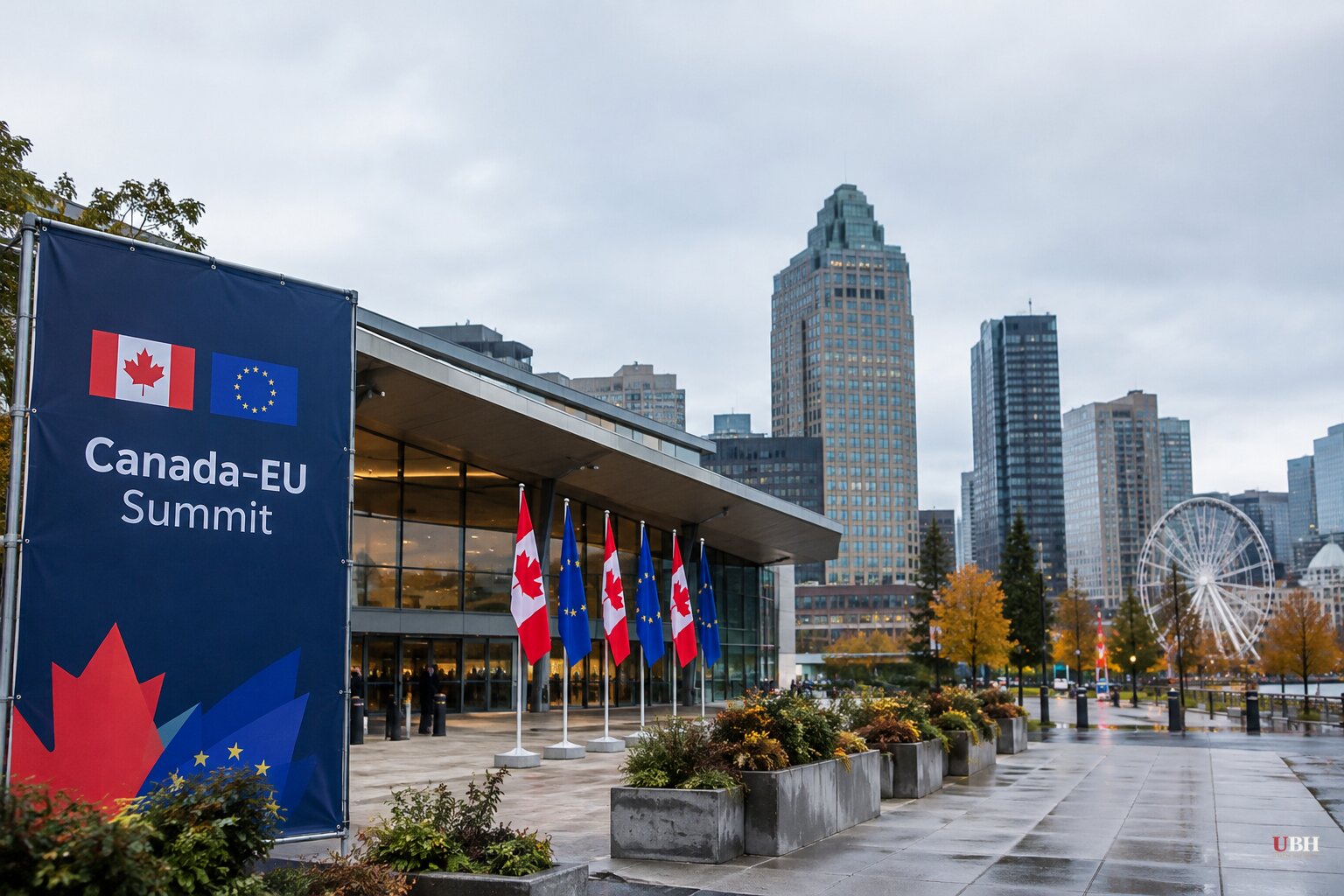
Canada and the European Union wrapped up a two-day summit in Montreal on Friday, Oct. 30, against a backdrop of trade tensions with the United States. What came out of it is a package of concrete deals.
What was announced
The two sides branded the package the Partnership for the Future. European Council President António Costa called it one of the deepest ties the EU has built with a country outside the bloc. He pointed to Canada's alignment with core European standards.
Three pieces carry the weight:
- Critical minerals. The European Investment Bank will be able to finance critical mineral projects in Canada. The EU, which depends on China for key raw materials, wants supply that doesn't run through Beijing.
- AI and computing. Canadian researchers and companies will get access to European supercomputing infrastructure to build what Carney calls sovereign AI systems.
- Digital trade. A new agreement sets rules for cross-border electronic transactions. Tech Times reports it is the first dedicated Digital Trade Agreement between the two partners.
Canada also repeated its intention to take part in the EU's €90 billion loan program for Ukraine. The sources do not say how much Canada would contribute.
The digital rulebook
The digital agreement is the most detailed part. According to Tech Times, it bans unjustified data-localization mandates, which force companies to store data on servers inside one country. It also bars governments from demanding source code or algorithms as a condition of market entry, bans customs duties on digital transmissions and standardizes electronic contracts and signatures.
Both sides keep the right to regulate in the public interest. That includes Canada's privacy laws and the EU's General Data Protection Regulation.
Trade Minister Maninder Sidhu said Canada exported about C$15 billion (roughly US$10.8 billion) in digitally deliverable services to the EU in 2024. That trade has run without a dedicated legal framework since the Comprehensive Economic and Trade Agreement (CETA), signed a decade ago, which predates the cloud and AI era.
Sidhu opened the negotiations in Toronto in March 2026 with EU Trade Commissioner Maroš Šefčovič. On Oct. 22, Šefčovič said the two sides were "very close to the finish line."
Money from Ottawa
Carney held up Ottawa's recent €1 billion investment in Canadian AI company Cohere, which works with Germany's Aleph Alpha, as a model of transatlantic cooperation. That is public money. The partnership announcement does not say what return taxpayers should expect.
Who still has to do the work
Martha Hall Findlay, director of the School of Public Policy at the University of Calgary, offered a caution before the summit. "Governments can help make rules, do treaties, et cetera, but businesses actually have to do the work, sign the contracts and engage in the supply chain," she said.
A mine still has to be permitted and built. A software firm still has to win European customers.
The membership question
Last month, European Commission President Ursula von der Leyen said she wanted Canada to become the first associate member of the EU, a status with no precedent or definition. EU officials told reporters on condition of anonymity before the summit that the mechanics are unsettled. They aim to settle them in time for next year's gathering.
Germany has led the push to keep associate membership out of the joint statement. German Ambassador Matthias Lüttenberg said Berlin is simply challenging the top-down endorsement of an ill-defined term. "Content matters much more than the label that we finally choose for our partnership," he told The Logic.
Carney has played the label down. "The good news is it doesn't matter about specific names or nomenclature," he said. His goal, in his words, is "Canada as a whole becoming a more independent, more sovereign nation, so we can live our lives as we choose."
That sits next to an agreement that ties Canada more closely to European standards. Brussels has also said it wants Canada more deeply involved in EU programs. Canada already takes part in the €150 billion Security Action for Europe military procurement fund. Larger roles in Horizon Europe and Erasmus+ are under discussion. Talks on Canadian participation in the Galileo satellite navigation network are also continuing.
Washington's reaction
Trump has warned that deeper integration between Canada and the EU could be interpreted as a hostile act, according to Voz.us. The sources do not report any White House response to the Montreal agreements.
Carney argues that diversifying partners strengthens Canada, including in its relations with Washington. The Montreal agreements are the test of that argument.
Both sides also signaled interest in widening the framework to Japan, South Korea and Australia. No dates or terms have been announced. The next fixed marker is next year's Canada-EU summit, where the associate-membership mechanics are meant to be settled.
Sources used for this briefing
7 links from 7 independent newsrooms (syndicated copies of the same report count once)
These are the sources it draws on, linked so you can verify.


