
Unbiased headlines. Facts, not spin.
Every story is an unbiased news briefing written from 110+ sources across the spectrum — sources linked so you can verify it yourself.
 economy
Major Story (7/10)
Event date: September 16, 2026
economy
Major Story (7/10)
Event date: September 16, 2026
California Regulators Advance $1.42 Billion Broadband Deal Tied to 14-Year Ban on Enforcing State Net Neutrality Law
The Vote and the Catch
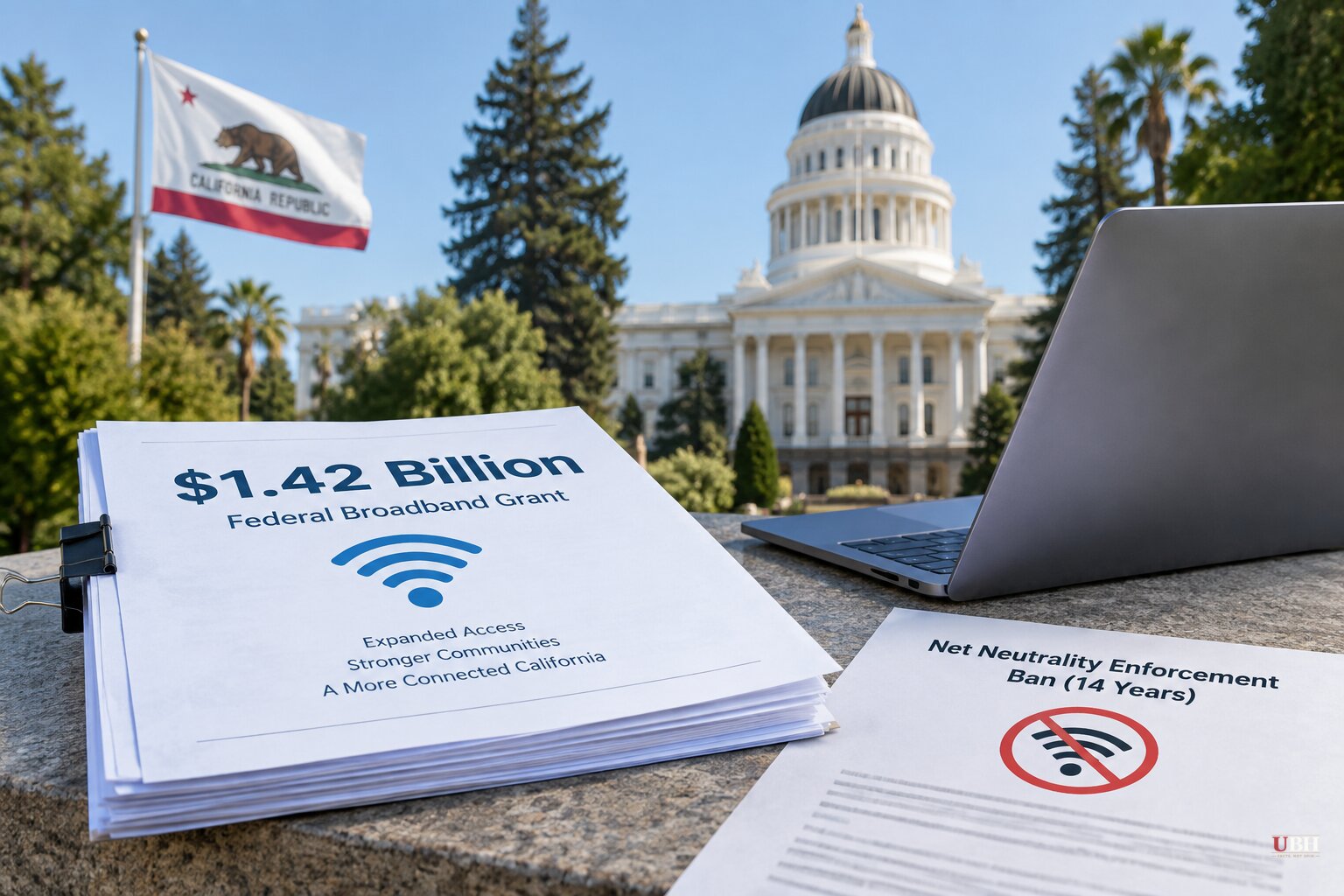
California's Public Utilities Commission voted Thursday, September 17, to authorize staff to take the "ministerial action necessary to implement and effectuate" the state's federal broadband buildout plan, according to CalMatters. The state is moving toward accepting $1.42 billion in federal money to wire up roughly 270,000 homes and businesses that still lack high-speed internet.
The grant includes a provision known as Condition 50. According to an analysis published this week by Stanford's Center for Internet and Society, the condition requires California to stop enforcing its net neutrality law, its broadband affordability rules, and its public-safety protections against any internet provider that takes the money, for roughly 14 years from when each provider's grant is finalized.
The restriction isn't limited to the rural areas the grant is actually paying to connect. Stanford's analysis says it covers every broadband service those providers offer anywhere in California, including their wireless networks. California would also have to write the same promise into its individual contracts with each funded provider, giving each one its own independent legal right to block state enforcement.
Where the Money Comes From, and Where It's Going
The Broadband Equity, Access, and Deployment program was created by the 2021 Infrastructure Investment and Jobs Act, a roughly $42.45 billion national effort to close the rural broadband gap. The National Telecommunications and Information Administration, now run under the Trump administration, approved California's deployment plan in July and issued a formal notice of award on August 31, giving the state 30 days to accept the money and terms. The commission has requested an extension of that deadline, CalMatters reported.
California's award shrank along the way. Tech Times reports the state's share was originally projected at $1.86 billion before the Trump administration restructured the program's bidding rules; the final award came in at $1.42 billion.
About 69% of that money goes to five large national providers, according to Stanford's analysis: Comcast ($400 million), AT&T ($331 million), Verizon/Frontier ($173 million), Amazon's Kuiper satellite service ($55 million), and SpaceX's Starlink ($22 million).
Why the 2018 Wildfire Keeps Coming Up
Every advocacy source in this fight points back to the same 2018 incident. During the Mendocino Complex Fire, then the largest wildfire in California history, Santa Clara County firefighters relied on a mobile hotspot to coordinate personnel and equipment. Verizon throttled the connection and, according to Stanford's account, refused to restore full speed unless the county upgraded to a pricier plan, forcing crews onto personal phones mid-emergency.
California responded in 2019 with a law banning ISPs from throttling first responders during declared emergencies. Condition 50 would suspend this protection for 14 years.
On affordability, the Electronic Frontier Foundation notes that California's approval of the Verizon-Frontier merger this year required the combined company to offer a $20-a-month internet plan to low-income residents. The California Public Utilities Commission found average broadband costs $51 a month across four major urban markets: San Mateo, Oakland, Los Angeles, and San Diego. EFF and Public Knowledge argue that gap adds up to billions in savings over the life of the merger condition, savings that Condition 50 would put at risk since the state couldn't enforce the deal it struck.
Public Knowledge's Harold Feld puts a number on the broader trade-off: he estimates Condition 50 could cost California between $5 billion and $16 billion in existing broadband benefits, against $1.42 billion in new federal money. That figure is Feld's own estimate, not an independently verified accounting, and Public Knowledge is an advocacy organization actively lobbying against the condition.
The Case for the Condition, and What's Missing From It
None of the available reporting includes NTIA or the Trump administration explaining, in its own words, why Condition 50 exists. CalMatters attributes the change generally to "deregulatory pressure from the broadband industry." The broader argument industry groups have made for years, independent of this specific fight, is that a patchwork of state-by-state net neutrality and rate rules raises compliance costs and discourages the kind of private investment BEAD is trying to attract to unserved areas. NTIA hasn't defended the specific terms on the record in these sources.
Public Knowledge also raises a further concern: that NTIA retains the power to "de-obligate" the grant, clawing back funds, if California adopts policies NTIA objects to, citing a hypothetical "burdensome AI law" as an example. That's a warning from an advocacy group about how the condition could be used, not a documented instance of NTIA doing so. No such action has been announced.
What Happens Next
Stanford's analysis argues Newsom doesn't have to choose between the money and the law. It says the state can challenge Condition 50 in court while still accepting the funds, as long as it acts before signing the final grant agreement.
Spokespeople for Newsom and the California attorney general's office did not respond to CalMatters' questions about whether they intend to challenge the condition. With the commission's acceptance clock still running toward its extended deadline, the open question is whether Newsom moves to challenge Condition 50 before California's signature makes it final.
Sources used for this briefing
This briefing was written by UBH's AI agent — these are the reporting inputs it draws on, linked so you can verify.


