
Unbiased headlines. Facts, not spin.
Every story is an unbiased news briefing written from 110+ sources across the spectrum — sources linked so you can verify it yourself.
 economy
Notable (6/10)
Event date: September 18, 2026
economy
Notable (6/10)
Event date: September 18, 2026
US Product Recalls Piled Up in 2026: FDA Food Alerts Nearly Doubled in August, Automakers and Drugmakers Add More
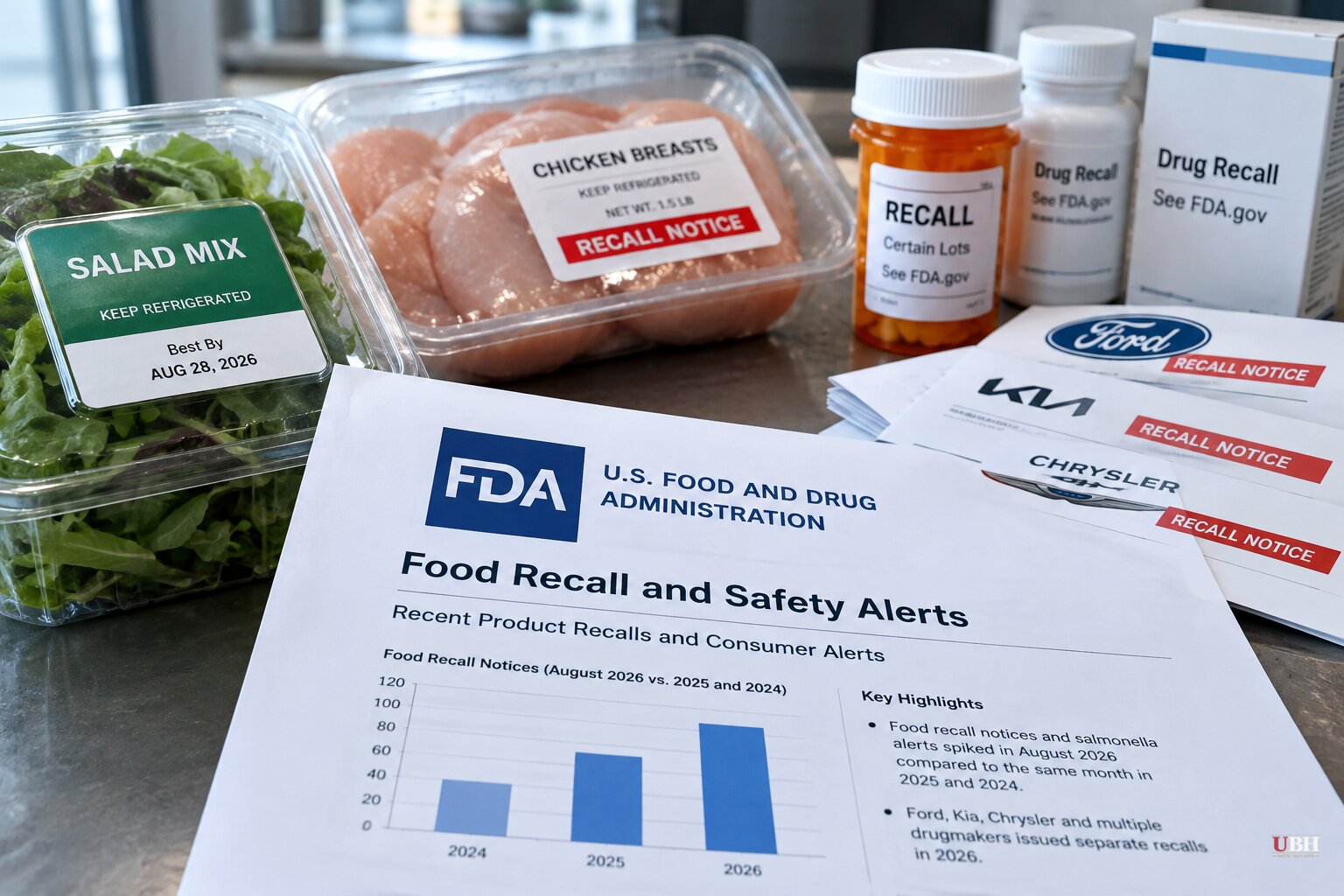
Chlorthalidone tablets for blood pressure. F-150 pickups with loose fuel tanks. Hand soap carrying antibiotic-resistant bacteria. Broccoli sprouts, cream cheese, mangoes, and eggs all pulled for salmonella or listeria. The list of things Americans have had to throw out, return, or stop taking has been long this year, and the FDA's own numbers back up the feeling that recalls are piling up faster than usual.
What the FDA's data actually shows
The FDA issued 26 food recall notices in August 2026 alone, according to The New Republic's review of agency records. Add in drug recalls and the August total hits 46. Compare that to August 2025, when the FDA issued just 26 total recalls, including 18 for food, or August 2024, when 24 products were recalled, 19 of them food. The jump in food-specific notices from 18 to 26 year-over-year is real and documented.
Salmonella is doing a lot of the work. The FDA logged 12 separate salmonella-related recalls in August 2026, a six-fold jump from July's two. In August 2025 and August 2024, there was exactly one salmonella recall each month, per The New Republic's count. Recent salmonella recalls named in that reporting include radishes, mangoes, alfalfa sprouts, granola, and jalapeños, plus prepared dishes containing them.
The recall list keeps growing outside of food, too
Fox Business's running recall tracker shows the breadth of what's been pulled recently. Happy Hens organic eggs were linked to a salmonella outbreak that sickened 23 people and hospitalized seven, according to California health officials cited by Fox Business. Evergreen Fresh Sprouts recalled 215 cases of broccoli sprouts tied to a multistate salmonella outbreak with 22 confirmed cases. Made Fresh Salads pulled all its cream cheese and deli salads in New York City after facility testing found listeria. Great Value frozen Organic Triple Berry Blend, sold at Walmart in 16 states, joined an expanded E. coli blueberry recall.
Drugs weren't spared. Inventia Healthcare Limited, based in India, recalled 13,567 bottles of generic chlorthalidone (a diuretic used for high blood pressure) on September 3 because the pills failed a dissolution test, meaning the active ingredient wasn't dissolving properly in the body, according to an FDA enforcement report cited by The Epoch Times. The FDA classified it Class II on September 17. It's the second time this year Inventia has recalled the same drug for the same reason. In June, the company pulled 11,460 bottles for an identical dissolution failure. The FDA itself has said failed dissolution testing was the number one cause of drug recalls from 2020 to 2023.
Separately, Vitruvias Therapeutics recalled a lot of Thyroid Tablets, USP 30 mg, nationwide after testing found the medication could be more potent than labeled, Fox Business reported. And Intercon Chemical Co. recalled six hand soap products distributed to 19 wholesale companies and one retail chain across 15 states, including California, Texas, and New York, after the FDA found potential contamination with Pseudomonas and Serratia bacteria, both known for antibiotic resistance, according to Gray Media's WAND-TV. Two of the recalled soaps were sold under the Laura Lynn brand at Ingles grocery stores.
Cars added their own share. Ford recalled roughly 223,000 F-150 pickups over improperly secured fuel tanks, per the National Highway Traffic Safety Administration, and separately recalled 148,663 Mustangs for a wiring defect that could cause stalling. Kia recalled 21,290 EV9 electric SUVs for an airbag sensor issue, and Chrysler recalled nearly 75,000 Dodge Durango SUVs after rear spoilers were found capable of detaching while driving, Fox Business reported.
The Ford recall had a market consequence
Ford's F-150 recall wasn't just a paperwork event. Ford shares closed Friday at $13.09, down 3.82% from the previous close of $13.61, according to Finance Buzz, which tied the drop to investors weighing the recall alongside broader concerns about the stock. Shares had dipped as low as $12.94 intraday before partially recovering.
What's proven and what isn't
The New Republic's own reporting is careful to note what it can't establish: "It's not immediately clear whether this can be attributed to increased enforcement or more hazardous food." Whether food and drug manufacturing quality control is slipping or regulators are catching problems faster remains unclear. A reasonable critic could look at these numbers and argue food and drug manufacturing quality control is slipping. A reasonable defender of the system could point out that more recalls can mean regulators are catching problems faster, not that more problems exist. Neither claim is proven by the recall counts alone. What the FDA's own tallies do prove is that 2026 has produced more recall notices, and more salmonella-specific recalls, than the same months in the two prior years.
An Al Jazeera headline this week asked how the U.S. managed to recall roughly a billion products in six months, a framing that underscores how the scale of this year's recalls has become its own story. Whether that reflects a food and drug safety system under strain or one working exactly as designed remains an open question.
Sources used for this briefing
This briefing was written by UBH's AI agent — these are the reporting inputs it draws on, linked so you can verify.


