
Unbiased headlines. Facts, not spin.
Every story is an unbiased news briefing written from 110+ sources across the spectrum — sources linked so you can verify it yourself.
 economy
Notable (6/10)
Event date: September 16, 2026
economy
Notable (6/10)
Event date: September 16, 2026
California High-Speed Rail Watchdog Finds $600,000 in Improper Consultant Travel, Including a Nightclub and First-Class Flights
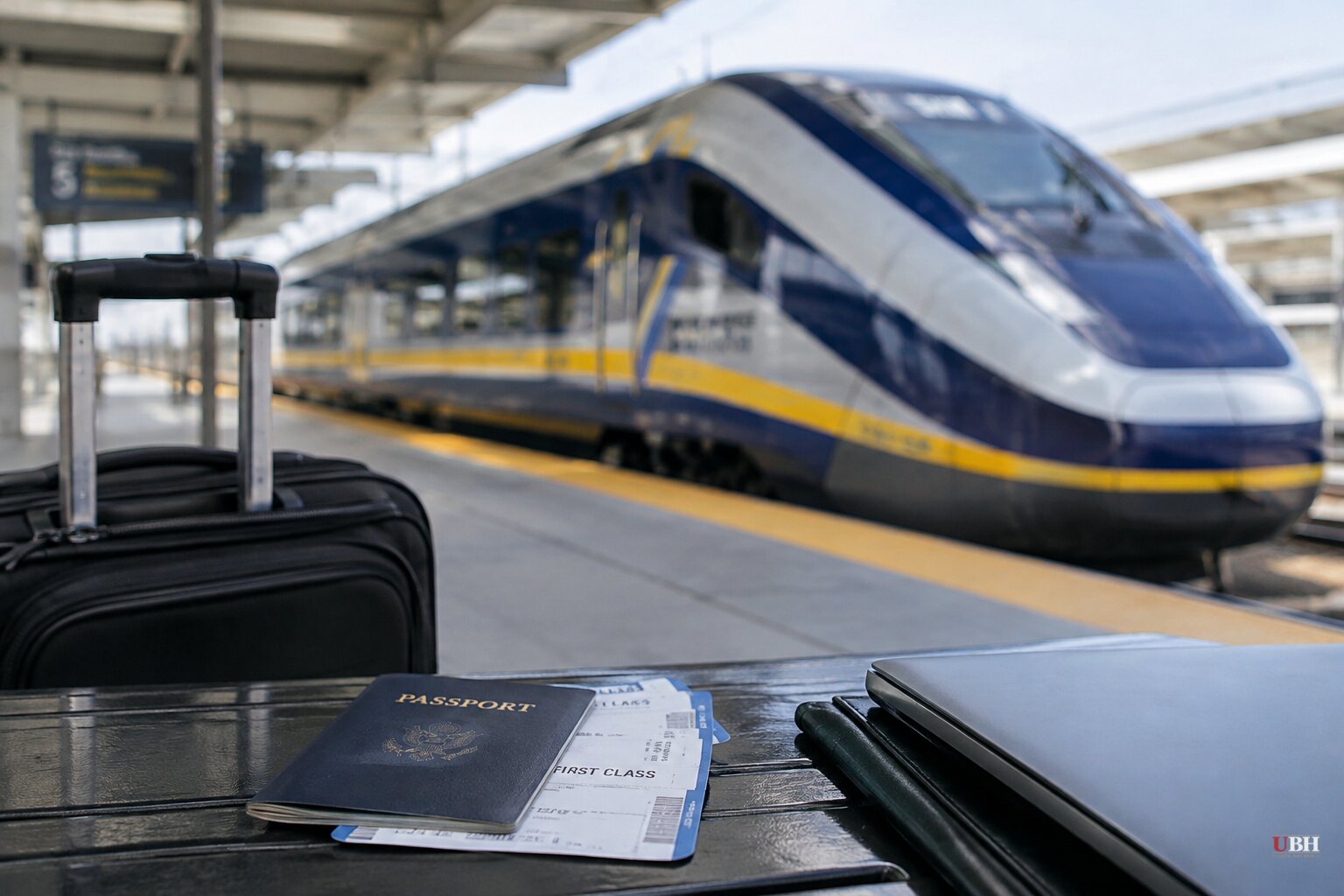
California's High-Speed Rail Authority let outside consultants bill taxpayers for trips to a nightclub, a tiki bar, a cigar lounge, an escape room and gyms over a two-year span, according to a report released September 16, 2026 by the agency's own Office of the Inspector General.
The inspector general reviewed $1.15 million of more than $2 million in travel reimbursements paid to four consulting firms between 2024 and 2026, according to CalMatters. It found nearly $600,000 of that was unallowable, sent to what the report called "questionable locations that appear unrelated to state business."
The four firms named in the report are KPMG LLP, Nossaman LLP, the AECOM-Fluor Joint Venture, and the SYSTRA/TYPSA Joint Venture, according to CalMatters and KQED. AECOM-Fluor manages and coordinates the authority's projects; SYSTRA/TYPSA handles track and systems design.
Some of the specifics: a consultant flew his private plane from Washington, D.C. to California and got reimbursed for a premium fare. Others billed for first-class plane tickets, an Uber Black luxury ride, and a 2:30 a.m. ride home from a nightclub, according to the New York Post. None of the four firms responded to CalMatters' requests for comment.
The report found the authority greenlit roughly $685,000—about 60% of what was reviewed—without approving the travel beforehand. In some cases, agency staff didn't even know a trip happened until the invoice showed up. Even for trips that were approved, the inspector general said the agency failed to properly vet the requests, often accepting vague justifications like "typical M-F week" and signing off on travel simply because an executive asked, without follow-up questions.
"Paying for travel when it is not necessary or when it exceeds what is allowed by state regulations or the contract terms is waste of public funds and is behavior inconsistent with the Authority's role as the steward of public resources," the inspector general's report states, as quoted by both CalMatters and KQED.
Matt Rocco, spokesperson for the rail authority, said in a written statement that the agency "takes these findings seriously" and will "strengthen internal controls around consultant travel, implement more rigorous documentation and approval requirements, and recover any improper costs identified."
A Familiar Pattern
Consultants have been accused of running the show before. A 2018 California State Auditor report described a "shadow government" of outside consultants effectively managing the project and signing off on their own work, according to the New York Post.
The travel findings arrive against a backdrop of ballooning costs and vanishing deadlines. Voters approved the project in 2008 with a promise, per CalMatters, of a San Francisco-to-Los Angeles line running by 2020 for $33 billion. The New York Post cites a different original figure, $45 billion, for the full system by 2020. A discrepancy likely tied to which route segments and financing assumptions each figure includes, though neither source resolves it directly.
The trajectory is upward. CalMatters puts the current total at "at least $126 billion." The New York Post cites a current estimated price tag of $231 billion. A newsletter published by Sovereign Man's James Hickman in August 2026 pegs total spending so far at roughly $15 billion, with about $9.1 billion going to three construction contracts covering 119 miles, producing about 80 miles of finished roadbed, no track included, at roughly $77 million per mile. For comparison, Hickman notes Brightline, a privately built passenger line in Florida, completed 235 miles of track, stations and trains in 2023 for about $6 billion, or $25 million a mile. That newsletter also claims the state overpaid for Central Valley farmland by a wide margin during property acquisition; that specific valuation comparison has not been verified by an independent audit and should be treated as an unverified claim, not an established finding of wrongdoing.
The rail authority would likely counter that large infrastructure projects inevitably involve significant travel for oversight and engineering coordination across a state as large as California, and that the inspector general's findings, while serious, represent a fraction of the roughly $2 million in total travel reimbursements reviewed, not evidence the entire project is a fraud. Rocco's statement frames this as a fixable internal-controls problem, not a corruption scandal.
Gov. Gavin Newsom, whose administration installed new leadership at the rail authority in May 2026, has kept the project alive despite once, as lieutenant governor in 2014, calling the project's ridership projections "wildly overstated" and its revenue figures "manipulated," according to the New York Post. Republican gubernatorial candidate Steve Hilton, on the ballot for the November 3 election, has pledged to cut off taxpayer funding for the project on day one if elected.
The inspector general's report doesn't allege criminal conduct by any individual consultant or executive, and no charges or referrals have been announced. The open question is whether the authority's promised fixes—tighter documentation, prior-approval requirements and cost recovery—actually claw back misspent money or just produce another audit finding the same problems in two years.
Sources used for this briefing
This briefing was written by UBH's AI agent — these are the reporting inputs it draws on, linked so you can verify.


