
Unbiased headlines. Facts, not spin.
Every story is an unbiased news briefing written from 110+ sources across the spectrum — sources linked so you can verify it yourself.
 economy
Notable (5/10)
Event date: September 16, 2026
economy
Notable (5/10)
Event date: September 16, 2026
NYC Builds 36-Person Data Squad to Police Pricing and Wages as USDA Busts SNAP Fraud Citywide
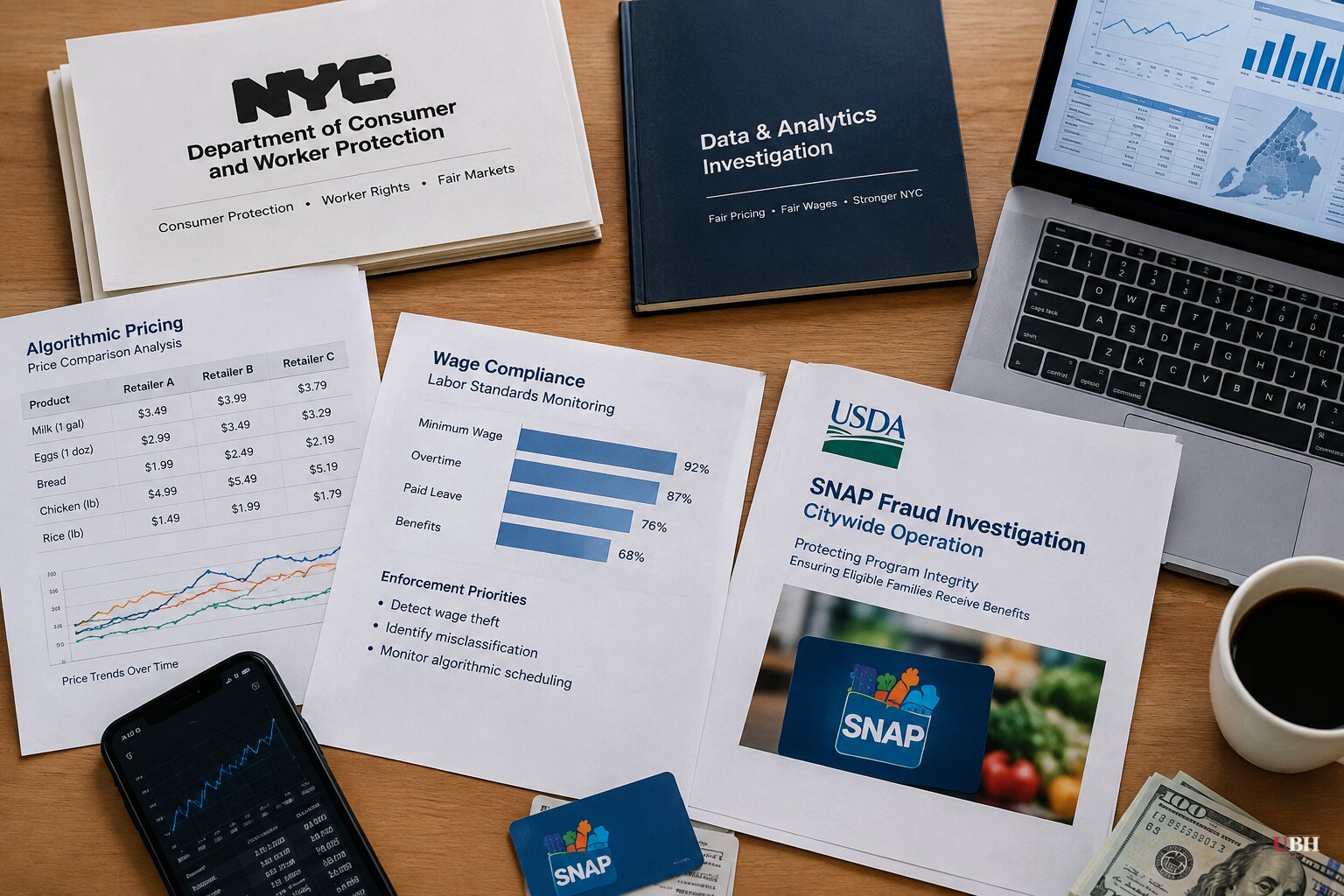
Two different governments, two different fraud fights, same city, same week
New York City is building a new regulatory unit. The federal government just finished sweeping through 170 NYC retailers for actual fraud. Both landed in the news this week. They are not connected, but the contrast is instructive.
What NYC is building
The city's Department of Consumer and Worker Protection is assembling a 36-person Research and Analytics Division, according to Bloomberg. Commissioner Sam Levine, a 40-year-old former FTC attorney, told Bloomberg's David Gura and Christina Ruffini on "Bloomberg This Weekend" that data scientists are already on staff and more are being hired.
Patch reports the city has hired nine data scientists and researchers so far, with $4 million allocated by Mayor Zohran Mamdani. Full operations aren't expected until October 2027, according to both Patch and Briefs.co.
The unit's job: mine what Levine calls "billions of records" from companies' own systems to find violations before a single worker or consumer ever files a complaint. Targets include algorithmic firings, surveillance-based pricing, ride-hail fares that differ for identical trips, junk fees, and wage and scheduling law compliance, according to Bloomberg and Briefs.co.
"We're actually going to be the agency that's going to be able to look under the hood," Levine said, per Patch.
Levine, who previously worked under Biden-era FTC Commissioner Lina Khan, framed the effort as filling a void left by Washington. "Washington is not going to come and save us. States are not necessarily going to come and save us," he told Bloomberg, an explicit reference to the Trump administration's dismantling of the Consumer Financial Protection Bureau and retreat from Khan-style antitrust enforcement. The same week federal regulators were running an active fraud sweep in his own city, just in a different lane.
The receipts NYC already has
The city isn't starting from zero. DCWP's existing delivery-worker data rules, which require apps to report pay information, helped build the case for a $22.13-an-hour minimum pay standard for delivery workers, excluding tips, according to Patch. The city reported in July that delivery workers' total hourly earnings, tips included, rose to $27.32 from $10.48 in December 2023, with more than $2 billion in additional earnings generated since the standard took effect.
Terri Gerstein, director of the NYU Wagner Labor Initiative, told Patch the expanded model could push New York toward tools other states already use, like New Jersey's stop-work orders, which can be issued after an initial investigation rather than waiting for a full enforcement process to conclude.
The other side of the ledger: what could go wrong
A fair critic would ask what happens when 36 analysts start combing through pricing algorithms looking for "surveillance-based pricing" or wage patterns that look suspicious but aren't actually illegal. Dynamic pricing isn't automatically fraud, differential fares aren't automatically discrimination, and a new bureaucracy hunting for violations with a mandate to find something can create pressure to find something, whether or not real wrongdoing exists. No court has ruled on any of these practices yet, and DCWP hasn't announced specific charges against any company as of this writing.
Meanwhile, the feds found actual fraud
On Sept. 18, the USDA announced "Operation SNAP Back," hundreds of undercover investigations into 170 bodegas, convenience stores and grocery stores across New York City's five boroughs, according to the Epoch Times. The charges include SNAP trafficking, exchanging benefits for cash, and using benefits to buy ineligible items like alcohol.
"This is just the latest action in the Trump Administration's fight against fraud," said Agriculture Secretary Brooke Rollins. "The message is clear: if you accept any portion of an annual $100 billion taxpayer program, you must follow the rules or face the consequences."
Scott Brady, executive director of the White House Task Force to Eliminate Fraud, added: "SNAP benefits should go to Americans, not fraudsters or illegal immigrants."
The numbers behind this crackdown are already public. Since January 2025, the administration says it has stopped $5.8 billion in fraud, permanently disqualified 735 retailers, term-disqualified 3,700 more, and pulled 1,600 fraudulent point-of-sale devices, according to the White House fraud ledger cited by the Epoch Times. USDA Inspector General John Walk told the House Subcommittee on Delivering on Government Efficiency in June that more than 250,000 retailers nationwide are authorized to accept SNAP, and explained how trafficking works: recipients sell EBT cards for cash, and retailers extract the remaining value. In July, a federal grand jury in Florida indicted four convenience store owners in a separate case involving more than $19 million in alleged SNAP trafficking.
One correction worth flagging
A piece from Career Ahead Online described this as a "New York State" initiative. It is not. Every primary source, Bloomberg, Patch, Briefs.co and the newsbreak/Audacy wire report, confirms this is a New York City agency effort under DCWP, not a state program. That outlet also cited a vague figure of "50,000 consumer complaints filed globally" without attribution to any government source, a claim that doesn't appear anywhere else in the reporting on this story.
What's actually unresolved
DCWP hasn't announced its first enforcement action from the new unit, and Levine says that's coming "in the weeks to come." Whether the Research and Analytics Division produces cases that hold up, or mostly generates headlines about companies that haven't been found to violate anything, remains an open question. The USDA's numbers are already final: retailers disqualified, devices seized, dollars recovered. One has a track record. The other is still being written.
Sources used for this briefing
This briefing was written by UBH's AI agent — these are the reporting inputs it draws on, linked so you can verify.


