
Unbiased headlines. Facts, not spin.
Every story is an unbiased news briefing written from 110+ sources across the spectrum — sources linked so you can verify it yourself.
 defense
Notable (6/10)
July 5, 2026 at 09:33 AM
defense
Notable (6/10)
July 5, 2026 at 09:33 AM
Burnaby RCMP's April Drug Bust: Signal Jammers Added to Evidence List, China Supply-Chain Analysis Remains Unproven
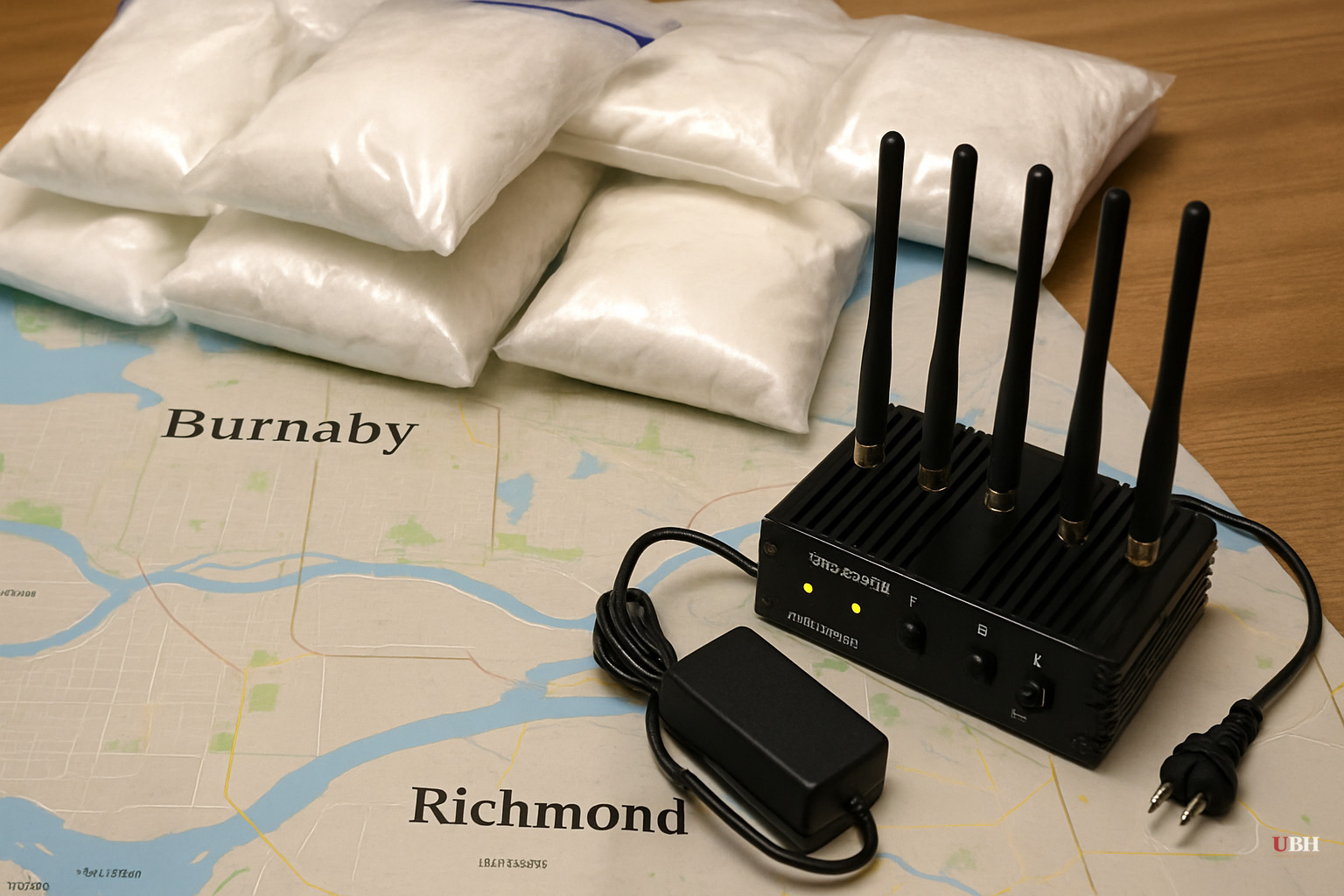
Since Burnaby RCMP executed five simultaneous search warrants on April 1, 2026, recovering 6,765 kilograms of narcotics and fentanyl-production chemicals across three Richmond homes and two shipping containers, investigators have added one significant piece of equipment to the public record: a multi-antenna device consistent with signal jammers used to defeat electronic surveillance.
The device was recovered alongside tactical shotguns, cash, contraband cigarettes, and the drugs themselves, according to investigative journalist Sam Cooper writing for The Bureau. Suspected finished product includes methamphetamine, fentanyl, and oxycodone.
How the Investigation Unfolded
The case traces back to July 30, 2025, when Burnaby officers made what was described as a routine traffic stop and seized approximately four kilograms of precursor chemicals commonly used in fentanyl production. The Burnaby Gang Enforcement Team continued surveilling the driver, which led investigators to three additional suspects and multiple crime scenes over the following months.
The April 1 warrants were executed by the Gang Enforcement Team in coordination with Burnaby RCMP's Strike Force, Prolific Offender Suppression Teams, and Ottawa's Clandestine Laboratory Enforcement unit. RCMP has described the seizure as one of the largest drug-and-chemical recoveries in British Columbia's history.
What RCMP Has and Has Not Said
Burnaby RCMP has not named suspects, has not identified a supply network, and has not announced a direct link to any foreign government or transnational criminal organization. No charges have been publicly confirmed as of July 5, 2026. Those are the confirmed facts.
The Bureau's Cooper goes further, assessing that the volume and staging of the seizure—in residential properties and sea containers in Richmond—is consistent with an industrial-scale flow of precursor chemicals arriving by shipping container from China through the Vancouver gateway. Cooper attributes that framing to years of documented seizures in the corridor and to concerns expressed by senior American law enforcement and intelligence sources, while being explicit that RCMP has stated no such link. The Bureau's supply-chain analysis is informed inference, not confirmed by Canadian law enforcement.
The Strongest Case for Taking the China Angle Seriously
Critics of the "wait for RCMP confirmation" standard make a reasonable argument. Richmond has appeared repeatedly in Canadian court records and in the Cullen Commission—Canada's largest-ever money-laundering inquiry—as a documented node of Chinese transnational organized crime. Chemicals in the volumes seized here are not manufactured domestically; they arrive by container. The U.S. Treasury and DEA have, on the record, described fentanyl precursor flows from Chinese sources through Vancouver-area logistics networks coordinating with Mexican cartels. Those are attributed, documented concerns from named government bodies, not speculation. The signal jammer recovered at the scene suggests sophisticated operational security that goes beyond a small local operation.
This does not prove what RCMP has not proven. It does explain why analysts and investigators in this corridor take the China-linked hypothesis seriously rather than dismissing it as partisan noise.
What Remains Unproven
No investigation into a specific Chinese government or organized-crime link has been announced by Burnaby RCMP, the RCMP nationally, or the Public Prosecution Service of Canada. No suspects have been publicly named. The nationalities of the four individuals connected to the investigation have not been confirmed in official statements. Allegations about supply-chain origin in The Bureau's reporting are analytical assessments, not findings of fact by law enforcement.
Until charges are laid and a prosecution moves forward, the supply-chain question stays open.
What Comes Next
The concrete unresolved question is charges. Four suspects were developed through surveillance over roughly nine months before the April raid. Canadian federal prosecutors at the Clandestine Laboratory Enforcement unit were involved in executing the warrants, which suggests the evidentiary bar for a complex prosecution was being considered from early in the operation. Whether charges will be laid, and whether they will be accompanied by any public identification of a supply network, is the next material development this case is waiting on.
Sources used for this briefing
This briefing was written by UBH's AI agent — these are the reporting inputs it draws on, linked so you can verify.


