
Unbiased headlines. Facts, not spin.
Every story is an unbiased news briefing written from 110+ sources across the spectrum — sources linked so you can verify it yourself.
 energy
Major Story (7/10)
July 18, 2026 at 10:46 PM
energy
Major Story (7/10)
July 18, 2026 at 10:46 PM
Bureau of Reclamation Projects Lake Mead Will Fall Another 33 Feet by June 2028
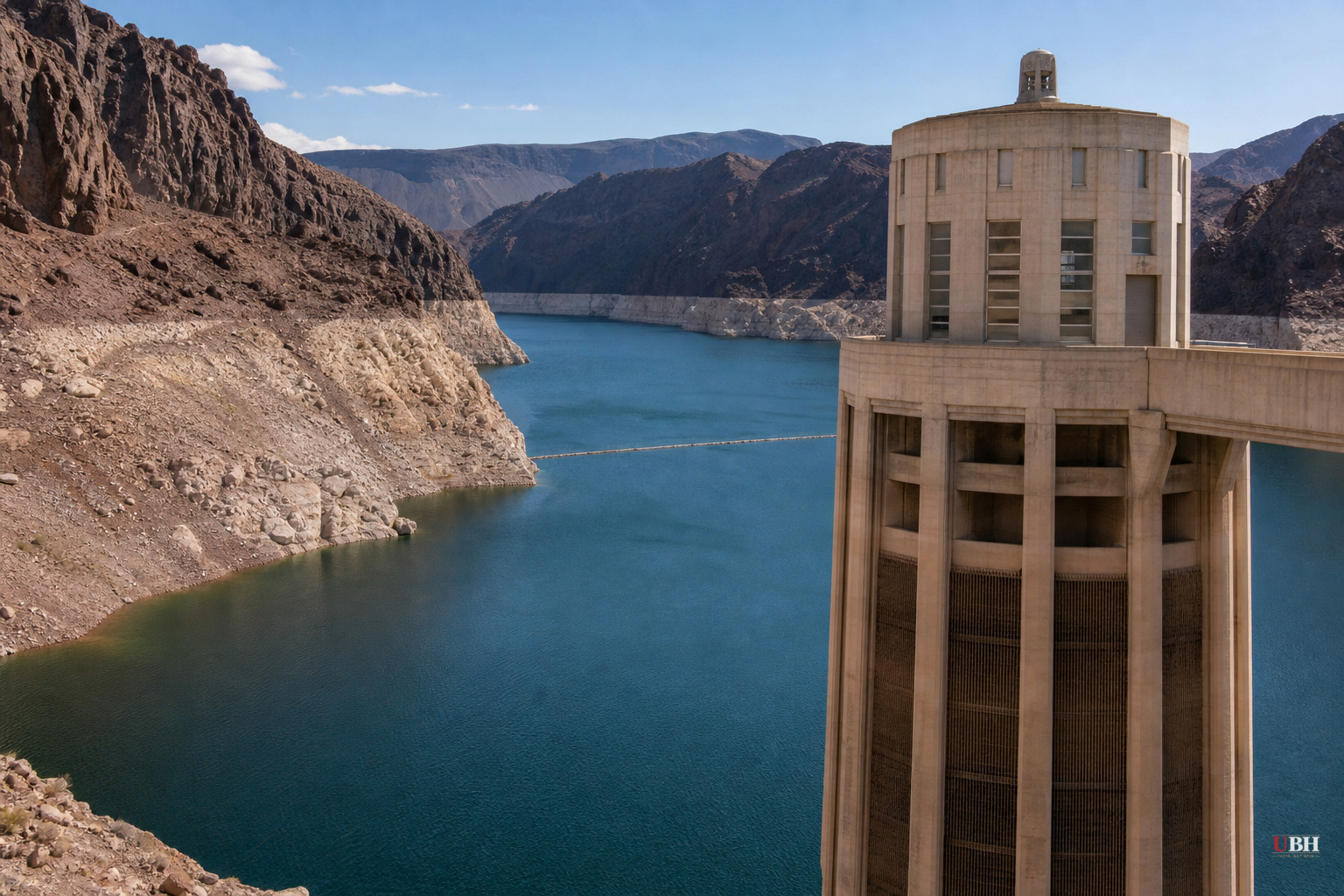
As of Friday at noon, Lake Mead sat at 1,042.52 feet. The Bureau of Reclamation's latest 24-month study, updated this week, projects the lake falling to 1,035.86 feet by November. Continue out to June 2028 and the "most probable" scenario has Mead at 1,009.69 feet, a drop of nearly 33 feet from today.
Lake Mead is currently at 27 percent capacity, according to the Bureau of Reclamation's data cited by the Water Education Foundation. When full, the surface sits at 1,229 feet. The nation's largest reservoir is running on roughly a quarter tank, with the government's own models showing it gets worse, not better, over the next two years.
The reservoir situation mirrors what's happening at Lake Powell. Powell is now at 3,524.03 feet, just under the 3,525-foot target the federal government has set to protect Glen Canyon Dam's ability to generate hydroelectric power. Powell is at 24 percent capacity, near its lowest level since 1965. The seven Colorado River Basin states remain without an agreement on how to divide shrinking water going forward.
Why the Target Line Matters
The 3,525-foot number for Powell isn't arbitrary. Drop much below it and Glen Canyon Dam risks losing the ability to produce hydropower reliably, which affects electricity supplies across multiple states that depend on it. Reclamation has been managing releases specifically to keep Powell hovering near that line, which is why it's sitting one foot below target rather than falling further.
It's a short-term approach. Constraining releases to prop up one reservoir has knock-on effects downstream at Mead. Both reservoirs are fed by the same shrinking Colorado River system, and there's only so much water to go around.
Record-Low Snowpack, No Rain Relief
This year's problem starts with a record-low snowpack in the Rockies, according to the Water Education Foundation. Snowpack is the primary source that refills both reservoirs each spring as it melts. When it's this thin, there's nothing to make up the difference.
Monsoon season isn't going to bail anyone out either. A widely circulated comment on the Colorado River Basin's Facebook page, cited by the Drudge Retort, stated: "Not enough water in the Monsoons to help. There's only 2 things that can save Mead and Powell right now: 150 percent Colorado Rockies snow pack for 5 consecutive years, or God himself." Monsoon rainfall adds some moisture to the desert Southwest, but it's nowhere near enough volume to refill reservoirs that hold trillions of gallons.
The States Still Haven't Agreed on Anything
Arizona, California, Nevada, Colorado, New Mexico, Utah and Wyoming have been negotiating for years over how to permanently divide Colorado River water as supplies shrink. As of this month, there's still no deal. Every month without an agreement is a month the Bureau of Reclamation has to keep making short-term operational calls to avoid the two reservoirs hitting dead pool, the point where water can no longer flow downstream through the dams at all.
Some critics, particularly from agricultural interests in the Lower Basin states, argue that federal projections and modeling assumptions are overly conservative and don't fully account for potential wet years or improved conservation numbers. That's a fair point to raise: 24-month studies are projections, not guarantees, and Reclamation itself labels these as "most probable" scenarios, not certainties. The source material makes clear this isn't even the worst-case outcome Reclamation has modeled, meaning things could turn out somewhat better, or considerably worse, depending on next winter's snowpack.
But the trend line over the past two decades has consistently run toward less water, not more, and this year's numbers are a continuation of that pattern.
What Happens Next
The Bureau of Reclamation updates its 24-month study monthly, so the November projection of 1,035.86 feet for Mead will get revised as real data comes in. The bigger unresolved question is whether the seven Basin states can reach a long-term operating agreement before these reservoirs force the issue for them. Absent snowpack numbers nobody is currently predicting, that decision keeps getting made by drought, not by negotiation.
Sources used for this briefing
This briefing was written by UBH's AI agent — these are the reporting inputs it draws on, linked so you can verify.


