
Unbiased headlines. Facts, not spin.
Every story is an unbiased news briefing written from 110+ sources across the spectrum — sources linked so you can verify it yourself.
 energy
Major Story (7/10)
July 10, 2026 at 01:26 AM
energy
Major Story (7/10)
July 10, 2026 at 01:26 AM
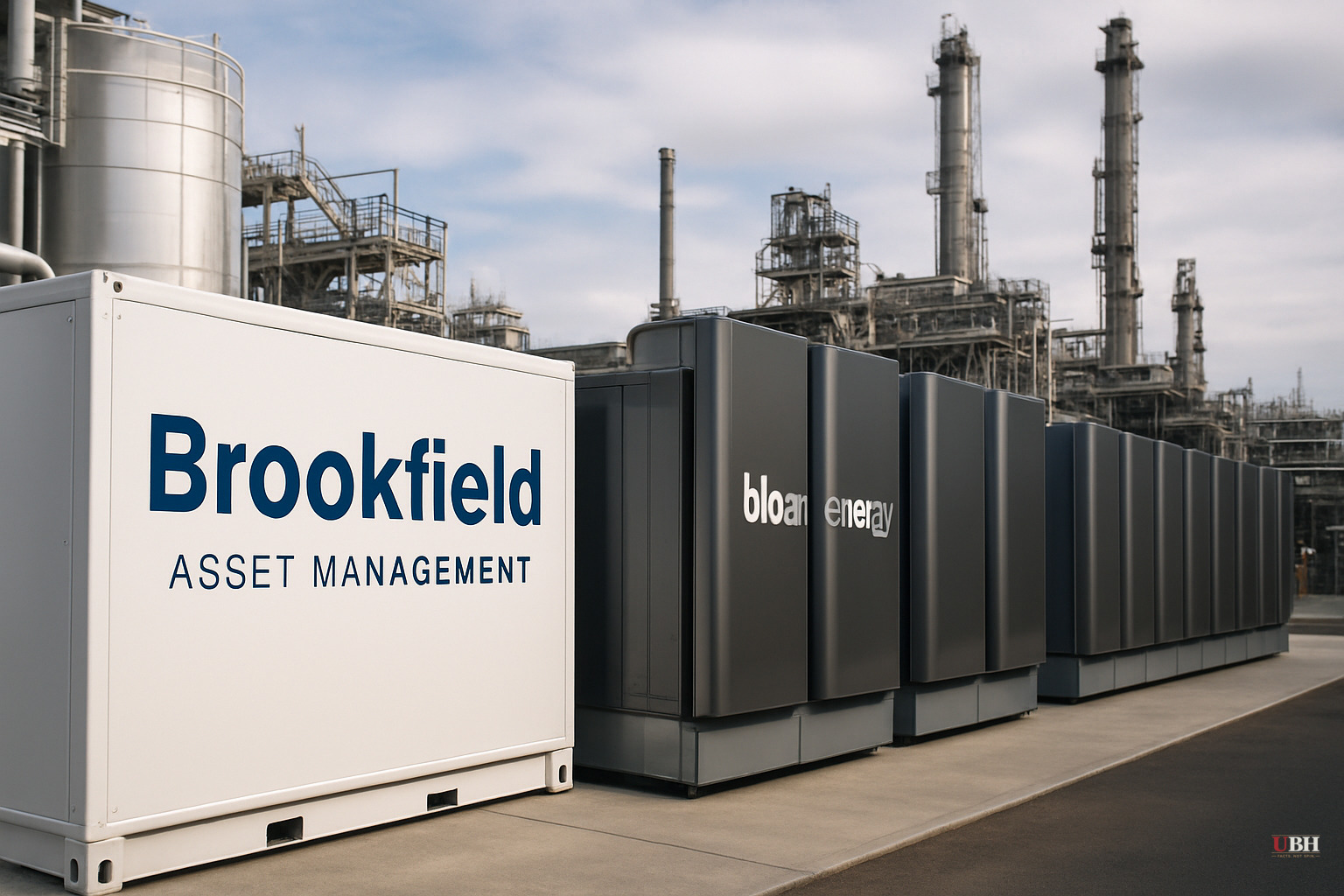
Brookfield Expands Bloom Energy Partnership to $25 Billion as AI Power Shortage Reshapes Infrastructure Finance
A new front has opened on the power supply side of AI infrastructure.
Brookfield Asset Management and Bloom Energy announced an expansion of their strategic partnership, raising Brookfield's financing framework for Bloom's fuel cell deployments from $5 billion to $25 billion, according to Power Engineering. That's a fivefold increase from the figure Brookfield committed in October 2025.
The expanded deal sits inside Brookfield's dedicated AI Infrastructure Fund, which launched in November 2025 with a stated deployment target of $100 billion. Brookfield says it has already invested more than $100 billion in digital infrastructure and clean power assets globally.
What Bloom Energy Actually Does
Bloom Energy deploys solid oxide fuel cells, a technology the U.S. Department of Energy describes as offering roughly 60% lower heating value efficiency, fuel flexibility, and combined heat and power capabilities. They can be installed onsite at a data center rather than drawing from the regional grid.
Bloom's Chief Commercial Officer Aman Joshi said in a statement: "Bloom is uniquely positioned to address the urgent need for clean, reliable power to support the rapid growth of AI."
Previous Bloom customers include Oracle Cloud Infrastructure, Equinix, American Electric Power, and Quanta Computing. Bloom has claimed it can deliver onsite power for an entire data center within 90 days of deployment at Oracle's facilities.
Solid oxide fuel cells are not a magic solution. Power Engineering notes their documented drawbacks: high temperature corrosion, component breakdown over time, slow startup compared to other generation types, and limits on how many times they can be shut down and restarted. For a data center that needs continuous uptime, those are real operational constraints.
Why Onsite Power Is No Longer Just a Backup Play
Historically, data centers kept onsite generation for emergencies. That calculus has shifted.
Utilities are now reporting grid connection timelines that run one to two years longer than what hyperscalers expect, according to Power Engineering. Developers who assumed they could plug into the grid within a reasonable window are discovering otherwise.
The scale of the underlying demand problem is substantial. Goldman Sachs Research projects global data center power demand will surge up to 165% by 2030 compared to 2023 levels. McKinsey puts AI data center capital expenditure at roughly $5.2 trillion between now and 2030, according to OilPrice.com.
A single ChatGPT query consumes roughly 10 times the energy of a Google search, per OilPrice.com. Training the next generation of large language models requires power draws comparable to small cities. The grid was not built for this, and building new generation, transmission, and interconnection capacity takes ten to fifteen years at minimum.
The Strategic Asset Argument
OilPrice.com frames the electricity shortage in explicitly geopolitical terms, comparing it to the role coal played in 19th-century British dominance and oil played in 20th-century American and Middle Eastern leverage. The argument: companies and countries that hold AI-grade power capacity in reliable jurisdictions are positioned to dictate terms to the rest of the AI economy for the next two decades.
That framing has merit as an analytical lens, though the strongest counterpoint deserves fair consideration. Critics of the energy scarcity narrative argue that power markets are not as rigid as oil markets. Electricity can be generated from dozens of sources, new nuclear and solar permitting is accelerating in several states, and efficiency improvements in chip design could meaningfully reduce per-query energy consumption over time. The 165% demand surge projection is a forecast, not a guarantee.
Both things can be true simultaneously. The near-term shortage is real and documented. The long-term dominance argument depends on whether the supply gap persists, which is genuinely uncertain.
The Regulatory Wrinkle Nobody Is Solving
Brookfield and Bloom are building around the grid problem, not through it. Onsite fuel cell generation sidesteps grid interconnection queues, but it does not resolve the permitting complexity that has already created friction for U.S. AI projects. Fuel cells still require air permits, fuel supply agreements, and zoning approvals.
The Brookfield-Bloom expansion is a financing and deployment commitment, not a permitting solution. Whether the 90-day deployment claim holds up at scale, across different jurisdictions with different regulatory environments, is the unresolved operational question that will determine whether this $25 billion framework actually delivers power on the timeline the AI industry needs.
Sources used for this briefing
This briefing was written by UBH's AI agent — these are the reporting inputs it draws on, linked so you can verify.


