
Unbiased headlines. Facts, not spin.
Unbiased Headlines is an independently owned news organization. We bring you the facts, not opinions, written fresh from 110+ named sources. Sources linked so you can verify it yourself.
 energy
Breaking / Critical (9/10)
Brent Trades Above $111 and WTI Tops $110 as Houthis Claim Strikes on Saudi Oil Sites
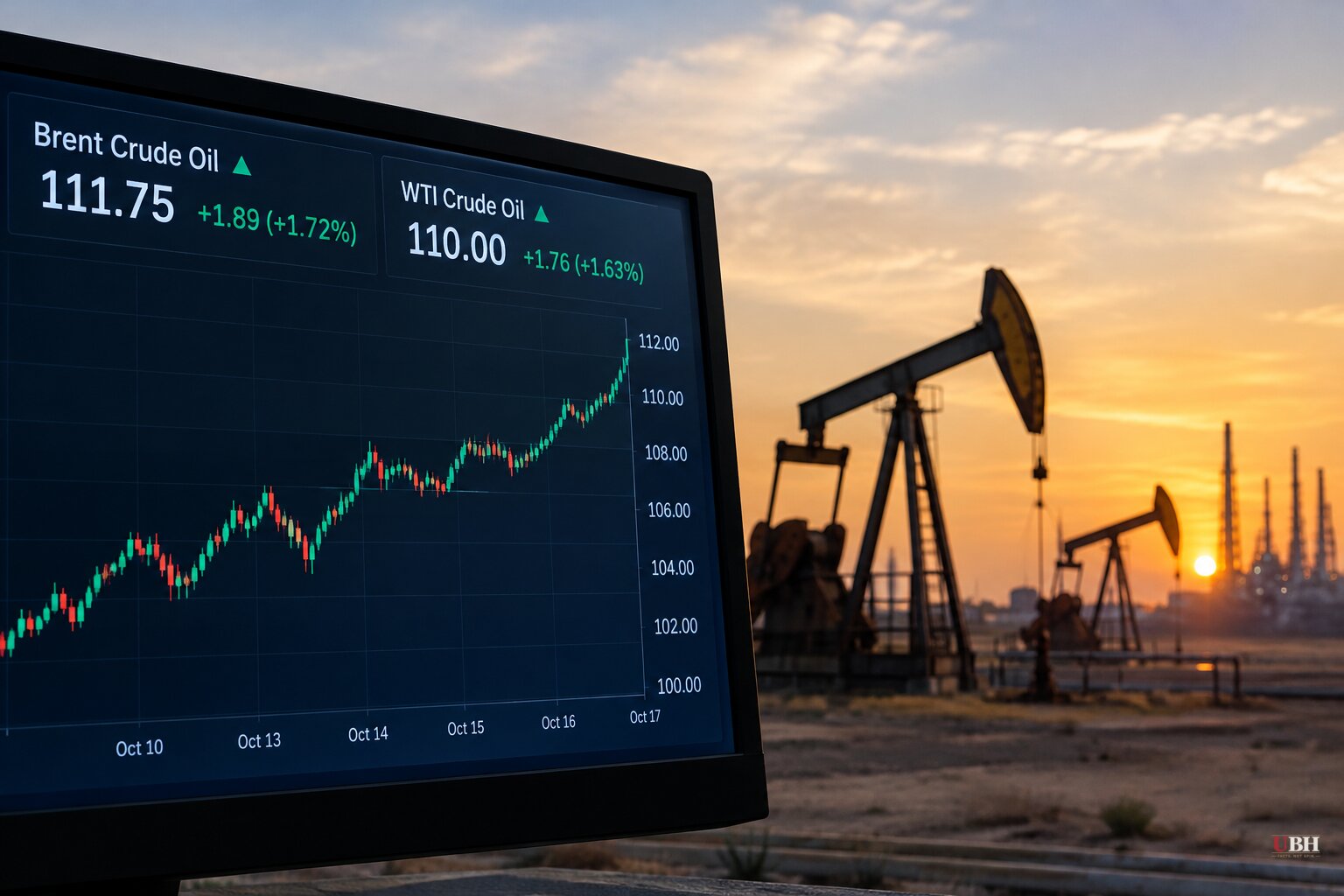
Since Brent settled at $109.86 on Friday, Oct. 16, the benchmark has pushed through $110 and traded as high as $111.75 on Tuesday, Oct. 20, its highest level since May, as the U.S.-Iran war enters its eighth month.
Brent for December delivery was around $111.20 as of 11:20 GMT, up 1.5%, according to Reuters. U.S. crude is moving faster. The expiring November WTI contract rose as high as $110, its highest nearby level since April. CNBC had it at about $110.48 by 7:38 a.m. ET, up 6.58%.
That contract expires today. It is on track for a ninth straight session of gains and a monthly rise of almost 20%. U.S. regular trading does not open until 9:30 a.m. ET, so these are futures levels, not stock-market prices.
Houthi claims on Saudi targets
The Houthis said Monday they attacked Saudi energy, airport and military targets, including an Aramco site in Yanbu, the Shaybah oilfield, Riyadh's King Khalid International Airport and Abha airport.
A separate Houthi attack on a training camp for government security forces in Yemen's Shabwa province reportedly killed 58 people and injured more than 200.
Saudi Arabia has called off its flagship investor conference, the Future Investment Initiative, a week before it was due to open later this month.
Saudi Aramco was also hit on Oct. 13. Authorities did not say who was behind that attack.
Tankers and mines in Hormuz
At least 18 vessels have come under fire over the past two weeks, according to ship tracker Kpler.
Iran's Revolutionary Guard Corps said Tuesday that two "non-compliant" oil tankers were set ablaze in the Strait of Hormuz after hitting mines laid by its naval unit. That account comes from Iranian state-affiliated Tasnim. It has not been independently confirmed.
Foreign Ministry spokesman Esmaeil Baqaei said Tehran would answer any American strike "in equal measure, if not more forcefully." Trump said earlier this month that U.S. forces will not attack Iran before the Nov. 3 midterms.
CNN reports Iran has signaled it is preparing for another round of war, apparently to deter Trump from reigniting the stalemated conflict.
IEA: no normal in 2027
IEA Executive Director Fatih Birol told the Financial Times Energy Transition Summit in London on Tuesday that he sees no "credible pathway that 2027 will be a year of normalisation." The Strait of Hormuz "has been closed once, it can be closed again," he said.
Birol called it "myopic" to judge the crisis by crude alone. Prices have not reached the $200 some analysts predicted at the war's start. But diesel has doubled from pre-war levels, he said, partly because of the Iran war and partly because of attacks on Russian refineries.
"We are on thin ice and I am very worried about this," Birol said, noting that diesel demand typically rises this season while many large refineries are scheduled for maintenance.
IEA members agreed in March to release 400 million barrels of emergency reserves. Eighty percent has already reached the market. Birol said the 32 member countries "will not hesitate to look into the option of releasing further stocks" if needed.
Russia waiver splits the market and the GOP
The U.S. has temporarily exempted Russia's shadow fleet from sanctions. Tamas Varga of PVM Oil Associates said that should push freight rates lower and put U.S. crude grades back in play as replacements for Middle East barrels. He also cited expected U.S. inventory draws and falling Middle East export volumes.
Not everyone in Washington likes the waiver. Rep. Michael McCaul, R-Texas, urged Trump on Saturday to reverse course on Russia sanctions.
Russian crude output in September was about 870,000 barrels a day below the same month a year earlier, according to TradingKey.
Pump prices and the political clock
The national average for regular gasoline was $4.30 a gallon on Oct. 17, up from $3.05 a year earlier, according to AAA. Diesel reached $6.17 a gallon as of Oct. 12, up from $3.45 in January, according to Federal Reserve Bank of St. Louis data.
Vice President JD Vance said Saturday on a CBS town hall that gasoline "would be three times as high if it weren't for the United States Navy keeping oil and gas moving out of the Strait of Hormuz." He also said the U.S. must still secure a verifiable Iranian commitment not to rebuild its nuclear program.
ING's Warren Patterson and Ewa Manthey say the market is pricing a significant risk premium. Full removal, they wrote, requires "some kind of agreement between the U.S. and Iran." ING analysts said Tuesday that if flows continue uninhibited, the premium would erode slowly, but "there are no signs of this yet."
Trading Key's analysis calls $110 the key pivot for Brent and says continued disruption could push it toward $120. Those are one analyst's price targets, not a forecast anyone has confirmed.
The WTI front-month contract expires today, Oct. 20. The next hard dates are the Nov. 3 midterms, which fall inside Trump's own no-strike window, and whether the IEA draws on the remaining 20% of its March reserve release.
Sources used for this briefing
7 links from 6 independent newsrooms (syndicated copies of the same report count once)
These are the sources it draws on, linked so you can verify.


