
Unbiased headlines. Facts, not spin.
Unbiased Headlines is an independently owned news organization. We bring you the facts, not opinions, written fresh from 110+ named sources. Sources linked so you can verify it yourself.
 energy
Major Story (8/10)
Event date: October 18, 2026 ·
Asian LNG Spot Price Hits $30.40, Highest Since December 2022, After Tanker Fired On Near Yemen
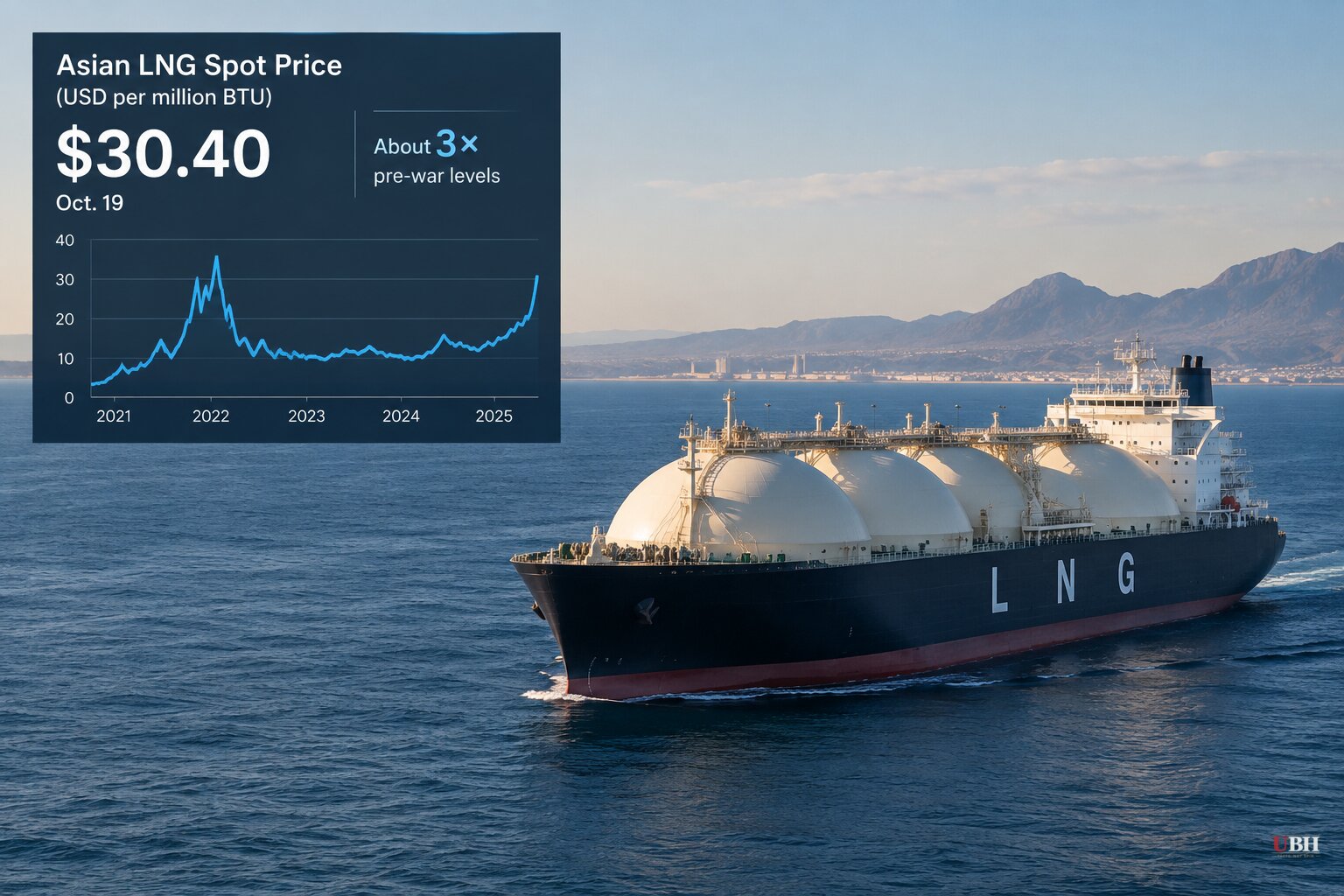
Since the U.S.-Iran war began in late February, Asian gas prices have roughly tripled. On Monday, Oct. 19, they hit a new high for the conflict.
Spot LNG in Asia rose to $30.40 per million British thermal units, according to traders. That is the highest since December 2022.
A tanker attack, then a price spike
The UK Maritime Trade Operations received a report over the weekend that an LNG carrier was fired on near Yemen on Saturday, Oct. 17. It is part of a recent rise in strikes on oil and gas vessels in the Red Sea and the Strait of Hormuz.
The attacks dampened hopes that exports from the Gulf would recover soon. Traders priced that in on Monday.
Astro Awani's analysis of Kpler data shows Iran's strikes on shipping in recent weeks are the highest in number since the war began.
Qatar is still mostly shut in
Qatar produces about a fifth of the world's LNG, with capacity near 80 million metric tons a year. Most of it is stuck behind Hormuz.
The country shut down much of its main Ras Laffan complex shortly after hostilities began. Iranian missile attacks then knocked out about 17% of Qatar's export capacity. The damage costs the country tens of billions of dollars in annual revenue and could take years to repair.
The International Monetary Fund forecasts Qatar's economy will shrink 8.6% in 2026. Before the war, it expected 6.1% growth.
Qatar's September LNG exports reached 1.6 million tons, their best month since the war began. That is still less than a quarter of the pre-war level.
Buyers who cannot get contracted cargoes are going to the spot market, where prices are higher. LNG flows from the region are about 80% below last year's levels.
Oil is recovering faster than gas
Crude has fared better. Middle East crude shipments through Hormuz rose in September to about 16 million barrels a day, roughly 80% of pre-war levels, according to the data firm Kpler. Producers are more willing to transit with U.S. Navy support, which has let Saudi Arabia, the UAE, Kuwait and Iraq raise output.
LNG has not followed. Brent crude is still hovering near $110 a barrel.
QatarEnergy has said it could restart LNG production within weeks once Hormuz reopens. The Astro Awani analysis, written from London, argues importers should not read too much into that. It concludes that Qatar's LNG industry "won't be returning to pre-war norms any time soon," given the destroyed capacity and the lag in restarting a shut-in complex.
Europe and Asia compete for the same cargoes
U.S. exports rose about 14% in 2026 to 123 million tons. That partially cushioned the hit, but the global gap remains large.
European gas storage was 74.47% full as of Oct. 19, according to Trading Economics data. The five-year seasonal average is 89%. The benchmark EU gas price rose to about €88 per megawatt-hour, also the highest since December 2022, and is up more than 7% on the week.
Some Asian buyers are still paying spot prices of $30 and up. That intensifies the bidding war with Europe, the world's other big LNG importer.
A cold snap would raise heating demand across northwestern Europe. Trading Economics notes that low storage makes the market vulnerable to sudden temperature swings.
The bill is landing on households and grids
The energy squeeze is raising household power bills and inflation. It is also pushing some economies back toward coal.
South Korea's energy minister said last week the country would lean on coal and nuclear power to cover a winter jump in electricity demand.
South Asia has taken the hardest hit. Wood Mackenzie says LNG demand in the region was projected to grow 2.7 million tonnes, or 7%, in 2026. It is now expected to fall by about 6 million tonnes.
Pakistan sourced 99% of its 2025 LNG imports from Qatar. Bangladesh sourced over 70%. Wood Mackenzie says Bangladesh's gas shortages triggered prolonged power outages and heavier coal use. The country paid over $18 per million BTU on average for spot LNG between March and June, with some March cargoes at $23 to $28.
Pakistan has had to curtail demand, switch fuels and release withheld domestic gas, which Wood Mackenzie says amounted to more than 2.5 million tonnes of lost gas demand. It also remains liable for daily terminal charges whether or not cargoes arrive.
"Countries that had diversified their supply sources and established multiple pricing mechanisms came through this crisis in far better shape than those that had not," said Johnson Quadros, Wood Mackenzie's head of gas and LNG research.
What comes next
The price path now depends on two things: whether Hormuz transit becomes safe enough for LNG carriers, and how cold the Northern Hemisphere winter turns out. Wood Mackenzie's Pakistan forecast assumes Hormuz-related disruption to Pakistan-bound cargoes through November 2026.
Europe has roughly 14 percentage points of storage to make up against its five-year average, with colder weather forecast for northwestern Europe.
Sources used for this briefing
7 links from 7 independent newsrooms (syndicated copies of the same report count once)
These are the sources it draws on, linked so you can verify.


