
Unbiased headlines. Facts, not spin.
Unbiased Headlines is an independently owned news organization. We bring you the facts, not opinions, written fresh from 110+ named sources. Sources linked so you can verify it yourself.
 energy
Major Story (7/10)
Amazon, AEP and X-energy Sign Agreement to Explore 12-Reactor, 960-Megawatt Nuclear Plant in Indiana
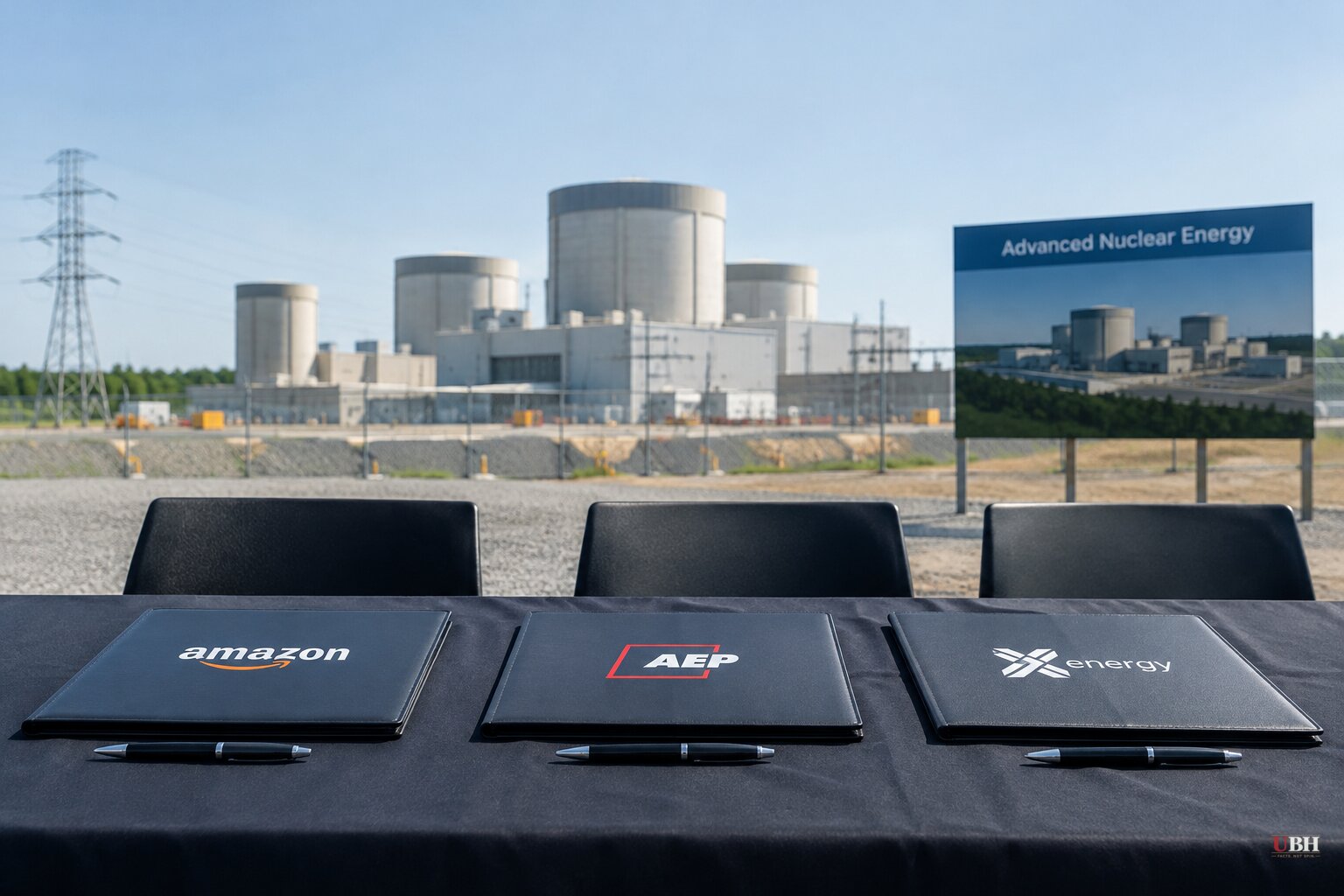
Amazon, American Electric Power (AEP) and X-energy announced Monday, Oct. 19, that they have signed an agreement to explore building 12 small modular nuclear reactors at the former Breed Generating Station site in Sullivan County, Indiana. The coal plant has been demolished. The site sits just south of Terre Haute.
If the project is built, it would produce up to 960 megawatts. Amazon is serving as a development funder and would be the first customer to buy the power.
What was actually signed
This is a joint development agreement, not a construction contract. It covers feasibility work, and Amazon's money is tied to milestones. X-energy calls it "milestone-based development capital."
None of the three companies has disclosed a dollar figure, a construction start, or an in-service date. Amazon's announcement does not mention a Nuclear Regulatory Commission application or approval from Indiana's utility regulator.
X-energy has also warned that the funding arrangements could end, that conditions might not be met, and that the studies may not support going forward. The partners may never reach agreements covering development, construction or operation.
The arithmetic is straightforward. Each Xe-100 reactor is rated at 80 megawatts, and 12 of them make 960. Amazon says the plant could create more than 1,000 construction jobs and more than 100 permanent ones.
Who does what
X-energy supplies the reactor design and fuel. The Xe-100 is a high-temperature, gas-cooled design that uses helium coolant and TRISO fuel, and Amazon says it can be cooled by air, water or a combination. AEP, through its Indiana Michigan Power utility, would operate the plant.
Unlike some newly announced projects built for a single customer, this one would connect to the public grid. Amazon says the power would serve both the regional grid and its data centers.
Under the plan, Amazon would buy the power through a long-term contract that covers the facility's costs and operations, the companies said.
Who pays
Ratepayers care most about who pays. AEP Chairman and CEO Bill Fehrman said the agreements will provide "all necessary capital protections and financial safeguards that we have said are essential for any potential nuclear project to move forward."
Amazon's Josh Weissman, vice president of data center infrastructure capacity delivery, said the companies want to "develop nearly a gigawatt of carbon-free power for the regional grid and pay our full costs without passing them to others."
Amazon's announcement also says AEP plans to cut residential rates by $100 starting in 2027 and freeze them for three years. Those are Amazon's figures, and the terms of the underlying agreement are not public.
Demand is real. Indiana regulators approved large-load interconnection rules last year, accepting a pact offered by Indiana Michigan Power, Amazon Data Services, Google, Microsoft and others. The utility expects Indiana peak load to jump from 2,800 MW to more than 7,000 MW by 2030, according to that decision.
Gov. Mike Braun said the project could strengthen the state's grid and "position Indiana as a national leader in advanced nuclear energy."
The unproven part
The Xe-100 has not yet produced commercial power. It is still in development and licensing.
X-energy's first plant, four reactors at a Dow Chemical site in Seadrift, Texas, has not broken ground. The company says its construction permit is in the final phases of NRC review. The companies' Indiana timeline depends on that project going well.
The state of Texas has sued over the Seadrift plant, accusing it of "habitual non-compliance" with water and solid-waste regulations and permits.
The industry's pitch is that factory-built reactors will avoid the budget blowouts of recent U.S. nuclear builds. TechCrunch's reporting notes that experts say mass manufacturing often takes about a decade to deliver cost benefits.
Indiana has its own cautionary history. The Marble Hill nuclear plant was abandoned half-finished in 1983 after $2.5 billion had been sunk into it.
Part of a larger buildout
This is the second Amazon and X-energy project, after the Cascade Advanced Energy Facility in Washington state. Cascade also plans 12 reactors, but construction is not expected to start until the end of this decade. The Indiana plan is roughly three times larger than their first agreement from 2024.
The two companies have said they aim to bring more than 5 gigawatts of new U.S. nuclear capacity online by 2039. Amazon led X-energy's $700 million Series C-1 round in October 2024.
X-energy went public on the Nasdaq in April at $23 per share. TechCrunch reported that the stock jumped 27% on its first day and has since dropped by nearly two-thirds.
On Sept. 30, Amazon announced a separate 20-year, 690-MW power purchase agreement with Constellation Energy to expand and improve the Calvert Cliffs nuclear plant in Maryland. Amazon says it is working toward net-zero carbon across its operations by 2040.
The next concrete marker is not in Indiana. It is the NRC's decision on the Seadrift construction permit, which X-energy says is in its final review phase. Until that plant breaks ground, the Sullivan County project remains a feasibility study with no price tag.
Sources used for this briefing
8 links from 7 independent newsrooms (syndicated copies of the same report count once)
These are the sources it draws on, linked so you can verify.


