
Unbiased headlines. Facts, not spin.
Unbiased Headlines is an independently owned news organization. We bring you the facts, not opinions, written fresh from 110+ named sources. Sources linked so you can verify it yourself.
 energy
Breaking / Critical (9/10)
energy
Breaking / Critical (9/10)
Brent Settles at $109.86 After Touching $110 as Houthis Keep Firing at Saudi Arabia and Hormuz Ship Attacks Continue
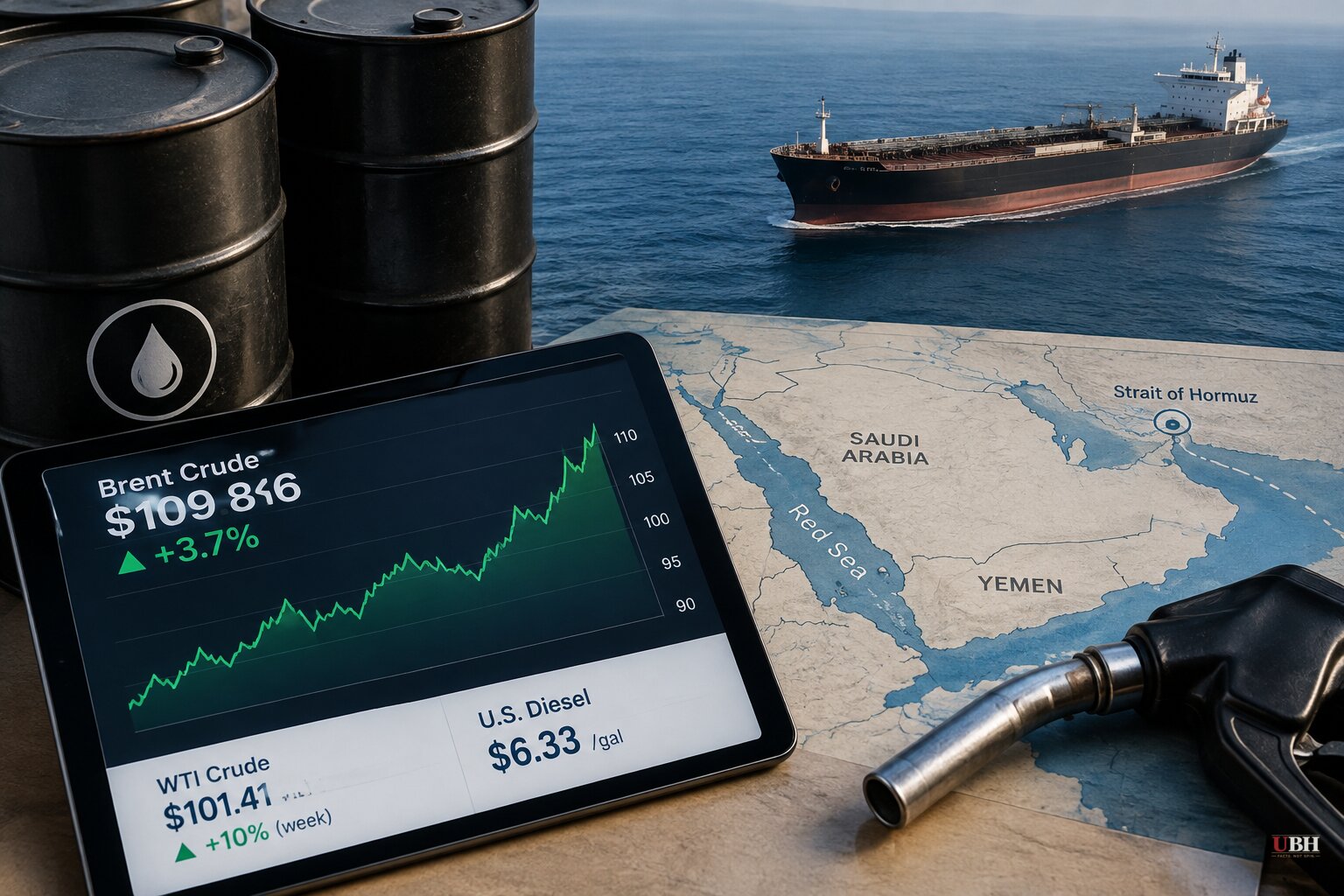
Oil has swung between disruption and partial recovery since the Iran war began. Today, Oct. 16, the swing went up: Brent futures hit a session high of $110 a barrel, the first time since May, before settling at $109.86, a gain of 3.7%.
U.S. West Texas Intermediate settled at $101.41, up 3.5% on the day. WTI gained more than 10% this week. Brent advanced nearly 5%, its second straight weekly gain.
Houthi fire on Saudi Arabia
Saudi Arabia intercepted several missiles fired over the Red Sea today, according to a military spokesman. One was heading for the Yanbu oil export terminal. Three drones were also destroyed over Riyadh and the kingdom's southern regions.
The Iran-allied Houthis have fired at Saudi Arabia repeatedly this week. The Saudi energy ministry said an Aramco administrative building in Dhahran was hit Tuesday. On Oct. 10, a Houthi attack on Riyadh's international airport killed 12 people and injured more than 300. Houthi missiles also struck the presidential palace complex in Aden on Thursday, killing five.
"After a brief reprieve, the oil market is having to price risk back in, particularly heading into the weekend," said Rebecca Babin, senior energy trader at CIBC Private Wealth Group.
Hormuz traffic pulls back
At least nine tankers and cargo ships have come under attack in the Strait of Hormuz since Sunday. U.S. Central Command said Iran sank the container ship GFS Pride on Wednesday. Singapore's maritime authority said the Singapore-registered ship's crew was evacuated safely. The International Maritime Organization counts three seafarers injured and two missing this week.
Tehran says it is stepping up strikes in response to the U.S. blockade of its ports and tougher sanctions introduced last month. IRGC chief Ali Ozmaei said Wednesday on Iranian television that Iran is "waiting for U.S. warships to approach the entrance to the Strait of Hormuz so we can sink them."
Crude exports through the waterway had touched prewar levels in September. They pulled back to 9.4 million barrels a day for the week ended Wednesday, about 70% of the prewar average, according to energy researcher Kpler. Kpler analysts said they expect a slower, more uneven recovery in Hormuz flows without a comprehensive political deal.
A U.S. official told Reuters that Iran has begun using unarmed spotters in small boats to find potential targets. Iranian officials told Reuters the aim is to keep Washington from pushing oil prices down before the midterms.
Russia, Ukraine and the diesel deal
The "energy ceasefire" Trump announced Oct. 11 has unraveled. Neither side formally confirmed agreeing to it. Ukraine held off on refinery strikes for three days while Russia kept hitting Ukrainian energy sites.
"The block is out. We're done," Zelenskyy told the Financial Times in an interview published Oct. 15. Hours later, Ryazan Governor Pavel Malkov reported a drone attack and a fire at the Rosneft-owned refinery, which accounts for nearly 5% of Russia's total refining capacity. Two industry sources told Reuters the refinery suspended operations at a primary crude distillation unit. Russia's Defense Ministry said falling drone debris started the fire.
Trump called Kyiv's decision to resume attacks on Russian refineries a "disgrace." "There's plenty of other targets; they don't have to hit," he said Thursday, adding that he finds Zelenskyy "more difficult to deal with than" Putin.
Zelenskyy told Piers Morgan on Wednesday that he felt "really, yes" betrayed by Washington's dealings with Moscow. He said lifting sanctions would let Russia press on with the invasion. He also said the country counts on the United States as a strategic partner.
On the diesel side, U.S. lawmakers introduced a bill today to block Trump's deal with Moscow to release several hundred million barrels of diesel. Trump has said Moscow will follow through. Bloomberg's reporting says ongoing strikes like the Ryazan attack are amplifying doubts about whether the agreement will deliver.
Dennis Kissler, senior vice president of trading at BOK Financial, said it is "questionable how much diesel fuel Russia can actually deliver to the markets."
The fuel is already expensive at the pump. Diesel averaged $6.33 a gallon in the U.S. today, more than 70% above a year ago, according to AAA. In New York, diesel futures settled at $4.90 a gallon. A U.S. commercial crude inventory decline of more than 8 million barrels for the week ended Oct. 9, tied to Gulf Coast production shut-ins from Hurricane Isaias, also fed the U.S. rally, according to the Energy Information Administration. The IEA agreed Thursday to release more than 20 million barrels of fuel, and the U.S. offered up to 17 million barrels from the Strategic Petroleum Reserve today.
Escalation odds
Eurasia Group analysts wrote that "the conflict is likely to escalate," raising their odds of intensification to 65% from 35%. "The standoff status quo is no longer sustainable for the US," they said.
In an interview with Newsmax, Trump declined to rule out using the GBU-43/B Massive Ordnance Air Blast bomb on Iran after the Nov. 3 election. CNN reported this week that U.S. strike plans could include that weapon.
Bloomberg says the persistently high prices leave Trump with fewer and fewer options to bring energy costs down ahead of the Nov. 3 midterm elections.
Two near-term markers to watch: the fate of the bill to block the Moscow diesel release, and whether Hormuz crude flows, now at about 70% of prewar levels, recover or fall further.
Sources used for this briefing
8 links from 8 independent newsrooms (syndicated copies of the same report count once)
These are the sources it draws on, linked so you can verify.


