
Unbiased headlines. Facts, not spin.
Unbiased Headlines is an independently owned news organization. We bring you the facts, not opinions, written fresh from 110+ named sources. Sources linked so you can verify it yourself.
 energy
Major Story (8/10)
Brent Falls More Than 6% From Near Wartime High as Mediators Head to Tehran
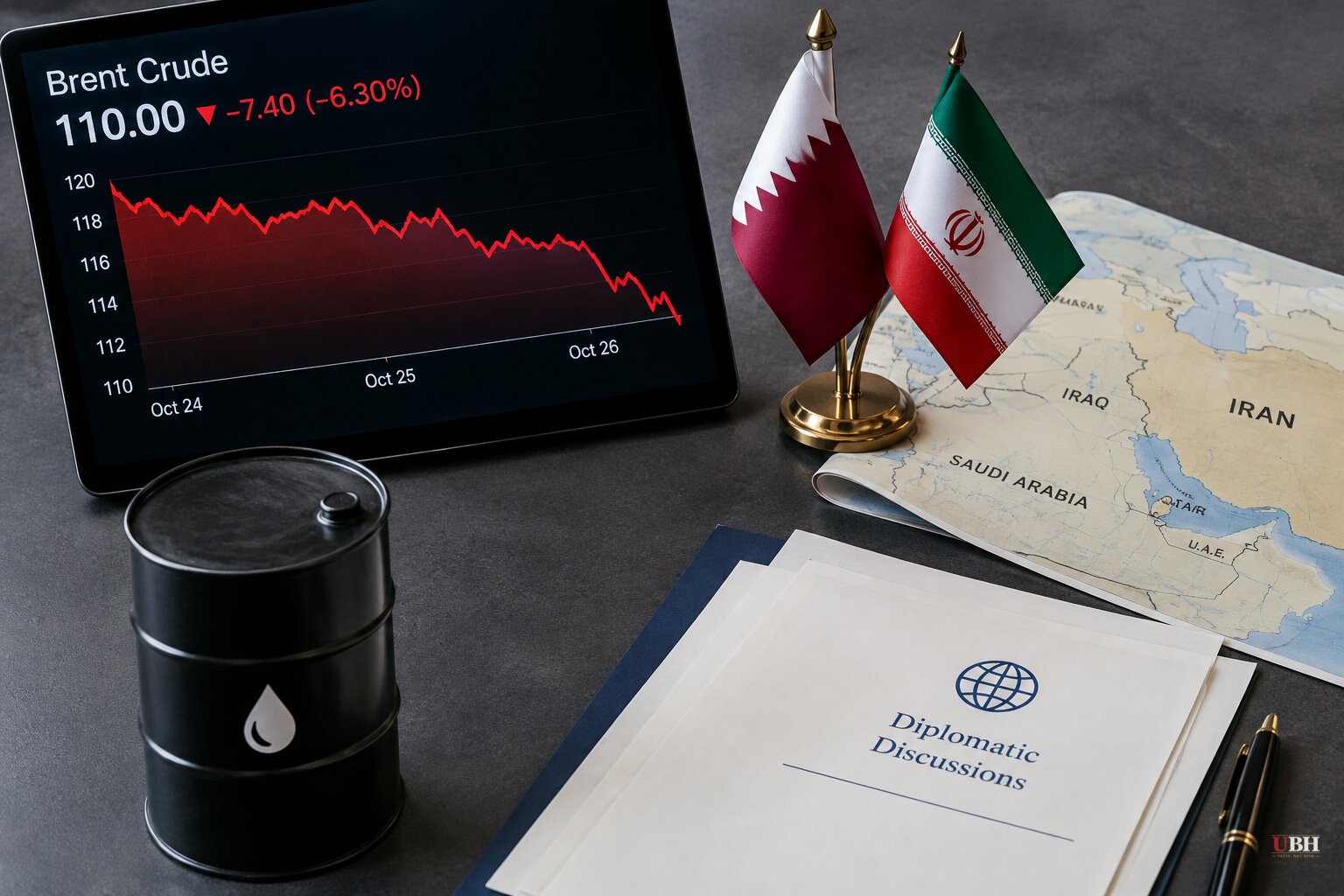
Oil's Iran-war premium has started to drain. On Monday, Oct. 26, Brent crude fell more than 6% in morning trading, from about $117.4 a barrel at Friday's close to around $110, according to Euronews. TradingKey put Brent at about $109.50 on the day and West Texas Intermediate at about $100.80, down 2.50%. Other reports put WTI at about $101.5 to $101. WTI closed Friday at $103.27, and Fox News reported Brent's Friday settlement at $116.72.
Friday's close was Brent's highest since March 19 and only about 2% below the $119.5 peak hit in early March, at the start of the Iran war. Before the conflict, Brent traded at around $72 a barrel.
What moved the market
The shift came over the weekend. Qatari mediators traveled to Tehran on Sunday in coordination with Washington. Saudi Arabia's defense minister, Pakistan's army chief and Turkey's intelligence chief were due in the Iranian capital Monday for regional security talks.
Trump told Fox News on Sunday the choice in front of him is simple: "do I make a deal with them, or do I finish them off?" He also said the US would not strike Iran that day, a statement that eased fears of imminent escalation.
The International Atomic Energy Agency added a diplomatic data point on Friday. Director General Rafael Grossi told the UN General Assembly the agency has completed much of the preparation needed to verify Iran's nuclear activities if Washington and Tehran strike a deal. He voiced optimism about mediation by Pakistan, Qatar, Oman and Egypt. No agreement authorizing inspections has been announced.
Profit-taking, not a supply fix
Market analysts cited by TradingKey described the drop as position adjustment and risk management rather than a significant improvement in Middle East supply conditions. As oil rose above $110, some traders began locking in profits. Brent gained more than 6% last week and WTI 4.4%.
The physical market has not loosened. US commercial crude inventories fell by about 3.06 million barrels to 412.5 million barrels, and the Houthis said they struck Saudi airports and energy sites again over the weekend. Riyadh said it shot down further missiles and drones.
Trump's Hormuz claim against the shipping data
At a campaign event in Port Huron, Michigan, Trump said, citing the Wall Street Journal, that "oil coming out of the Strait of Hormuz is now topping what it was before the war," adding that "our navy has been incredible."
Ship-tracking firm Kpler's data points in the same direction with a caveat. Gulf crude exports excluding Iran returned to pre-war levels in September. But around 40% of those barrels now bypass the strait through pipelines, versus 17% before the war. The strait carried about a fifth of the world's oil before the conflict.
The US also maintains a naval blockade targeting Iranian oil exports, and commercial vessels still face security threats in the strait.
The strike option stays open
Trump has raised the possibility of additional strikes on Iran after the November midterms. No new military operation has been announced.
Aaron Cohen, an Israeli special operations veteran and founder of Gideon, told Fox Business on Friday that earlier US and Israeli operations had weakened Iran's military infrastructure. He argued that Tehran could rebuild without continued pressure and pointed to reported activity at the Eagle 44 underground base and changes in Iran's defense leadership. That is his assessment, not a confirmed finding.
Gas and markets
The relief is not uniform across energy. Oil & Gas Journal reported that Dutch TTF gas futures touched €97.50/MWh on Oct. 26, their highest level since December 2022, on winter supply concerns, even as crude eased.
European equities opened higher Monday. The Stoxx 600 and Euro Stoxx 50 traded more than 0.6% above Friday's close, and S&P 500 and Nasdaq 100 futures were up 0.3%. Investors face a week of central bank rate decisions and earnings reports.
Russian President Vladimir Putin is preparing to host Iranian President Masoud Pezeshkian in Moscow next week, a separate diplomatic track to watch alongside the Tehran talks. Whether the regional delegations leave Iran with anything Trump will accept as a deal is the open question that decides whether Brent's drop holds.
Sources used for this briefing
7 links from 6 independent newsrooms (syndicated copies of the same report count once)
These are the sources it draws on, linked so you can verify.


