
Unbiased headlines. Facts, not spin.
Unbiased Headlines is an independently owned news organization. We bring you the facts, not opinions, written fresh from 110+ named sources. Sources linked so you can verify it yourself.
 energy
Notable (6/10)
Event date: October 23, 2026 ·
McKinsey Projects Asia Needs $1 Trillion a Year in Energy Investment Through 2040
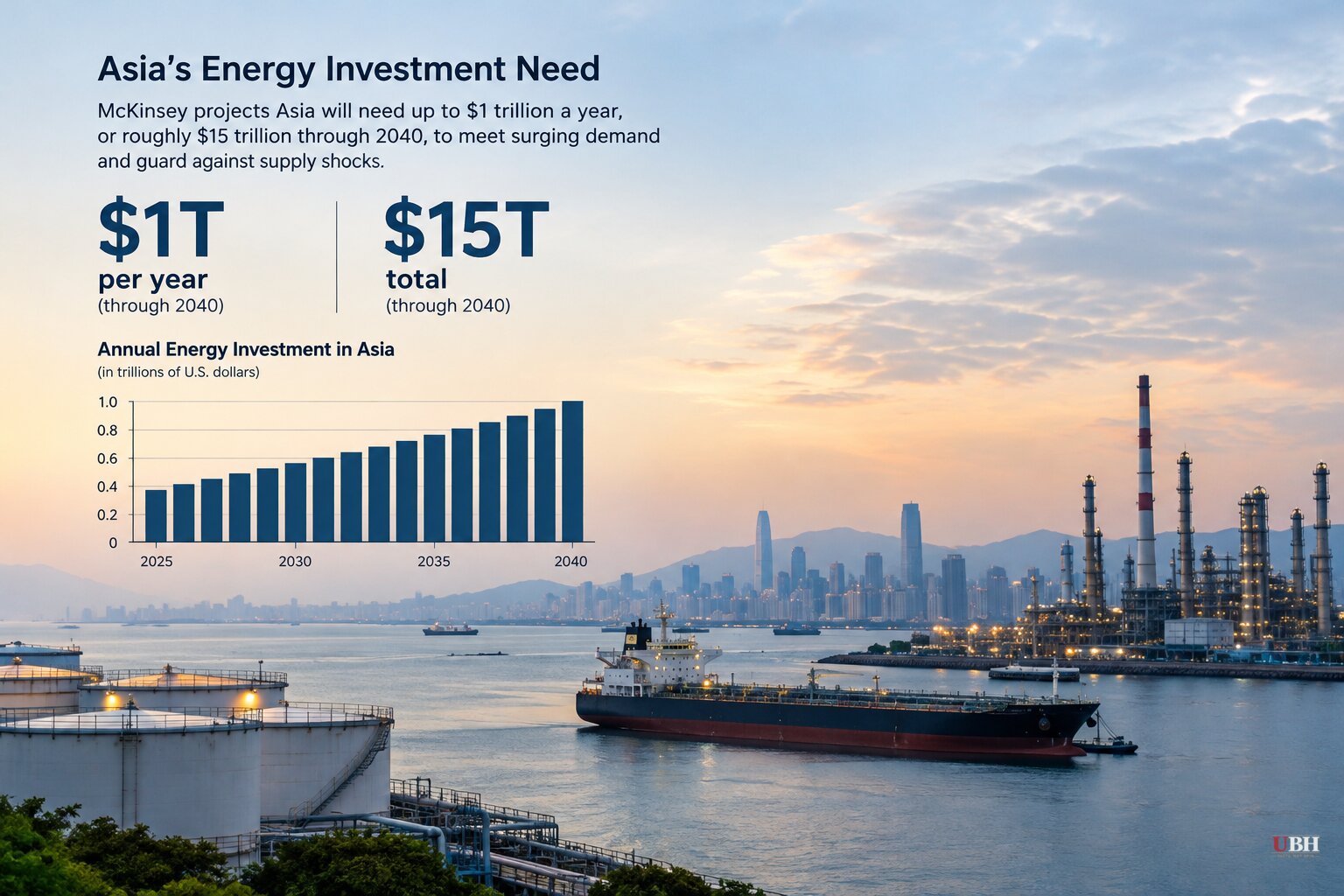
McKinsey & Company published a report on Thursday, Oct. 22, estimating that Asia needs up to $1 trillion a year in energy investment over the next 15 years. That works out to about $15 trillion through 2040.
The report, titled Asia's Energy Reckoning: Securing the Energy System to Drive Growth, ties the number to two pressures: rising demand and the exposure of an import-dependent region to supply shocks.
Demand is bigger than last year's forecast
McKinsey now expects Asian energy demand to hit 370 million terajoules by 2040. That is 15% above the firm's forecast from a year ago.
Asia is projected to account for about 70% of global net energy demand growth through 2040. The firm points to data centers, industrial expansion and cooling needs as the drivers.
The region already uses nearly 50% of the world's energy and produces 55% of greenhouse gas emissions, while generating around 38% of global GDP.
Hormuz exposed the dependence
Asia burns about 40 million barrels of oil a day and produces only about 10 million barrels of crude. In 2025 it imported between 135 million and 140 million tonnes of LNG from outside the region.
Historically, more than half of Asia's crude imports and over 40% of its LNG imports have moved through the Strait of Hormuz. McKinsey estimates that governments across the region have absorbed more than $30 billion in extra fiscal costs since March 2026 through fuel subsidies, tax relief and market stabilization. The disruption also contributed to fuel shortages and industrial interruptions in several economies.
Under its Continued Momentum scenario, McKinsey projects Asian crude output falling to about 7 million barrels a day by 2040. Regional gas self-sufficiency would drop from 76% to around 60%.
Coal is not going anywhere fast
Coal makes up about 47% of Asia's primary energy mix, against 25% for oil and about 12% for natural gas. In power generation, coal supplies more than 50% of the region's electricity, and 67% in South Asia, led by India.
McKinsey expects coal demand to stay broadly flat over the next decade. Falling use in China, where renewable generation is growing quickly, is expected to be offset by increases in India and Southeast Asia.
Asian thermal coal prices are elevated. Reduced production in China, supply quotas and disruptions in Indonesia, and gas-to-coal switching in Japan and South Korea are all cited as factors.
Gas is on a different path. McKinsey expects demand growth to slow over the next five to 10 years as countries lean on cheaper domestic coal and renewables for power. A longer-term rebound is projected, driven mainly by industry as manufacturers move away from oil and coal.
Renewables: cheap on paper, slow in practice
McKinsey puts annual solar and wind investment at about $300 billion through 2040, concentrated in India and Southeast Asia. China remains Asia's largest renewable market.
The firm says utility-scale solar is now the lowest-cost power source in the vast majority of Asian markets, thanks to steep drops in capital and equipment costs. That is the argument for the build-out: it pays for itself.
The execution record is weaker. McKinsey found that 50% to 60% of renewable projects in Vietnam, Thailand and Indonesia were canceled or stalled between 2021 and 2025. Inadequate infrastructure and policy support were among the obstacles. Cheap domestic coal also delays the point at which renewables win on cost in places like India.
That gap between cost and delivery matters for anyone assuming the region will simply follow Western climate timelines. Asian governments, not Washington or Brussels, will decide how fast coal, oil and gas fade.
Energy security is pushing governments toward home-grown supply
McKinsey says a stronger security focus could support government-backed, higher-cost domestic oil and gas development. It names China, the Philippines, Thailand, Vietnam and Turkmenistan as candidate markets.
Biofuels could replace $90 billion to $100 billion of fuel imports in 2040, according to the report.
The $15 trillion figure is McKinsey's own estimate, not a budget any government has adopted. It is a multiple of an annual "up to" number, and the report's scenarios, such as Continued Momentum, depend on assumptions about policy and prices.
Supply diversification is already showing up in commodity proposals. One example is Strathcona's plan to export 250,000 barrels per day of Canadian crude, which is aimed at Asian buyers seeking alternatives to Gulf supply. Whether that volume, or anything like it, reaches Asian refiners by 2040 is untested.
Sources used for this briefing
7 links from 6 independent newsrooms (syndicated copies of the same report count once)
These are the sources it draws on, linked so you can verify.


