
Unbiased headlines. Facts, not spin.
Unbiased Headlines is an independently owned news organization. We bring you the facts, not opinions, written fresh from 110+ named sources. Sources linked so you can verify it yourself.
 energy
Major Story (8/10)
Event date: November 25, 2026 ·
Brent Ends Week Near $95 as OPEC+ Is Set to Hold Q1 Targets and Iraq Presses for a Higher Quota
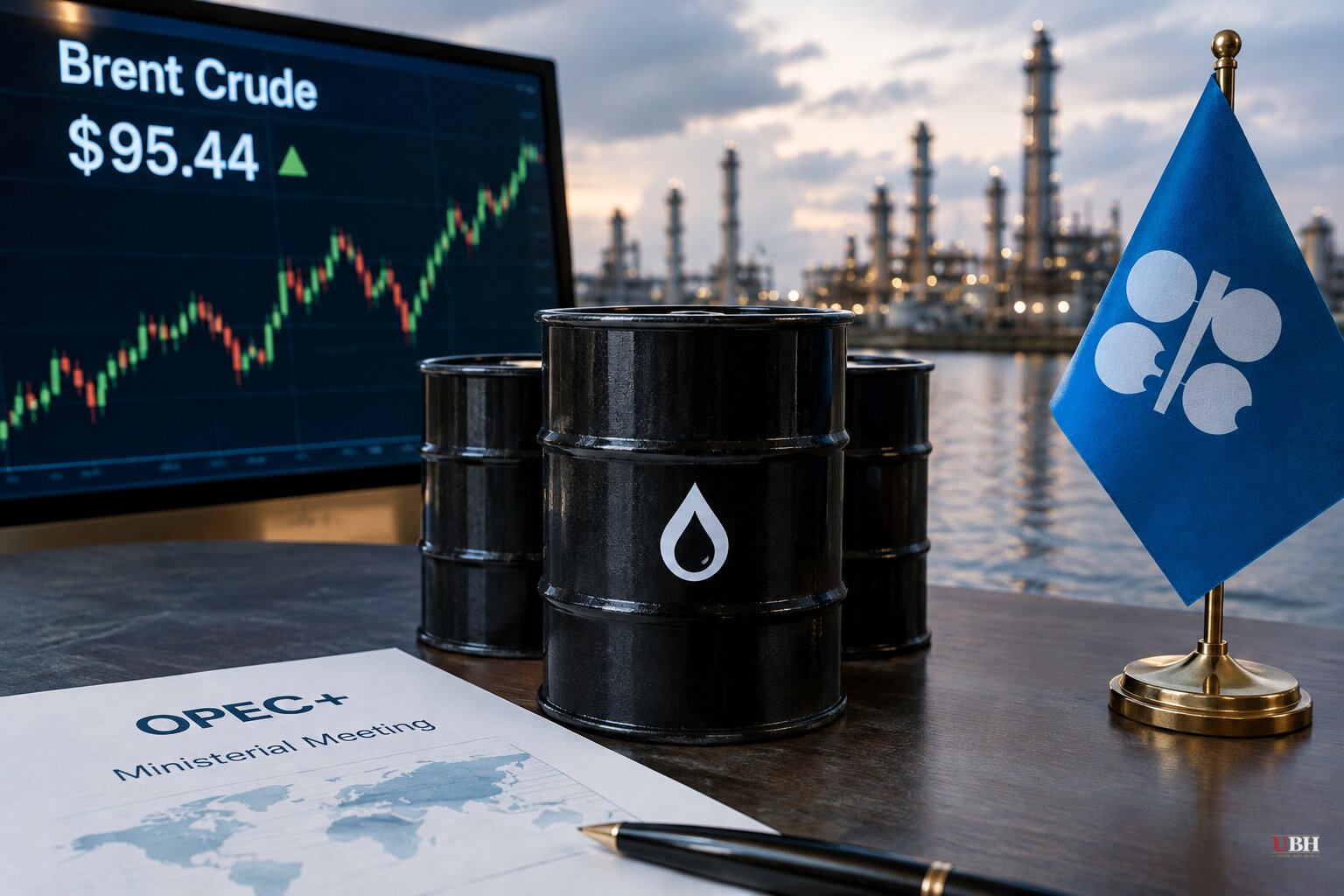
Since Brent dipped below $90 earlier this week, a run of strikes on Saudi and Kuwaiti sites has lifted it back toward $95 ahead of Sunday's OPEC+ meeting. Brent for January delivery slipped 1.2% to $95.44 a barrel on Friday, Nov. 27, finishing the week up roughly 3%, according to Finexus market data. WTI for January fell 0.7% to $83.08.
The weekly gain broke a losing streak for Brent. Thursday's settle was its highest since the week of the midterm elections, CNN reported. Prices are still well below the near-$120 peaks reached at points during the war with Iran.
Refinery and base strikes
A projectile hit an oil refinery in Saudi Arabia's Jazan region on Thursday, Nov. 26, killing a Nepalese worker. The Saudi Ministry of Energy said the strike started a fire and temporarily suspended some operations at the facility.
That followed the Houthis' claim on Wednesday of a hit on Ras Tanura, the kingdom's biggest refinery. A skyscraper housing the headquarters of Saudi Arabia's sovereign wealth fund in Riyadh was hit for the second time in days, wounding 11 people, according to an eyewitness and Saudi authorities.
On Thursday a suspected Iranian drone attack on a Kuwaiti military site killed two Italian technicians employed by Rheinmetall Italia, Italian Foreign Minister Antonio Tajani said. Kuwait's defense ministry said a Kuwaiti and a Pakistani national were wounded. Iran denied carrying out the attack.
"Prices had been under pressure for roughly four weeks as the market leaned into surplus talk," said Phil Flynn, senior market analyst at Price Futures Group. "But attacks on Saudi infrastructure and continued incidents around the Strait of Hormuz have put risk premium back."
Hormuz flows
CNN's analysis of UK Maritime Trade Operations data counts around two dozen attacks on tankers in the Strait of Hormuz in November, close to the record 30 in October. CNN put recent flows through the strait at 55% of pre-war levels. Preliminary Kpler data put them at about 31%. The two figures do not match, and neither source says why.
Supply from the Gulf is still increasing. Combined crude exports from Saudi Arabia, the UAE, Iraq and Kuwait rose 10% to 15.53 million barrels a day in October, according to Bloomberg's tanker tracking. The IEA said crude and fuel flows through Hormuz rose 7% in the third quarter to 9.1 million barrels a day, against 21.4 million a year earlier.
Iraqi exports are holding up, but delays to several November and December cargoes have raised concern about near-term reliability, Finexus reported.
What OPEC+ is expected to do Sunday
OPEC+ oil ministers hold a series of four meetings on Sunday. Three sources told Reuters on Friday that the group has an agreement in principle to keep output targets unchanged in the first quarter of 2027. Rapidan Energy Group also expects no change, citing uncertainty over how long the Iran war will last and what it does to Gulf output and exports.
The complication is the group's first-ever review of members' production capacity, meant to help set 2027 targets. Preliminary findings put Iraq at 4.9 million barrels a day, according to sources who spoke to Reuters earlier this week. Kazakhstan is also seeking a higher estimate.
Iraqi Oil Minister Basim Mohammed Khudair said Friday that Iraq is negotiating with OPEC to raise its ceiling. "We are conveying to the OPEC member states that Iraq needs to develop its infrastructure," he said. "Therefore, its production ceiling within OPEC should be raised, with special consideration given to its situation." He did not say when a higher quota might come.
Baghdad has warned it may leave OPEC if its quota is not raised. The UAE already left OPEC and OPEC+ months ago to pump more, after years of arguing its quota did not reflect its investment in capacity. Russian Deputy Prime Minister Alexander Novak said Wednesday the capacity review would be finished by the end of the year, and that ministers would see on Sunday what stage it has reached.
The surplus argument
Many producers fear a glut more than a shortage. Commentator Daniel Lacalle wrote in The Epoch Times that an oil executive told him he was more worried about oversupply than about the geopolitical risk priced into the market. Lacalle argued that if the geopolitical premium disappears just as supply recovers, prices could fall faster than many expect.
The numbers behind that worry are in the agency data. The IEA said global supply rose 5.3 million barrels a day between August and October, and that the market is in surplus by about 2 million barrels a day this quarter. It cut its 2026 demand forecast by 90,000 barrels a day, to 102.29 million.
Rystad Energy forecasts a 2027 surplus of about 5 million barrels a day, roughly 5% of world demand, even if Gulf supplies recover only partially.
LSEG's Zhenqiang Seto said surplus concerns going into 2027 are outweighing shipping risks. He added that any increase in managed-money flows and fresh geopolitical headlines could push prices up again.
The open question for Sunday is whether Iraq gets any concession on its 4.9 million barrel estimate, or whether the group simply defers the dispute while it extends current targets through the first quarter.
Sources used for this briefing
6 links from 6 independent newsrooms (syndicated copies of the same report count once)
These are the sources it draws on, linked so you can verify.


