
Unbiased headlines. Facts, not spin.
Unbiased Headlines is an independently owned news organization. We bring you the facts, not opinions, written fresh from 110+ named sources. Sources linked so you can verify it yourself.
 energy
Major Story (8/10)
Brent Reaches $96.25 After Houthi Claim on Ras Tanura and Reported Tanker Mine Strikes in Hormuz
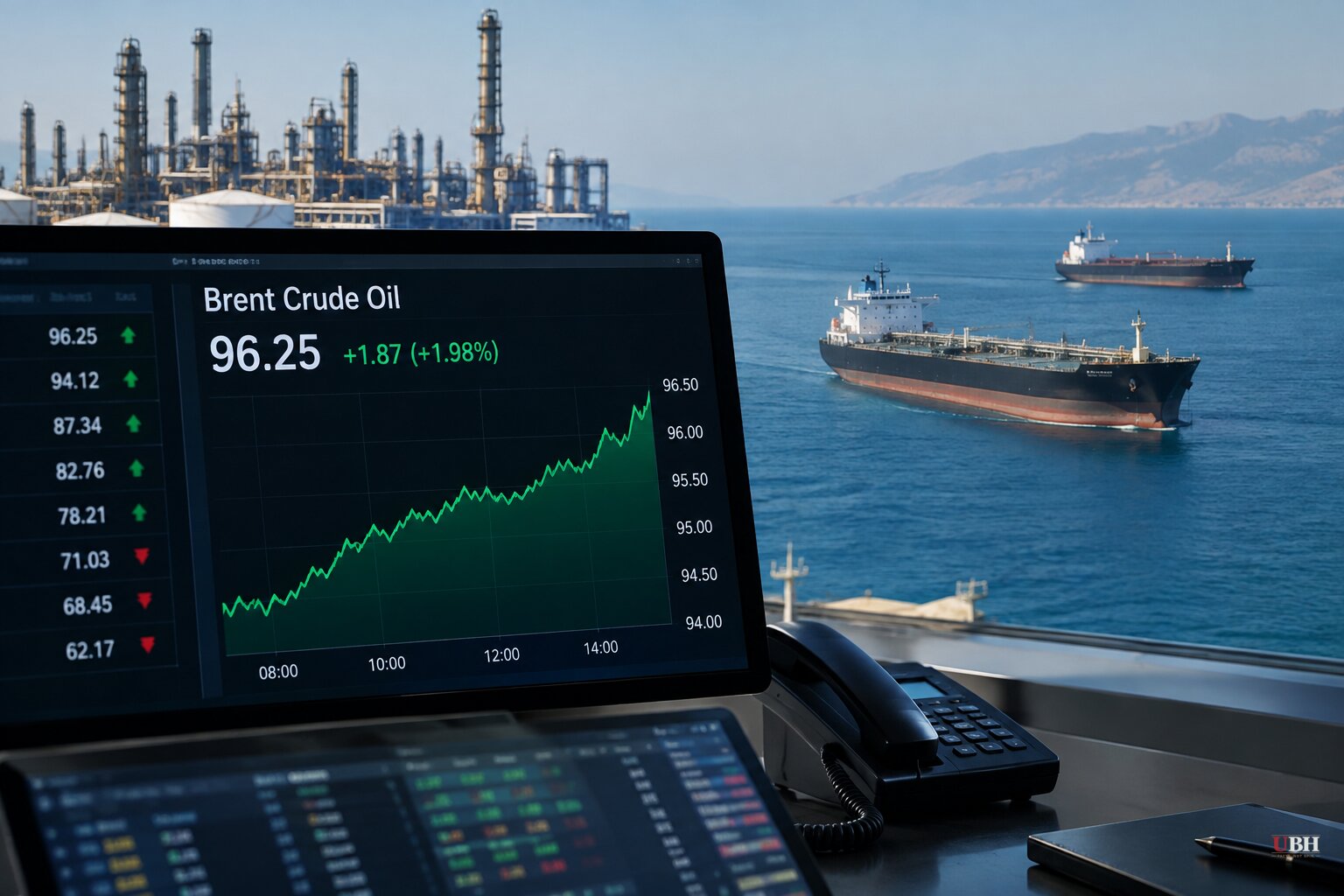
Oil's slide stopped this week. Brent has climbed to $96.25 a barrel as of 1425 GMT Thursday, Nov. 26, up $1.64, or 1.73%, on the day. U.S. West Texas Intermediate was at $84.78, up $1.10.
WTI will have no official settlement Thursday because U.S. markets are closed for Thanksgiving. WTI touched $79.07 early this week, a three-month low, before buyers returned.
The Ras Tanura claim
On Wednesday, Nov. 25, Yemen's Iran-aligned Houthis said they had attacked Saudi Aramco's Ras Tanura refinery and targets in Riyadh's financial district. Brent settled 3.5% higher that day. WTI settled 2% higher.
Ras Tanura is Saudi Arabia's largest refinery, with processing capacity of about 550,000 barrels per day. It sits inside a complex that includes one of the kingdom's main crude export terminals.
The damage is unclear. Satellite imagery showed smoke near the refinery, according to FinanceFeeds. Saudi Aramco had not issued a detailed public assessment of refinery operations at the time of that report. The extent of operational damage and any resulting reduction in crude exports have not been independently established.
PVM analyst Tamas Varga said the Houthi statement triggered Wednesday's rally as traders added a geopolitical risk premium. He also said traders were likely covering short positions ahead of the holiday.
Tankers and mines in Hormuz
The second pressure point is the Strait of Hormuz. Iran's Islamic Revolutionary Guard Corps said Thursday that two oil tankers struck naval mines north of Oman's Khasab port while trying to transit the strait. The Guards said both vessels suffered explosions and fires, including a supertanker carrying more than 2 million barrels of crude.
Iranian state media reported that two tankers struck mines and exploded in the strait on Wednesday. Fars news agency cited an Iranian Army statement saying one tanker hit a mine and caught fire in a "restricted zone." The Iranian account has not been independently verified in full.
Crude shipments through Hormuz had been recovering toward pre-war levels. ANZ analyst Daniel Hynes said the broadening conflict "threatens to halt the recovery in oil flows in recent weeks," adding that Persian Gulf crude exports rose last week but remain on a declining trend.
Morgan Stanley analysts estimated Middle Eastern crude exports, including shipments through alternative routes, reached about 15.3 million barrels per day last week. FinanceFeeds noted the figure is preliminary and does not establish how much supply may have been affected by the latest incidents.
The surplus argument
The price jump runs against a market that was heading toward oversupply. The International Energy Agency said in its Nov. 13 report that global supply rose 2.3 million barrels a day in October to 105.4 million, topping demand for the first time since the war in Iran began. The agency forecast a fourth-quarter surplus and a larger build in 2027.
The IEA also flagged limits. Onshore inventories remain at their lowest level since at least 2016, and global stocks are down a cumulative 462 million barrels since the war began. Diesel markets remain under severe pressure.
U.S. data added a small supportive note. The Energy Information Administration said crude stocks rose by 1.1 million barrels to 418.9 million barrels in the week ended Nov. 20. Analysts had expected a 1.5 million-barrel rise.
Brent was trading at approximately $72 a barrel before the war started in late February, according to AP. It remains roughly $24 above that level.
Iran's leverage
CNN reported before this week's attacks that Iran's grip on Hormuz was slipping because oil kept flowing despite Iranian attacks on shipping. Capital Economics' David Oxley told CNN that Iran appears "either unwilling or unable to prevent the flow of crude oil at present." Danny Citrinowicz of Israel's Institute for National Security Studies said that if prices keep falling despite Iranian attacks, "an important part of that strategy becomes less effective."
Tehran sees it differently. Mohsen Rezaei, head of Iran's Supreme National Security Council, said: "We want to impose a cost on the Americans that makes attacking Iran too expensive, and that serves as a deterrent." Iranian officials have claimed victory, saying the closure of the strait has already produced major strategic gains.
The tanker reports and the Ras Tanura claim land in that context. Whether they signal a real return of supply risk or a short-lived premium depends on what Aramco and shipping data show over the coming days.
OPEC+ on Nov. 29
OPEC+ ministers are scheduled to hold a series of meetings on Nov. 29 to set 2027 output policy. The group faces the task of balancing output with the UAE no longer a member. Iraq and Kazakhstan are also pressing OPEC+ to raise its estimate of their production capacity.
Those talks come against a market that has just rallied on geopolitical risk. They will also come with the status of Ras Tanura and the two tankers still unconfirmed.
Sources used for this briefing
7 links from 7 independent newsrooms (syndicated copies of the same report count once)
These are the sources it draws on, linked so you can verify.


