
Unbiased headlines. Facts, not spin.
Unbiased Headlines is an independently owned news organization. We bring you the facts, not opinions, written fresh from 110+ named sources. Sources linked so you can verify it yourself.
 economy
Major Story (8/10)
economy
Major Story (8/10)
Bombardier Stock Drops 6% as Trump Threatens US Sales Ban, Dow Falls 575 Points on Oil Spike and Trade War
Markets Take the Hit as Tariffs Go Live
Canada's retaliatory tariffs on roughly C$27.6 billion (about $20 billion) of American goods took effect at 12:01 a.m. Tuesday, September 8. By midday, Wall Street was showing the strain, though oil was doing most of the damage.
The Dow Jones Industrial Average fell 575 points, or 1.08%, to 52,839, according to Yahoo Finance. The S&P 500 slipped 0.37% and the Nasdaq Composite dropped 0.13%. Brent crude crept toward $100 a barrel and West Texas Intermediate neared $93, per Yahoo Finance, as fears of a broader Middle East conflict pushed inflation worries back to the front of investors' minds ahead of Friday's Consumer Price Index report.
TradingView reported that crude prices climbed further after Saudi Arabia said attacks had halted operations at several energy facilities. This differs from the Iran-related tensions over the Strait of Hormuz that BigGo Finance flagged Monday, when Dow futures fell more than 300 points overnight. Both are compounding the same inflation anxiety, but they are not the same event, and neither source claims otherwise.
Bombardier Takes the Direct Hit
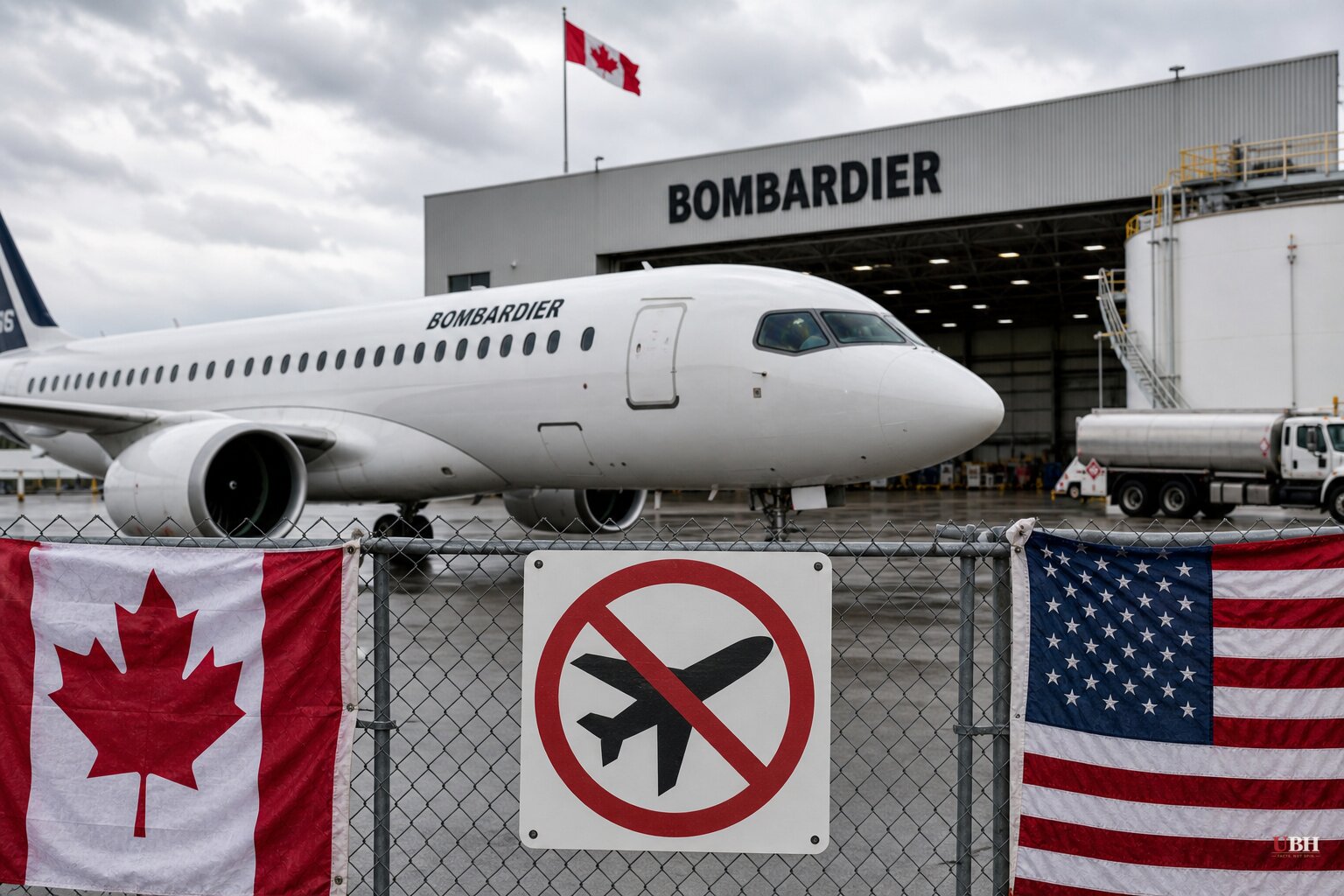
The most concrete casualty of the trade fight Tuesday was Bombardier. President Trump posted on social media Monday afternoon, hours before Canada's tariffs kicked in, writing: "NO MORE SELLING BOMBARDIER IN THE UNITED STATES! Their products aren't good enough! Over 50% of their revenue comes from the United States... They even blocked Gulfstream Aerospace from doing business in Canada - Completely unjust and unfair!"
Bombardier's Toronto-listed shares dropped 6% Tuesday, and its US-listed stock (BDRBF, BDRAF) fell the same amount, according to Morningstar/MarketWatch. RBC Capital Markets analysts called the threat "a negative for sentiment" that could "create near-term uncertainty around U.S. customer commitments."
Trump's stated grievance has a specific history behind it. In January, per RBC's note, Trump floated decertifying some Bombardier business jets and threatened a 50% tariff on Canadian-built aircraft because Canada hadn't certified certain planes made by Gulfstream, the American manufacturer owned by General Dynamics. That standoff "was ultimately defused when Canada moved to certify the relevant Gulfstream models," RBC noted. Trump's current threat frames Bombardier as living off American buyers while Canada blocks US companies in return, an argument he has now repeated for the second time this year.
Bombardier pushed back in a statement, saying its plan is "to continue to invest in our people, our customers and the communities in which we operate." The company said its aircraft support roughly 2,800 American supplier companies across 47 states. Neither side has announced a resolution, and no formal US ban has been implemented as of Tuesday.
What the Tariffs Actually Cover
Canada's government said in a statement that the new duties apply 15%, 25%, and 50% rates on goods matching the tariff levels the US placed on Canadian products under Section 338 and Section 232. LiveMint's product list shows the 50% tier hitting dairy items like milk, cream, and whey, plus steel products, plastics, and aluminum articles. Products already in transit to Canada on September 8 are exempt.
RBC Economics, in an analysis of the measures, estimated the Canadian value-added content of the newly tariffed US imports adds up to about 0.4% of Canadian GDP and jobs, meaning the aggregate hit to Canada's economy is small. More than 80% of Canadian exports remain duty-free under CUSMA, RBC said.
But RBC flagged an asymmetry worth watching. Only about 3.7% of total US imports of the targeted products came from Canada in 2025, while the US accounted for 81% of Canadian exports of those same products. That means American buyers have far more room to shop elsewhere than Canadian exporters do, concentrating the pain in specific sectors: plastics, electrical machinery, furniture, and wood products, hitting Quebec, British Columbia, and Ontario hardest, according to RBC.
What RBC Doesn't Know Yet
RBC's economists were blunt about the biggest open question: how long any of this actually lasts. They pointed to a pattern of prior Trump tariff actions being modified or dropped within weeks, including blanket Canada tariffs imposed in March 2025 that were reversed days later once a CUSMA exemption list was carved out.
That history cuts against predicting a long-term standoff on Bombardier or the broader Section 338 tariffs. Whether the same pattern of walk-backs repeats depends on what happens next in a trade relationship where both sides have now shown they're willing to escalate first and negotiate later. Friday's CPI report will show whether the oil-driven inflation pressure gives the Federal Reserve, and both governments, less room to maneuver.
Sources used for this briefing
7 links from 7 independent newsrooms (syndicated copies of the same report count once)
These are the sources it draws on, linked so you can verify.


