
Unbiased headlines. Facts, not spin.
Unbiased Headlines is an independently owned news organization. We bring you the facts, not opinions, written fresh from 110+ named sources. Sources linked so you can verify it yourself.
 finance
Notable (6/10)
Event date: October 5, 2026 ·
finance
Notable (6/10)
Event date: October 5, 2026 ·
Blue Owl Redemption Requests Fall for a Second Straight Quarter to $4.2 Billion, but Tech Fund Stays at 39%
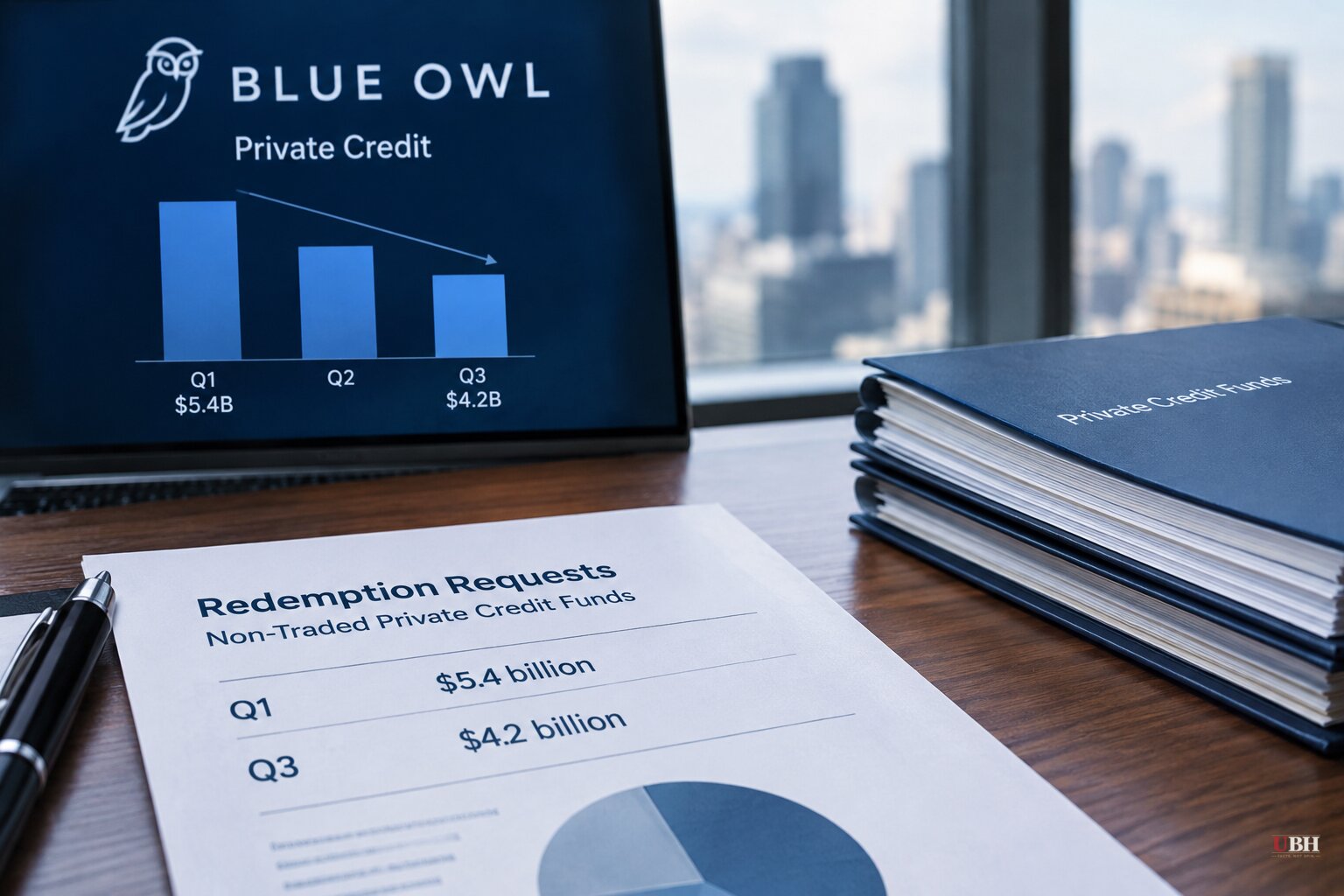
Withdrawal requests at Blue Owl Capital's two non-traded private credit funds fell for a second straight quarter. The firm's Oct. 2 investor letter put third-quarter requests at $4.2 billion, down from $4.7 billion in the second quarter and a record $5.4 billion in the first.
The improvement is real but uneven.
Flagship fund improves, tech fund does not
The drop came mostly from Blue Owl Credit Income Corp. (OCIC), the $35.1 billion fund that is the second-largest non-traded business development company. Requests there fell to 16.8% of outstanding shares from 18.8%.
Blue Owl said most of that demand came from investors resubmitting tenders that went unfilled in earlier periods, not from new withdrawal requests. Non-traded funds typically cap quarterly buybacks at 5% of shares, so anyone not fully paid out has to reapply the next quarter. That keeps the headline number high even when fresh demand cools.
The $5 billion Blue Owl Technology Income Corp. (OTIC) moved the other way. Investors there sought to withdraw $1.1 billion, or 39% of shares, up from 38.1% in the second quarter. The fund lends heavily to software companies.
A competitor also reports easing
Goldman Sachs' $18.2 billion GS Credit fund reported requests equal to 2% of shares, down from 3.2% in the second quarter. It also took in about $400 million of gross inflows.
Blue Owl's own executives have framed the trend as a correction of overreaction. James Clarke, the firm's global head of institutional capital, said on Bloomberg's The Asia Trade today, Oct. 16, that redemptions are coming down after "excessive" market concerns earlier in the year. He runs institutional capital for the firm, so he is an interested party.
Co-CEO Marc Lipschultz has pointed to scale. He said the wealth-channel direct lending products that drew most of the scrutiny make up 11% of Blue Owl's assets, and total assets under management stand at $319 billion. Management also said 90% of OCIC investors requested no redemption at all for the second quarter in a row.
The discount question
The market is not fully buying the all-clear. Cox Capital Partners has an outstanding cash tender offer for OCIC Class I shares at $7.31 each. That is 20% below the fund's reported net asset value of $9.14 as of Aug. 31.
The base offer is for up to $10 million of shares. Cox reserved the right to buy an additional 2% of outstanding Class I shares, roughly $196 million at that price. Before announcing the offer on Oct. 5, Cox told Blue Owl it was considering a tender for up to 33 million shares, about $240 million.
Blue Owl asked for a new tender notice, and Cox said it complied as an accommodation. The offer now commences Oct. 23 and expires at 5 p.m. Eastern on Nov. 25. Price and size are unchanged. John Cox, the firm's CEO, said the goal is "a reliable secondary liquidity option" so advisors have "an alternative path to liquidity."
Separately, Blue Owl Capital Corporation (NYSE: OBDC), a publicly traded BDC with a different portfolio and different liquidity terms, closed at $10.11 on Oct. 9. That was 29.1% below its reported June 30 net asset value of $14.26. Cox's release itself notes OBDC and OCIC are not the same product.
Blue Owl's parent stock has also struggled. Shares of OWL rose 1.56% on Oct. 2 to $9.09, but they were down about 35% year to date at that point, according to 24/7 Wall St.
Subscriptions and 2028 loan maturities
Evercore analyst Glenn Schorr said the tougher problem for non-traded BDCs may now be weak new subscriptions. Direct lending could take time to win back wealth managers and their advisers, he said.
Blue Owl executives told analysts software portfolio performance has been broadly stable, but refinancing risk will matter more as loans mature, particularly around 2028. Management said stronger borrowers should be able to extend on tighter terms. Weaker credits may have to cut leverage materially, or could ultimately be sold or handed to lenders.
Truist Securities data on Blue Owl Technology Finance Corp. shows software non-accruals at 0.1% of fair value and 0.6% of cost. Median revenue growth and free-cash-flow margins have been stable for four quarters.
Trouble abroad
Outside the U.S., stress has grown. Australia's Metrics Credit Partners, which manages about A$40 billion ($28 billion), froze redemptions in some unlisted funds after auditor KPMG declined to sign off on annual accounts for three listed vehicles.
Metrics said KPMG disagreed with assumptions in preliminary statements, including the valuation of unlisted commercial real-estate equity investments. Australia's corporate regulator said it is closely monitoring the sector and had already warned about valuation, liquidity, governance and transparency practices.
The next data point arrives Oct. 23, when Cox's tender opens. How many OCIC holders accept $7.31 a share before the Nov. 25 expiration will show how much of the fund's investor base values quick liquidity above the reported $9.14 NAV.
Sources used for this briefing
7 links from 7 independent newsrooms (syndicated copies of the same report count once)
These are the sources it draws on, linked so you can verify.


