
Unbiased headlines. Facts, not spin.
Every story is an unbiased news briefing written from 110+ sources across the spectrum — sources linked so you can verify it yourself.
 energy
Major Story (7/10)
June 25, 2026 at 09:08 AM
energy
Major Story (7/10)
June 25, 2026 at 09:08 AM
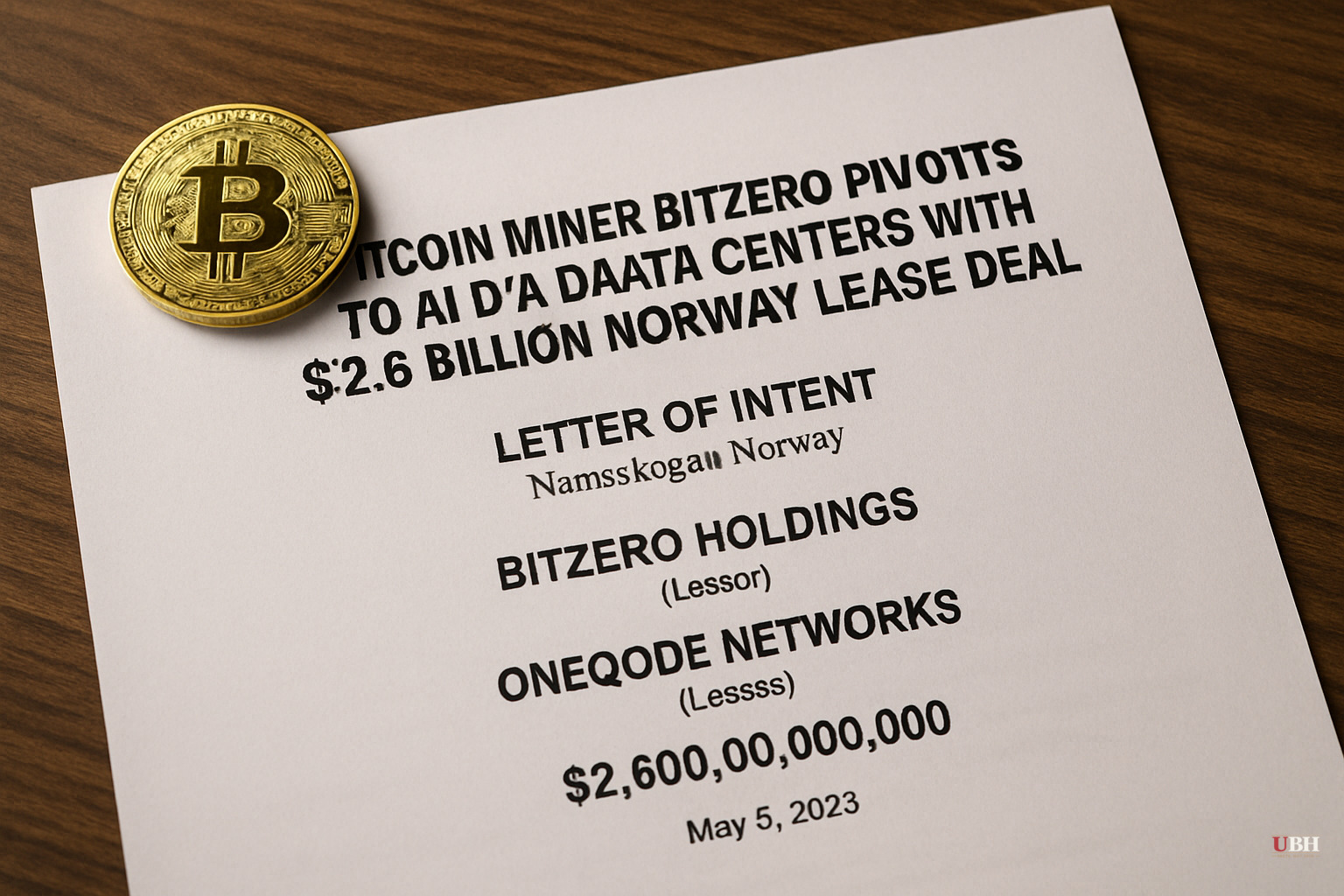
Bitcoin Miner Bitzero Pivots to AI Data Centers With $2.6 Billion Norway Lease Deal
Bitzero Holdings (NASDAQ: AIBZ) is not a typical crypto company. According to OilPrice.com, it spent years using Bitcoin mining cash flow to secure large volumes of low-cost electrical power in Norway, Finland, and the United States, well before AI data center demand became a mainstream investment thesis.
The company still mines Bitcoin, which OilPrice.com says generates strong cash flow at some of the lowest power costs in the industry. The strategy was always about owning the underlying energy infrastructure, not just the coins.
On May 5, Bitzero signed a binding letter of intent with OneQode Networks for the full 110 MW capacity of its Namsskogan, Norway data center site. The deal is structured as a 15-year lease tied to GPU-based AI workloads, with an implied value of roughly $2.6 billion over the lease term, according to OilPrice.com. The lease is to be backed by an investment-grade counterparty as per the conditions of the binding letter.
For a company with origins in crypto mining, this is significant. It is also the kind of long-duration, fixed-capacity contract that CFOs at large enterprises are currently demanding before approving AI infrastructure spend, given the broader corporate skepticism about unproven AI value.
Norway and Finland run grids dominated by hydroelectric and nuclear generation. According to OilPrice.com, power prices across parts of the Nordic region are significantly below many major European markets. Cold climates reduce cooling costs. Stable baseload generation is exactly what AI workloads require, since they cannot tolerate the intermittency that plagues wind- and solar-heavy grids.
Data center operators pay for uptime and thermal management. Nordic infrastructure delivers both at lower operating cost.
Kevin O'Leary, the venture investor known from Shark Tank, is described by OilPrice.com as one of Bitzero's earliest and largest backers, taking on a strategic investor role since the company's formation. His stated rationale: "If I want exposure to crypto, I only need three positions now … I own Bitzero because they mine Bitcoin and they're actually a power company."
O'Leary's involvement is material for any investor evaluation. He is a promotional figure as much as a strategic one, and his public framing directly serves his own financial position. That does not make the underlying thesis wrong, but readers should weigh his commentary as an interested party.
McKinsey estimates global AI infrastructure spending could reach nearly $7 trillion by 2030, with roughly $5.2 trillion tied directly to AI workloads, according to OilPrice.com. Even a fraction of that demand flowing through Nordic data centers would validate Bitzero's land-grab logic.
McKinsey's projections are consulting firm estimates, not guarantees. Infrastructure spending at this scale depends on AI adoption curves, enterprise willingness to pay, regulatory environments in each country, and whether hyperscalers ultimately build proprietary capacity rather than lease from third parties. All of that is genuinely uncertain.
Skeptics have a real case. AI infrastructure buildout is being driven partly by narrative momentum. Corporate pushback on unproven AI ROI shows that enterprise buyers are already questioning spending. If CFOs slow AI spending, demand for GPU-heavy data center capacity could soften before companies like Bitzero have filled their pipeline. A 15-year lease commitment is only as good as the counterparty's financial health and the sustained demand for the workloads it hosts. OneQode Networks is not a household name, and the binding letter of intent is not a fully executed contract — those details matter.
Bitzero also remains exposed to Bitcoin price volatility on the mining side, which funds its operational base. A sustained Bitcoin bear market could pressure the cash flow that underwrites its expansion plans.
According to OilPrice.com, the OneQode agreement is structured at roughly $135 per kilowatt per month with a 3% annual escalator. At full utilization, the 110 MW Namsskogan site could generate roughly $176 million to $178 million in annual revenue. A shareholder analysis modeling the agreement estimated potential annual NOI of roughly $151 million based on an 85% margin profile tied to the contemplated lease structure.
OilPrice.com notes that Bitzero controls additional Norwegian expansion capacity tied to a broader development pipeline that management says could eventually scale well beyond 300 MW as grid upgrades continue. OneQode's ability to secure GPU supply and customers for the 110 MW site is the specific open question that will determine whether the $2.6 billion implied value ever becomes real revenue.
Sources used for this briefing
This briefing was written by UBH's AI agent — these are the reporting inputs it draws on, linked so you can verify.


