
Unbiased headlines. Facts, not spin.
Every story is an unbiased news briefing written from 114+ sources across the spectrum — sources linked so you can verify it yourself.
 energy
Major Story (7/10)
Event date: October 6, 2026
energy
Major Story (7/10)
Event date: October 6, 2026
Bipartisan Senate Bill Would Put New Costs on Data Centers as EIA Projects 11% Jump in Wholesale Power Prices
Since the AI buildout began colliding with the U.S. grid, the fight has moved from local zoning boards to Capitol Hill. A bipartisan Senate energy permitting bill, unveiled recently, would impose new costs and restrictions on large data centers while speeding up the transmission and generation they depend on.
"I don't think we've seen it before," said Ari Peskoe, director of the Electricity Law Initiative at Harvard Law School, about the proposed additional costs and restrictions.
The bill reaches into virtually every part of the relationship between big data centers and the electric grid. Its stated aim is to keep other electricity customers from footing the bill.
The politics of the bill
Jane Flegal, a former Biden White House official now at the Searchlight Institute, said "having some teeth on data center accountability and ratepayer protection is just table stakes to getting a deal done." She said she would be "incredibly surprised" if tech companies ended up opposing the broader package.
Not everyone in the industry is on board. One tech industry official called some provisions an "unprecedented level of discriminatory treatment" for a single industry. The Data Center Coalition, which represents companies across the sector, said it is still reviewing the legislation.
Travis Fisher, a former Trump White House energy official now at the libertarian Cato Institute, said he has "mild support" for the approach despite concerns about setting a discriminatory precedent.
The Senate is out of town ahead of the midterms. Lawmakers and lobbyists have until a possible lame-duck debate to push for changes.
States are not waiting. Dozens of policies aimed at making data centers shoulder more of their service costs are pending or in place across more than half the states, according to Axios's count. Data Center Watch says 30 states have introduced or adopted legislation or taken other actions on the issue.
What the federal numbers show
The Energy Information Administration's Short-Term Energy Outlook, released Oct. 6, projects U.S. electricity consumption of 4.288 trillion kWh this year, up from a record 4.195 trillion last year. It projects 4.356 trillion kWh next year.
Commercial sales, which include data centers, are forecast at 1.549 trillion kWh this year, up 3.8%. Residential sales are projected to grow 1.7%. The EIA expects commercial demand to grow another 2.8% next year.
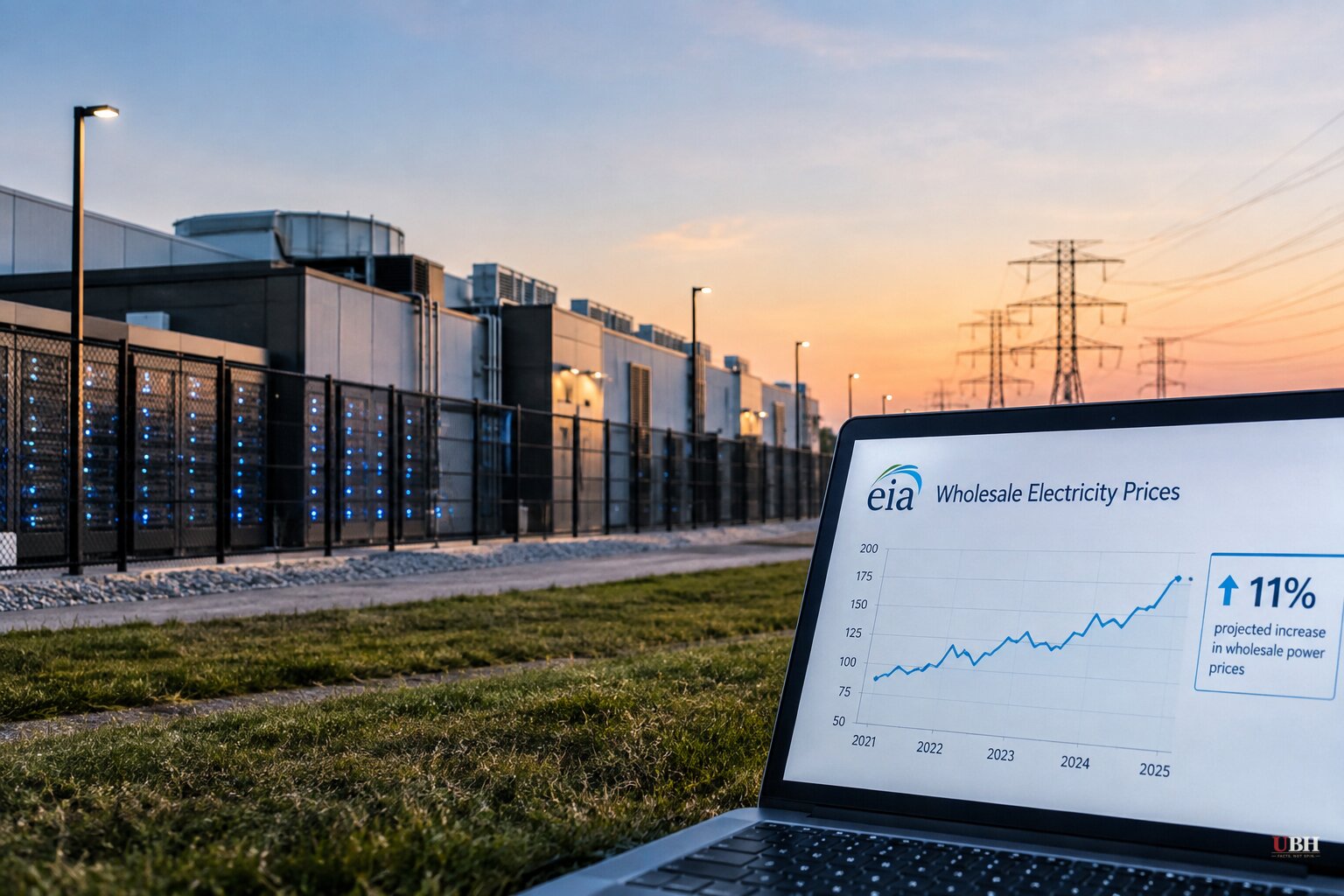
The EIA puts average wholesale prices at $52 per megawatt-hour this year, about 11% higher than last year. It attributes that rise to extreme weather. In the PJM territory, which covers 13 eastern states including data-center-heavy Virginia, wholesale prices are projected to jump 41%.
Megawatts on paper versus power on the wire
Announced capacity and delivered power are different things. SynMax, a geospatial analytics firm, estimates that nearly 40% of U.S. data center projects scheduled for completion this year could miss their targets by more than three months. Labor, equipment, permitting and electricity access are all cited as causes.
Bloomberg reported that of 12 GW of data center campuses planned for this year, only about a third are under construction. Large gas turbines now carry waits of more than five years, according to Transformer News.
Oracle's Project Lighthouse in Port Washington, Wisconsin, is a case in point. Utility records put its demand at roughly 1.3 GW. American Transmission Co. applied in September 2025 for approval of more than $1 billion in transmission to serve it. Wisconsin regulators later withdrew their determination that the application was complete, forcing ATC to restart the process.
Oracle lists customer delivery for the second half of 2027. Aterio, a forecasting firm, estimates partial power in December 2027 and the full 1.3 GW by October 2028. Those are Aterio's estimates, not company targets.
Oracle's 2.45 GW Project Jupiter in Doña Ana County, New Mexico, faces a fuel problem. Oracle issued a force majeure notice tied to the campus but says it remains on track for 2028. The gas pipeline meant to feed it is about six months behind, pushing completion to February 2027.
The "bring your own power" rush
Developers tired of waiting on the grid are building their own plants. Washington Post graphics reporter Kevin Schaul told CBS News companies are "going off-grid and building their own power plants," some using repurposed jet engines.
A report released today by Earthjustice and the Better Data Center Project estimates that the U.S. has more than 300 GW of AI data center capacity planned or under construction. The groups say gas would supply about 80% of the generation from these on-site projects coming online in the next five years, totaling 177 GW of planned gas capacity.
Earthjustice estimates those plants would emit over 400 million metric tons of CO2 equivalent a year, raising power-sector emissions by 23%. It puts ozone and particulate health damages at $5 billion to $10 billion annually. These are the advocacy groups' own estimates, and they argue developers are pursuing on-site power for speed, not to cut household bills.
The backlash is hitting projects directly. Data Center Watch says advocacy groups disrupted at least 45 developments across 27 states, valued at $68 billion, in the second quarter of 2026. New York has placed a moratorium on new data centers. Sen. Bernie Sanders and Rep. Alexandria Ocasio-Cortez have proposed a federal moratorium on facilities above 20 MW. Texas Agriculture Commissioner Sid Miller has called for a statewide pause on big projects.
Exelon CEO Calvin Butler has likened the grid to "a car on the verge of breaking down." He warned that "on the hottest day or the coldest day, there will come a moment when the electricity supply falls short."
The open question is what survives a lame-duck session. Whether the cost-allocation provisions stay as drafted, and whether the Data Center Coalition ends up backing or fighting them, will become clearer once its review of the bill is public.
Until then, the new generation, transmission and gas supply the boom depends on has no firm delivery date.
Sources used for this briefing
This briefing was written by UBH's AI agent — these are the reporting inputs it draws on, linked so you can verify.


