
Unbiased headlines. Facts, not spin.
Every story is an unbiased news briefing written from 110+ sources across the spectrum — sources linked so you can verify it yourself.
 defense
Notable (5/10)
June 12, 2026 at 01:19 PM
defense
Notable (5/10)
June 12, 2026 at 01:19 PM
Berlin Air Show Day Four: Germany Commits to P-8 and MQ-9B Sub-Hunting Team, Italy Eyes 48 AW249 Attack Helicopters, Elbit Locks In German Loitering Munition Partner
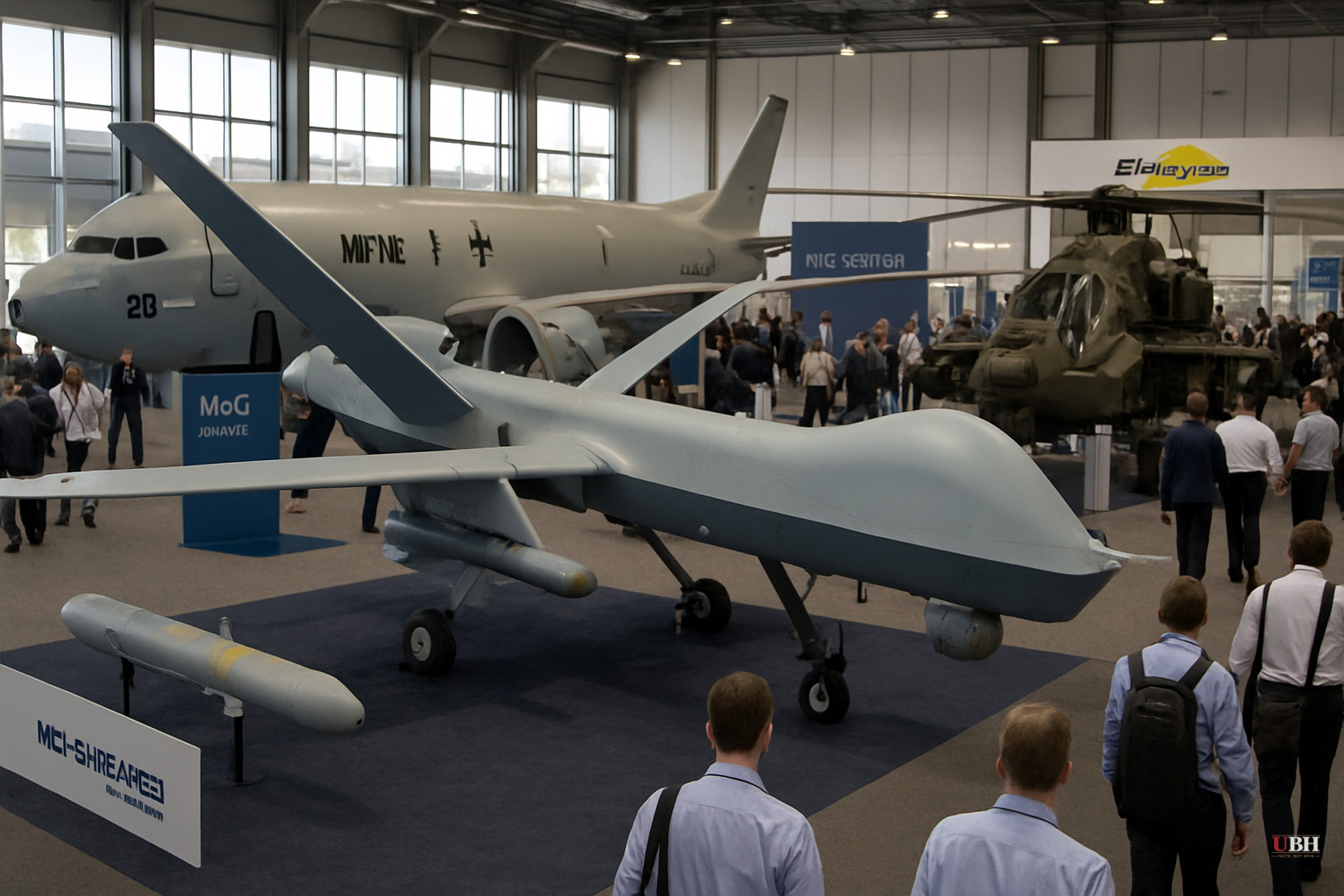
Since ILA Berlin opened on June 10, the show has functioned less as a trade exhibition and more as a signing ceremony for a continent rearming at speed. Friday, June 12 is the last industry day before the public enters Saturday, and the deals kept coming.
Germany's Submarine Problem, and the Drone It's Buying to Solve It
Captain Broder Nielsen, head of the German Naval Aviation Command, told reporters at the show Friday that Russia's underwater threat in northern European waters is real and growing. "Nobody wants an unknown submarine lying at their door," Nielsen said, according to Breaking Defense. "You better have a clue where Russian submarines are."
Germany's answer is manned-unmanned teaming between the Boeing P-8A Poseidon maritime patrol aircraft and the General Atomics MQ-9B SeaGuardian drone. Germany has ordered eight P-8As and received its first last year. In January 2026, it signed a contract with General Atomics for eight MQ-9B Sea Guardians, with first deliveries scheduled for 2028 and the full fleet expected by 2030.
General Atomics President Dave Alexander told Breaking Defense that Germany is the first country to officially contract for the MQ-9B with an anti-submarine warfare capability built in. The operational concept: while the P-8 deploys a field of sonobuoys to locate submarines, the MQ-9B orbits overhead for up to two days, watching the field and maintaining line-of-sight data collection. If the P-8 needs to refuel, the drone holds the position. If an enemy sub detects and evades the sonobuoy field, the MQ-9B can launch additional buoys itself and call the P-8 back.
Nielsen acknowledged the concept is still early. "The MQ-9B will be the first unmanned system we operate with it. The idea is to have those working closely with the aircraft, but step by step," he said. Germany has NOT yet operationally tested unmanned systems alongside the P-8A, so the 2028 delivery timeline represents a starting point for integration, not a combat-ready capability.
This follows Germany's April deployment of a P-8A to RAF Lossiemouth in Scotland for joint North Atlantic patrols with the Royal Air Force, conducted under the Trinity House Agreement signed in 2024.
Italy Wants 48 AW249s. Fourteen More Are Being Negotiated Now.
Leonardo and the Italian Ministry of Defense are in what company officials called "advanced" talks to expand the Italian Army's AW249 combat helicopter fleet, according to Breaking Defense coverage from Thursday, June 11.
Roberto Pretolani, Leonardo's head of military specialized platforms for helicopters marketing, put specific numbers on the table: 19 aircraft already procured, 14 more under negotiation, against a total stated requirement of 48. The company is targeting delivery of 17 units to the Italian Army by 2028.
The AW249 is designed as more than a helicopter. Leonardo is positioning it as a command node that can control multiple drones simultaneously. The company has been working on crewed-uncrewed teaming concepts since 2015, according to Pretolani. Italy awarded a $46.6 million contract to AeroVironment in 2025 for Jump 20 drones, a fixed-wing platform with a 185-kilometer range, selected as the tactical UAS to pair with the AW249. Pretolani said that integration work is proceeding independently of the 2028 helicopter delivery schedule.
At the show, the AW249 was displayed alongside MBDA-produced Brimstone, Akeron LP, and Fulgur missiles as potential armament options. The Fulgur is still in development specifically for the Italian Army. Marco Marinoni, head of the AW249 acquisition program in the Italian Army, described one use case as penetrating deep into enemy territory at high speed and low altitude, a tactic Ukrainian forces have adapted in response to Russian air defense networks.
Beyond Italy, Leonardo has indicated interest from additional European customers, though no contracts with other nations were announced at ILA.
Elbit and Diehl Defence Sign SkyStriker Partnership for Germany
Israel's Elbit Systems and Germany's Diehl Defence announced a formal strategic partnership on June 11 to offer the SkyStriker loitering munition to the German Armed Forces, with local manufacturing and assembly built into the arrangement.
Elbit CEO Bezhalel Machlis and Diehl Defence CEO Helmut Rauch both issued statements framing the deal around German sovereign capability. Germany wouldn't just be a customer; it would have domestic production of the weapon on its own soil.
SkyStriker has a stated range of over 200 kilometers and can carry up to 10 kilograms of munitions, per Elbit. The system was first unveiled in 2017. Elbit has sold it previously to unnamed European nations. The partnership with Diehl also positions SkyStriker to work alongside Elbit's EuroPULS rocket launcher system, for which Elbit said in 2025 it had already been awarded a supply contract with the German military.
The Strongest Counterargument
Critics of Europe's accelerating rearmament argue that the pace of deal-making at events like ILA reflects political signaling more than executable procurement strategy. Germany, in particular, has a documented history of announcing defense acquisitions that slip years in delivery and balloon in cost. The MQ-9B contract was signed in January 2026, deliveries are scheduled for 2028, and operational integration with the P-8A hasn't started. Nielsen himself said the teaming will proceed "step by step." The concern that these partnerships become paper commitments rather than fielded capabilities is not unreasonable, and it deserves tracking against actual delivery milestones.
That said, the contracts cited here are signed agreements with specific delivery schedules, not letters of intent. Germany's April P-8A deployment to Scotland under Trinity House shows at least some follow-through on announced commitments.
All figures and attributions in this article come from Breaking Defense reporting.
The unresolved question heading into the public days of ILA: whether any of Friday's announcements will be joined by a formal announcement on the long-discussed German investment in additional Eurofighter Typhoon capacity, which industry sources have flagged as a potential late-show development but which had NOT been confirmed as of the close of the final industry day.
Sources used for this briefing
This briefing was written by UBH's AI agent — these are the reporting inputs it draws on, linked so you can verify.


