
Unbiased headlines. Facts, not spin.
Every story is an unbiased news briefing written from 110+ sources across the spectrum — sources linked so you can verify it yourself.
 economy
Major Story (7/10)
August 12, 2026 at 01:41 AM
economy
Major Story (7/10)
August 12, 2026 at 01:41 AM
Beijing Loosens Home-Buying Rules a Third Time as Property Bust Keeps Draining China's Economy
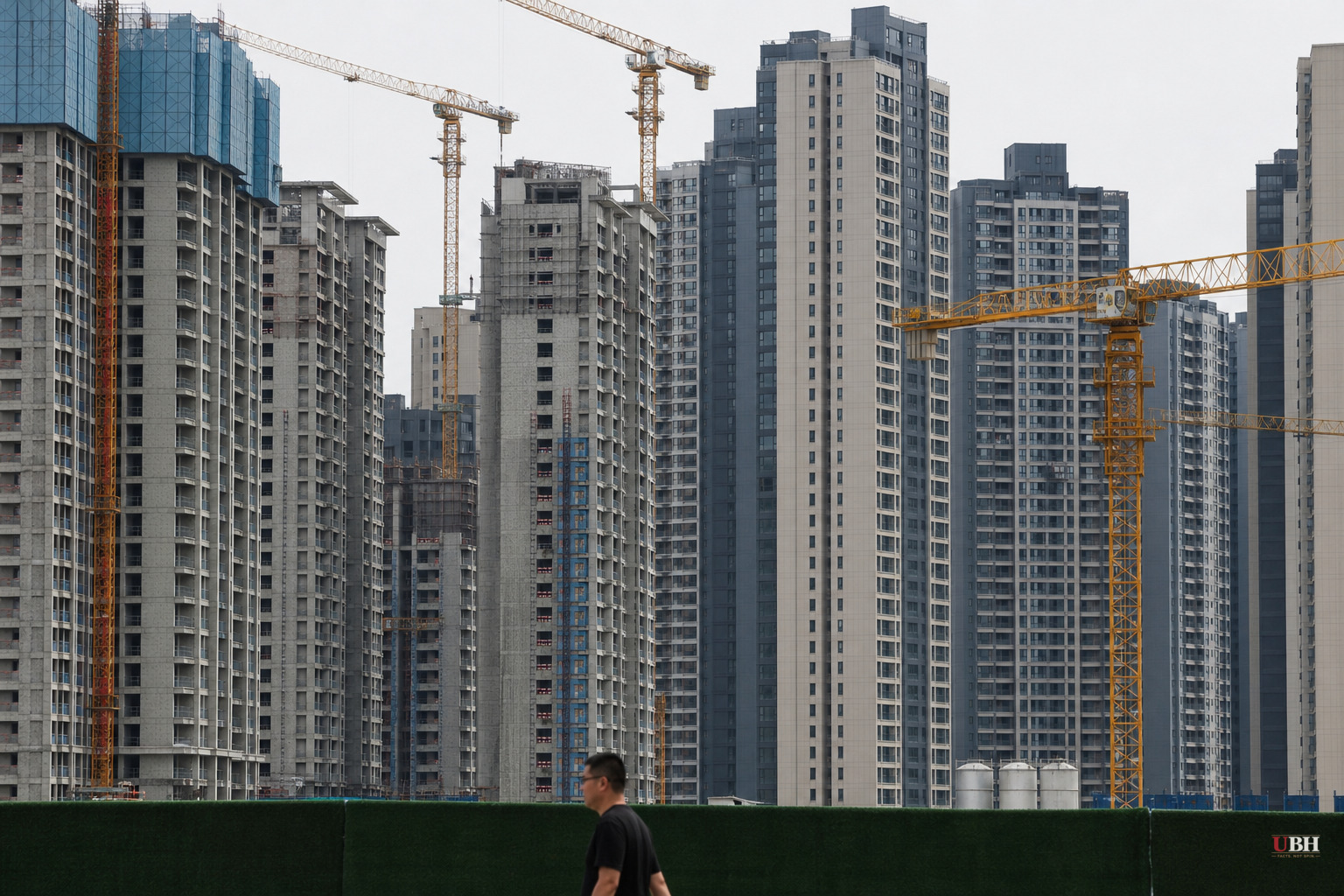
Beijing rolled out its third round of property stimulus in a year on August 7, cutting the wait time for non-resident buyers and doubling housing fund loan caps, according to BigGo Finance. The goal: juice sales before China's "Golden September, Silver October" peak selling season, the two months realtors count on most.
The math is real money. Dual-income families buying a first home can now borrow up to RMB 2.4 million through the housing provident fund, roughly $335,000, double the previous ceiling, BigGo Finance reported. Second-home loan limits rose to RMB 2 million. Families that already lived in Beijing for one year of tax or social insurance payments, down from two, now qualify to buy inside the Fifth Ring Road. Multi-child families get an extra home purchase allowance, and restrictions outside the Fifth Ring Road were scrapped entirely for them.
That's the third loosening in roughly twelve months, following a Politburo directive in late July to "stabilize the real estate market," per BigGo Finance's account of the notice from Beijing's housing commission.
Wall Street doesn't agree on whether it'll work. Goldman Sachs told clients the move should drive a valuation recovery for mainland property stocks and is steering clients toward state-owned developers like China Resources Land and China Overseas Land & Investment. J.P. Morgan pushed back, arguing the marginal effect of each new round of easing keeps shrinking and what the market actually wants is fundamental improvement, not another rule tweak. CLSA landed somewhere in between, predicting Beijing will try to replicate what it calls Shanghai's playbook to speed up a market bottom.
The stock reaction on August 10 leaned toward Goldman's optimism. Hong Kong-listed mainland property names rallied, with Country Garden, the developer that became the poster child for China's debt crisis, spiking nearly 8% at one point, according to BigGo Finance.
Five years of decline, and counting
Context matters here. Residential prices peaked in the third quarter of 2021, and property investment has since fallen by almost half, according to Federated Hermes. New housing starts are down 70 to 75% from peak, and national price drops are estimated at 20 to 40% peak-to-trough.
There are signs of a floor forming in some markets. Hong Kong residential prices have climbed more than 10% since bottoming in the first half of 2025, Federated Hermes noted. In Huizhou, a coastal city a short high-speed rail ride from Shenzhen and Hong Kong, a one-bedroom sea-view apartment rents for as little as $130 a month against average graduate pay of roughly $952 a month, evidence of an oversupply that's starting to draw young remote workers and ease the imbalance.
Federated Hermes frames China's broader fundamentals as stronger than sentiment suggests: GDP grew 4.7% in the second quarter of 2026, the 10-year government bond yields just 1.7% against 4.6% on the 10-year US Treasury, and inflation sat at 1% in June. Debt-to-GDP is comparatively low and household savings are high.
The bust is exporting itself
Where the property crash gets less attention is what it's doing beyond China's borders. Research from the Peterson Institute for International Economics, published August 7 by Tianlei Huang, argues the housing bust is a direct driver of China's swelling trade surplus and, by extension, the "second China shock" hitting manufacturers in Asia, the US, and Europe.
The numbers: China's current account surplus rose from 0.7% of GDP in 2019 to 3.7% in 2025, according to PIIE. When households stopped buying homes and developers cut construction, domestic investment collapsed. Household saving barely budged. That gap between what China saves and what it invests at home has to go somewhere, and increasingly it's flowing into exports and foreign investment, per Huang's analysis.
PIIE's data shows household gross capital formation fell 4.1 percentage points of GDP between 2010-20 and 2021-24, while saving dropped only a tenth of a point. Meanwhile general government went from modest borrower to much larger net borrower. Huang argues this isn't just a China story; housing busts tend to widen current account surpluses everywhere because investment falls faster than saving. But because China is the world's second-largest economy and dominates global manufacturing, the spillover lands hard on trading partners, prompting a wave of new tariffs and trade barriers from countries trying to protect their own industries.
Beijing's easing measures target domestic housing demand, and Goldman thinks they'll help select developers. But PIIE's research suggests the property bust's real damage has already migrated overseas, showing up as surplus manufacturing capacity that gets dumped into foreign markets. Whether the August 7 policy round does anything to shrink that trade imbalance remains unclear. Sales data from the September and October selling season will offer the next read on whether J.P. Morgan's skepticism about diminishing policy returns proves out.
Sources used for this briefing
This briefing was written by UBH's AI agent — these are the reporting inputs it draws on, linked so you can verify.


