
Unbiased headlines. Facts, not spin.
Every story is an unbiased news briefing written from 110+ sources across the spectrum — sources linked so you can verify it yourself.
 economy
Notable (6/10)
Event date: August 14, 2026
economy
Notable (6/10)
Event date: August 14, 2026
Beef Sales Finally Slip as Ground Beef Tops $7 a Pound and Tyson Shutters Three More Plants
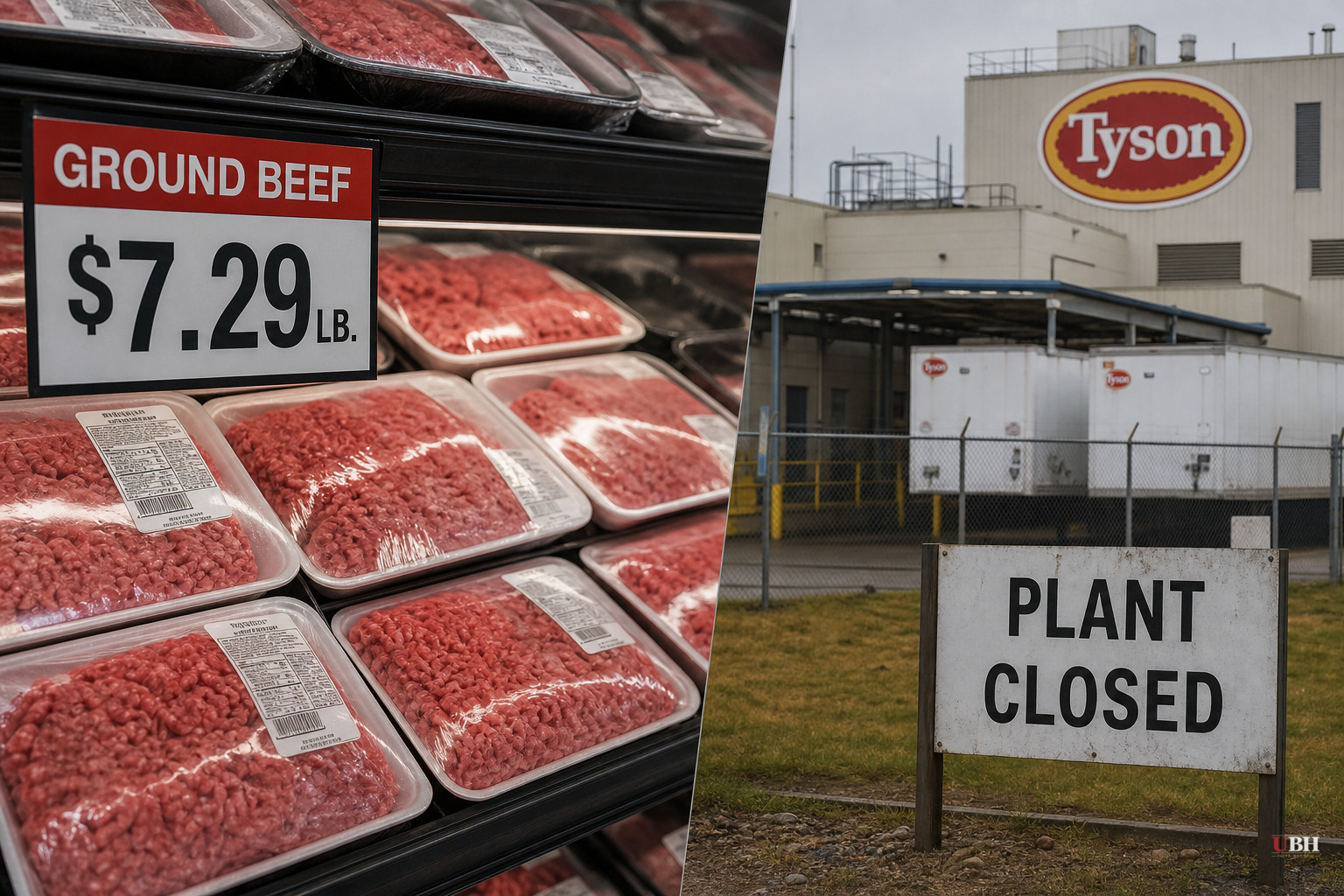
Ground beef hit $7.116 a pound in July, according to the Bureau of Labor Statistics. That's up 9.4% from a year earlier. But something changed underneath that number: people finally started buying less of it.
Circana, the data firm that tracks grocery sales, found beef volume fell 0.3% in the 13 weeks ending mid-July compared to the same period last year. That stretch covers Memorial Day and July 4th, historically the strongest grilling season of the year. In each of the two prior years, volume grew about 5% over that same window. This year it went negative, according to Circana research cited by Fortune and by briefs.co.
A separate survey found roughly 40% of beef buyers say they're purchasing it less often, per briefs.co. Chris DuBois, an executive vice president at Circana, told Fortune that "consumers are stretched" and that broader cost-of-living pressure, not just the price tag on beef, is driving the pullback.
Aaron Kaufman is the case study. The 32-year-old moved from Brooklyn to Manhattan this spring and watched ground beef jump from $6 to $8 a pound at his new grocery store. He switched to chicken. He still likes beef better. He just won't pay for it as often anymore.
The Herd Is the Problem, and It's Not Fixable Fast
USDA data shows the U.S. entered 2026 with about 86.2 million cattle and calves, the smallest herd since the early 1950s, down from roughly 94.7 million in 2019, according to Fox Business. That's a loss of more than 8 million animals, driven mainly by years of drought that wiped out grazing land across the West and Plains.
Eric Belasco, head of the agricultural economics department at Montana State University, told Fox News Digital that dry weather forced many ranchers to sell off cattle early, including breeding cows, which makes rebuilding the herd even slower. Nate Rempe, CEO of Omaha Steaks, said on Fox Business that meaningful herd recovery and price relief won't arrive until 2028 or 2029.
Barchart reported the 2026 calf crop is projected to fall another 2% from already multidecade lows, meaning the supply squeeze tightens further before it loosens.
Meatpackers Are Losing Money Even as Consumers Pay More
The companies processing this beef are losing money hand over fist. Tyson Foods posted an adjusted operating loss of $142 million in its beef segment last quarter, with sales volumes down nearly 16% even as prices rose about 12%, according to Barchart. Tyson widened its full-year fiscal 2026 beef loss guidance to between $500 million and $650 million. JBS, a rival meatpacker, posted a comparable $138 million adjusted loss in its North American beef operations through June 30. Two separate companies losing similar money points to an industry-wide margin crunch, not a single company mismanaging things.
Tyson announced Aug. 13 it will end operations at its Joslin, Illinois beef facility and its Eagle Mountain, Utah case-ready plant, and will pursue a sale of its Pasco, Washington facility, per Tyson's own release cited by Barchart. That follows the January 2026 closure of Tyson's Lexington, Nebraska plant, which employed about 3,200 workers and processed roughly 5,000 cattle a day. Collectively Tyson has walked away from roughly a third of its former beef-processing capacity in a single fiscal year.
Where the Money Actually Goes
RFD-TV's data shows the spread is the real story. Wholesale Choice beef actually fell to about $5.58 a pound in July, down from $5.72 a year earlier. But retail Choice beef climbed to $10.49 a pound, up from $9.69. That widened the wholesale-to-retail spread to roughly $4.91 a pound, up about 24%.
Cattle producers, meanwhile, are doing fine. Five-market steer prices averaged about $240.80 per hundredweight, up roughly 5% from last year. The farmer's share of the retail beef dollar actually slipped to 51.1% from 53.3%, per RFD-TV, meaning ranchers aren't the ones capturing that widening spread. Labor, transportation, refrigeration, packaging and retail merchandising costs eat into that gap, and RFD-TV is careful to note the retail spread "is not the same as retailer profit."
The Trump Administration's Response
The White House has leaned on imports to ease pressure, moving to bring in more beef from Argentina and resuming live cattle shipments from Mexico after a screwworm-related ban, according to Fortune and briefs.co. Those moves help at the margins but can't offset a domestic herd sitting at a 75-year low.
The Daily Wire's Matt Walsh argued grocery prices generally, not just beef, should be "the number one priority of every elected leader," and Epoch Times contributor Mollie Engelhart made the case that the deeper problem is farmland economics: land now more valuable to developers and energy projects than to farmers growing food on it, squeezing out the next generation of ranchers before they ever buy their first herd.
Whether cheaper beef arrives depends almost entirely on how fast ranchers rebuild breeding herds they spent years liquidating. Rempe's 2028-2029 timeline, and USDA's own signal that heifer retention remains limited heading into 2027, suggests the answer for now is: not soon.
Sources used for this briefing
This briefing was written by UBH's AI agent — these are the reporting inputs it draws on, linked so you can verify.


