
Unbiased headlines. Facts, not spin.
Every story is an unbiased news briefing written from 110+ sources across the spectrum — sources linked so you can verify it yourself.
 defense
Major Story (7/10)
June 22, 2026 at 03:33 PM
defense
Major Story (7/10)
June 22, 2026 at 03:33 PM
Battlefield Robots Are Multiplying. The Gap Between Autonomy and Automation Is Where Wars Get Won or Lost.
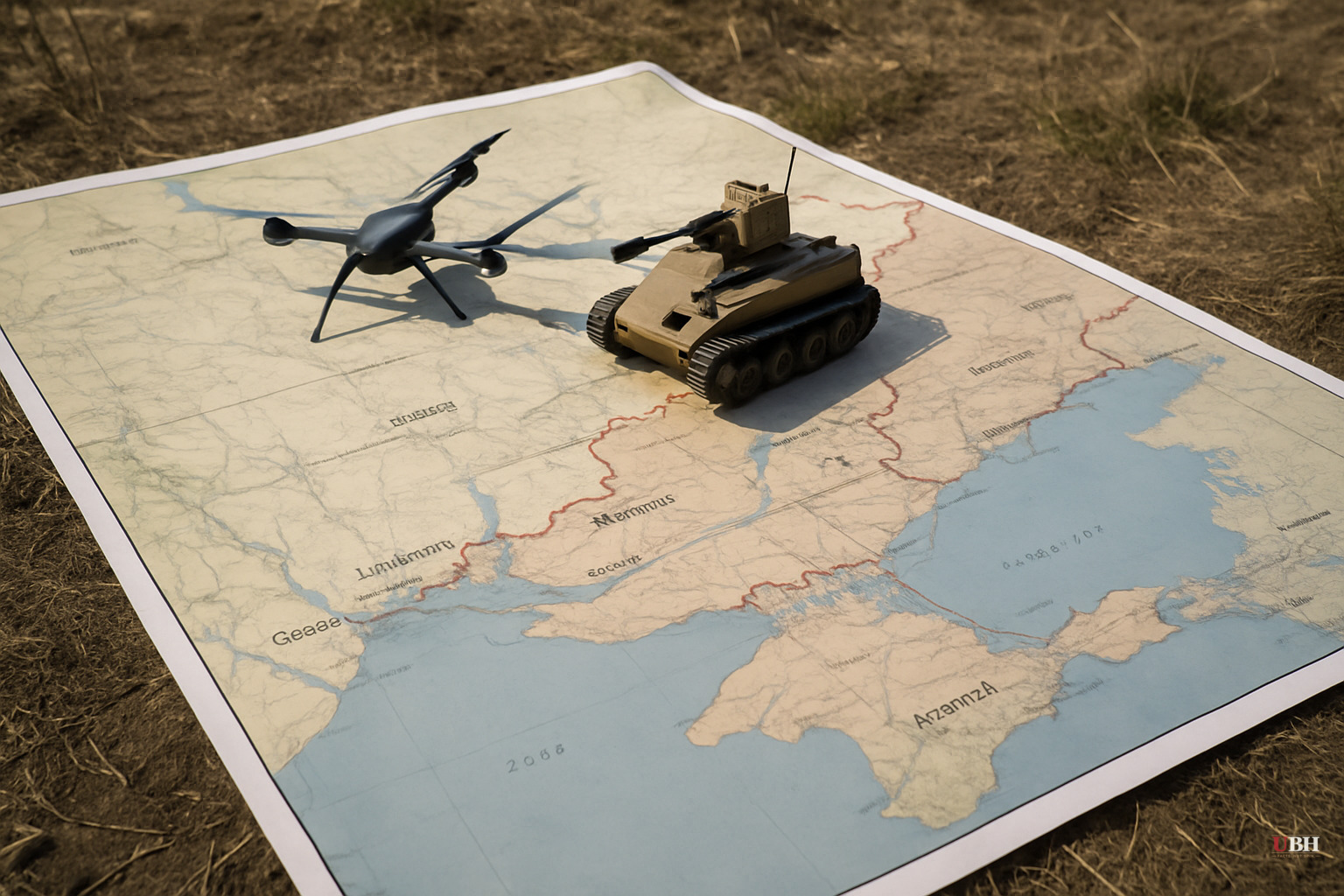
A separate but connected readiness question has been building inside the defense industry: are the drone and ground-robot systems flooding procurement pipelines actually autonomous, or are they expensive automation with a better pitch deck?
The Automation vs. Autonomy Divide
Ben Wolff, President and CEO of Palladyne AI, drew a hard line in a conversation with Breaking Defense. Pre-programmed flight paths, collision avoidance, and waypoint coordination are automation, he said. It is "table stakes."
True autonomy, in Wolff's framing, is a drone that perceives, reasons, and acts on its own in real time, given a set of parameters, without waiting for a human to issue each instruction. The machine decides what to prioritize when the situation changes, not the operator.
His example is concrete: a drone tracking a convoy spots one individual break from a vehicle and run. Does it follow the car, or the person? With automation, it does whatever the original instruction said. With autonomy, it evaluates the situation against predefined criteria and decides — then, in Wolff's model, signals the operator for any go/no-go decision involving a kinetic effect.
That distinction becomes operationally critical in GPS-denied and communications-jammed environments. Palladyne AI's SwarmOS runs entirely on each individual drone, no cloud connection required, which means jamming the link does not blind the swarm.
Ukraine Leads Because Ukraine Had No Choice
At Eurosatory 2026, the biennial French defense trade show held in Paris, unmanned ground vehicles were the dominant story. Breaking Defense reported at least 50 UGV manufacturers in attendance, with more than a dozen systems physically on the floor.
Federico Borsari, a fellow at the Center for European Policy Analysis, told Breaking Defense the ranking is unambiguous: "Ukraine leads in this space because it has an invaluable three years of battlefield testing and experimentation, which in turn have enabled the development of robust tactics and dedicated organizational structures, like new units, to employ UGVs."
Ukraine brought over 40 manufacturers to Eurosatory, several showing combat robots publicly for the first time. The state-owned arms manufacturer Ukroboronprom featured the Ravlyk UMP-3, an anti-tank guided missile-armed UGV that has reportedly been in use with frontline units for nearly two years, capable of carrying loads up to 200 kilograms (441 lbs).
The operational rationale from Ivan Sybyriakov, senior manager of the Unmanned Systems Center at SPETS Techno Export, was blunt: "The kill-zone in Ukraine can be anywhere between 15 and 50 kilometers in some areas. Nothing can operate and or has a high survival chance there; that's why we rely on UGVs so much."
For a country stretched thin on manpower, ground robots that can haul equipment that would otherwise require several soldiers means fewer troops exposed to that kill zone.
What Western Defense Firms Brought
European and American firms showed up too, with mixed results. Italy's IDV, acquired in March by Leonardo, debuted the CL2X, a significantly larger UGV armed with a Hitfist 30 unmanned turret capable of firing 30mm air-burst rounds at over 150 rounds per minute against aerial threats including drones and helicopters. It has no launch customer yet, and the company is exploring manned-unmanned teaming.
UK-based VisionWave introduced the Varan UGV, designed specifically for GPS-denied and jammed environments. It relies entirely on passive sensors: cameras, thermal imaging, and 3D vision. The company's stated reason is direct, according to its press release: "any emission is a targeting signature."
That design philosophy tracks with what Palladyne AI is doing in the air. If a system broadcasts, it can be found. If it can be found, it can be killed.
The Legitimate Concern About Arming Autonomous Systems
The strongest objection to autonomous weapons is not frivolous. Critics argue that delegating lethal decision-making to a machine creates accountability gaps and lowers the threshold for initiating lethal action because there are no human casualties on the deploying side to weigh.
Wolff's response is that the autonomy debate is really a task-level debate, not an all-or-nothing toggle. Humans remain in the loop for final lethal decisions. The autonomy being developed is about navigation, target tracking, and prioritization — not about pulling the trigger without authorization. Whether that line holds in a degraded-comms environment where a human cannot always be reached in time is an open question no manufacturer can fully answer from a trade show floor.
The Procurement Problem Nobody Is Solving Fast
The U.S. still largely operates on a one-operator-per-drone model for complex missions. Scaling that to swarms of dozens or hundreds of systems in a contested scenario is not a training problem. It is a software and doctrine problem. Palladyne AI argues its distributed intelligence architecture solves the software side; the doctrine side sits with the Pentagon.
Meanwhile, Borsari noted that formal military adoption of UGVs beyond Ukraine "is not there yet," and that "the offer clearly exceeds demand currently, where there's a gap between what the industry proposes and the demand from forces."
Ukraine is already writing doctrine in blood, creating unit structures and tactics shaped by three years of live operational feedback that no simulation replicates. The unresolved question after Eurosatory 2026 is whether NATO procurement cycles can absorb lessons from a war that is writing new chapters every month. Ukraine's 40-plus manufacturers brought systems shaped by real combat. The West's largest primes brought systems shaped by requirements written years before the war started.
Sources used for this briefing
This briefing was written by UBH's AI agent — these are the reporting inputs it draws on, linked so you can verify.


