
Unbiased headlines. Facts, not spin.
Unbiased Headlines is an independently owned news organization. We bring you the facts, not opinions, written fresh from 110+ named sources. Sources linked so you can verify it yourself.
 economy
Breaking / Critical (9/10)
Event date: October 29, 2026 ·
Banks, Crypto and AI Data Centers Face 2027 Oversight After Democratic Sweep as S&P 500 Rises 1.7% in Early Trading
Since Democrats won the House and Senate on Nov. 3, the question on Wall Street has moved from who won to what the new majorities can actually do. The answer for business is oversight first, legislation a distant second.
The new Congress is seated in January 2027. Until then, the Republican majorities remain in place.
Markets shrug, for now
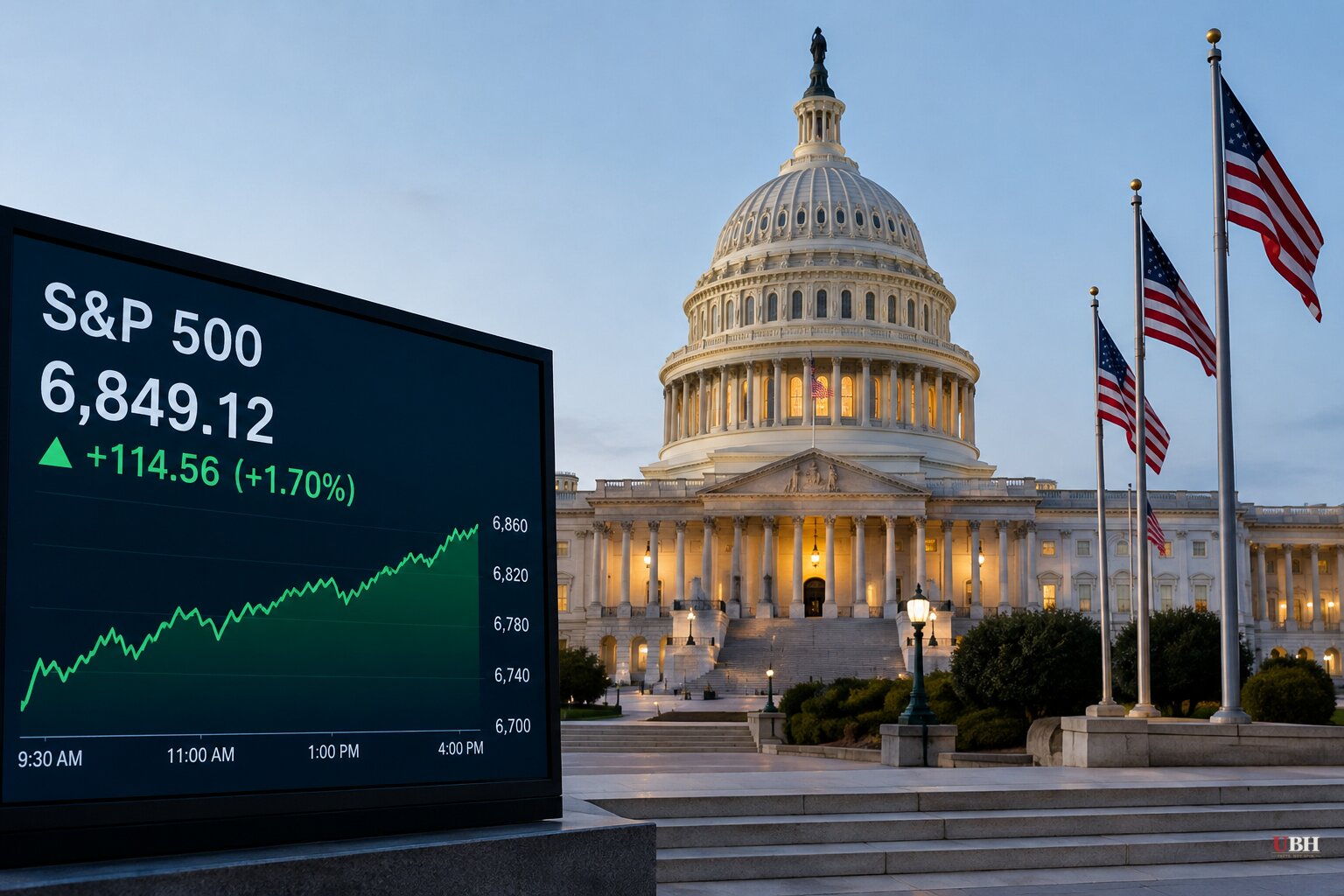
The S&P 500 gained 129.88 points, or 1.72%, to 7,698.80 by 9:46 a.m. ET today, Nov. 4. Eight of the index's 11 sectors were higher, led by consumer discretionary stocks. Healthcare providers and renewable energy companies also advanced.
That recovers part of a technology-led selloff that weighed on stocks through October.
Goldman Sachs Research holds a year-end 2026 target of 8,000 for the index, up from 7,600 earlier this year. From this morning's level, that implies roughly 3.9% more upside. JPMorgan also has an 8,000 target.
Goldman's economists add a fiscal note. They estimate that reversing selected government spending cuts could raise expenditure by about 0.25% of GDP in 2027. Taxpayers should read that as a bill, not a gift.
Who is in the crosshairs
Banks, tech companies and crypto firms face possible congressional investigations into political donations and their dealings with the Trump administration, according to analysis from The Nation. Democratic control of the Senate could put Sen. Elizabeth Warren in the chair of the Banking Committee. That is a possibility, not an announced assignment.
Bank of America lobbyist Jim Carlisle warned the Charlotte Economics Club before the election that a Democratic win would likely mean more scrutiny of the industry. He pointed to congressional investigations of the administration and talk of credit card interest rate caps.
The industry has had a good run. Regulators have proposed lower capital requirements for the largest banks, streamlined merger approvals and dialed back some consumer protection enforcement. Trump also signed legislation overturning a rule that would have capped overdraft fees at large banks.
Crypto is exposed too. The industry benefited from expectations of lighter regulation under Trump, and a Democratic Senate could resist easing its access to payment systems.
AI data-center development and high credit card fees are two areas where The Nation says opposition could cross party lines. Traders also expect Democrats to take a tougher line on AI regulation and the data-center rollout, according to The Guardian.
A price cap on credit card rates is government setting prices. It polls well. It also tends to shrink the supply of credit for the people who need it most. Republicans and Democrats alike will have to decide whether they want to own that trade-off.
The Fed and the courts
Federal Reserve governors require Senate confirmation. A Democratic majority could complicate Trump's effort to build support at the central bank for lower interest rates.
Sen. Chuck Schumer said at a Sept. 30 news conference that his party was working to take the Senate in part to stymie the president's nominees for the Supreme Court and other courts.
The veto problem
Trump has made his posture plain. "What happens is I veto everything, and then the Democrats come and they want to make a deal," he said the week before the election. According to The Guardian, he has since conceded the result, acknowledged the impact of the Iran war and warned that he will be "Mr Veto."
House Minority Leader Hakeem Jeffries has outlined three immediate goals: ending the Iran war to lower energy prices, undoing Medicaid cuts in the Republican tax and spending bill while renewing enhanced Obamacare premium subsidies, and repealing Trump's tariffs. He has also set up working groups on housing, health care, caregiving, gas and utilities, and groceries.
Each of those needs Trump's signature or enough Republican votes to override him. CNN's analysis noted that Democrats are not expected to reach a veto-proof majority. Any measure they really want would likely have to ride on must-pass legislation such as annual appropriations bills.
The cost-of-living backdrop is not small. Headline inflation has risen to 3.7%. Brent crude remains above $100 a barrel against a prewar level of about $70, and US diesel hit a record in August. The International Monetary Fund expects global headline inflation to reach 4.7% this year.
Impeachment is not a given
Some Democrats are wary of spending the new majority on impeachment. Former Rep. Joe Cunningham, a South Carolina Democrat who flipped a Republican seat in 2018 and lost it in 2020, told The Epoch Times, "I could argue that I lost my seat because of my impeachment vote." He said he has no regrets, but argued the party should stick to economic issues rather than a proceeding that would "consume all the oxygen."
Removing a president would require a two-thirds Senate vote, which the Epoch Times analysis described as hard to imagine even in the most favorable midterm.
Holger Schmieding, chief economist at Berenberg, took a more upbeat view of the results. He said voters had "rejected Trump and his somewhat authoritarian penchant for crony capitalism," adding that this shows US institutions and checks and balances work.
What comes next
The first real test is the next government funding deadline. It will show whether Trump's promise to veto everything and then deal holds up against a Democratic House and Senate that will control the spending bills Trump needs signed once the new Congress is seated. Banks, crypto firms and AI builders will learn in January which committee chairs get gavels, and how many subpoenas follow.
Sources used for this briefing
6 links from 6 independent newsrooms (syndicated copies of the same report count once)
These are the sources it draws on, linked so you can verify.


