
Unbiased headlines. Facts, not spin.
Every story is an unbiased news briefing written from 110+ sources across the spectrum — sources linked so you can verify it yourself.
 defense
Notable (5/10)
June 21, 2026 at 07:24 AM
defense
Notable (5/10)
June 21, 2026 at 07:24 AM
Australia Buys 11 Japanese Mogami-Class Frigates in $6.5 Billion Deal, Japan's Largest Warship Export Since WWII
The Deal
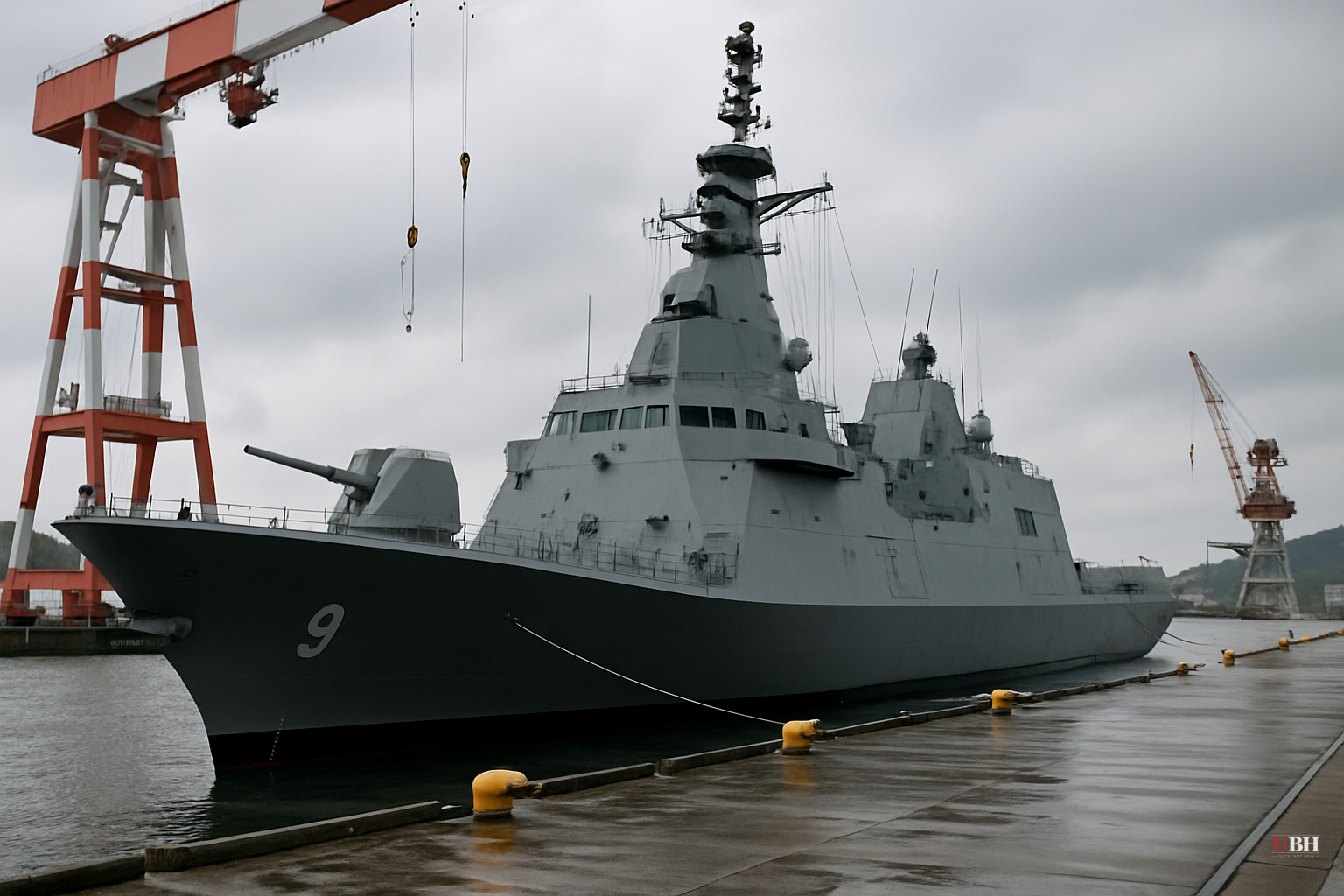
Australia's government confirmed the purchase of 11 Japanese frigates from Mitsubishi Heavy Industries, with Australian Defense Minister Richard Marles calling it "clearly the biggest defence industry agreement that will ever have been struck between Japan and Australia" in a statement to parliament, according to Business Insider.
Canberra is expected to pay $6.5 billion for the fleet. Three vessels will be constructed in Japan, with the remaining eight to be built at a port in Western Australia. The first delivery could come as early as 2029, according to Militarnyi, citing reporting by Japan's Nikkei.
The Japanese frigates beat out competing bids from Germany, Spain, and South Korea.
What Australia Is Actually Buying
The original Mogami is a 427-foot stealth frigate that entered Japanese service in 2022, armed with Type 17 anti-ship cruise missiles, a vertical launch system, torpedo tubes, a five-inch main gun, and drone or helicopter capacity at the stern. Its most notable design feature: automation lets a crew of roughly 90 operate a ship that comparably-sized warships staff with up to 200 sailors.
But Australia may not be getting the baseline Mogami. Japanese Prime Minister Ishiba Shigeru confirmed on social media that the deal involves the "New FFM," a more advanced successor, according to Militarnyi. The New FFM stretches nine meters longer than the Mogami and displaces 4,880 tons rather than 3,900. It carries a 32-cell Mk 41 vertical launch system capable of SM-2 and SM-6 anti-aircraft missiles alongside anti-ship and anti-submarine rounds. Speed stays at 30 knots. Maritime drones for mine countermeasures and reconnaissance are also part of the design.
Business Insider noted the question of whether Australia would receive the upgraded 32-cell VLS variant was unresolved at the time of its reporting. The Militarnyi reporting, which cites Nikkei, suggests the New FFM is the confirmed platform, though final price and contract details were still being negotiated as of that reporting.
Japan's 80-Year Arms Barrier, Broken
Japan banned weapons exports after World War II as an explicit renunciation of its militarist past, tightening those restrictions progressively over decades.
Then-Prime Minister Shinzo Abe partially lifted the ban in 2014, opening the door to limited exports and joint development with partner nations. Six years later, Japan sold the Philippines $100 million worth of air surveillance radar systems. In 2023, Tokyo revised policy again to explicitly permit lethal weapons sales to partner nations, a direct response to deepening cooperation between China and North Korea.
The Australia deal is the first time Japan has sold a complete warship abroad under any of those frameworks.
The China Factor
Neither government is being subtle about why this is happening. Japan and Australia are two of the four members of the Quad alongside India and the United States, a grouping explicitly designed as a counterbalance to Beijing's expanding influence across the Indo-Pacific.
Australia's Anzac-class frigates, the ships these Mogamis are replacing, are being decommissioned as they hit approximately 30 years of service. The timing of replacement, the choice of a partner nation, and the scale of the deal all point to a deliberate alignment of allied naval capacity against a shared strategic concern.
The American Angle
The Australia-Japan deal doesn't exist in isolation. The Pentagon's fiscal year 2027 budget includes a proposed $1.85 billion request that U.S. Naval Institute News reported is being considered as a precursor to procuring warships directly from Japanese and South Korean shipyards for the U.S. Navy itself, according to Naval News.
The shipbuilders in play include Japan's Mitsubishi Heavy Industries, Kawasaki Heavy Industries, and Japan Marine United, alongside South Korea's Hanwha Ocean, HD Hyundai Heavy Industries, and Samsung Heavy Industries.
The case for this is concrete: U.S. shipbuilders are running well behind schedule on Arleigh Burke-class destroyers across multiple programs. Japanese shipbuilders MHI and JMU laid the keels for two Aegis System Equipped Vessels within the past year and expect to deliver them in 2028 and 2029. Advanced surface combatants can be built in both Japan and South Korea faster and cheaper than in the United States, with extensive use of robotics and modern construction techniques, Naval News reported.
Then-Secretary of the Navy John Phelan acknowledged the Navy had been directed to examine foreign-built combat ships, noting that "producibility considerations" pointed toward South Korea and Japan.
The Legitimate Concern
Critics of this approach make a serious argument: relying on foreign shipyards for U.S. warships hollows out American industrial capacity at precisely the moment the country needs to rebuild it. A supply chain routed through Tokyo or Seoul is a supply chain vulnerable to regional escalation, the very scenario these ships are meant to deter. If China moves on Taiwan, allied shipyards become contested assets.
The administration's counter is what it calls the "Bridge Strategy." Foreign builders construct initial vessels while simultaneously investing in U.S. facilities, with production transitioning home over time. The icebreaker agreements with Finland are cited as the template. Hanwha's 2024 acquisition of Philly Shipyard is the model for how foreign investment translates into domestic capacity.
Whether that transition actually materializes, or whether "temporary" foreign procurement becomes a permanent dependency, is a question Congress has not yet resolved. The $1.85 billion FY2027 request will be a key test of whether the legislative branch treats this as a genuine bridge or a slow surrender of industrial capability.
For Japan, the stakes are different but equally consequential: the Mogami deal establishes a commercial and strategic precedent that no amount of post-WWII policy revision had previously produced. Whether Tokyo can turn that precedent into a durable defense export industry depends heavily on whether the New FFM performs to spec once it reaches Australian waters.
Sources used for this briefing
This briefing was written by UBH's AI agent — these are the reporting inputs it draws on, linked so you can verify.


