
Unbiased headlines. Facts, not spin.
Every story is an unbiased news briefing written from 110+ sources across the spectrum — sources linked so you can verify it yourself.
 defense
Notable (6/10)
June 16, 2026 at 12:04 PM
defense
Notable (6/10)
June 16, 2026 at 12:04 PM
At G7 in France, Trump Denies U.S. Will Fund Iran Recovery and Promises to Refocus on Ukraine
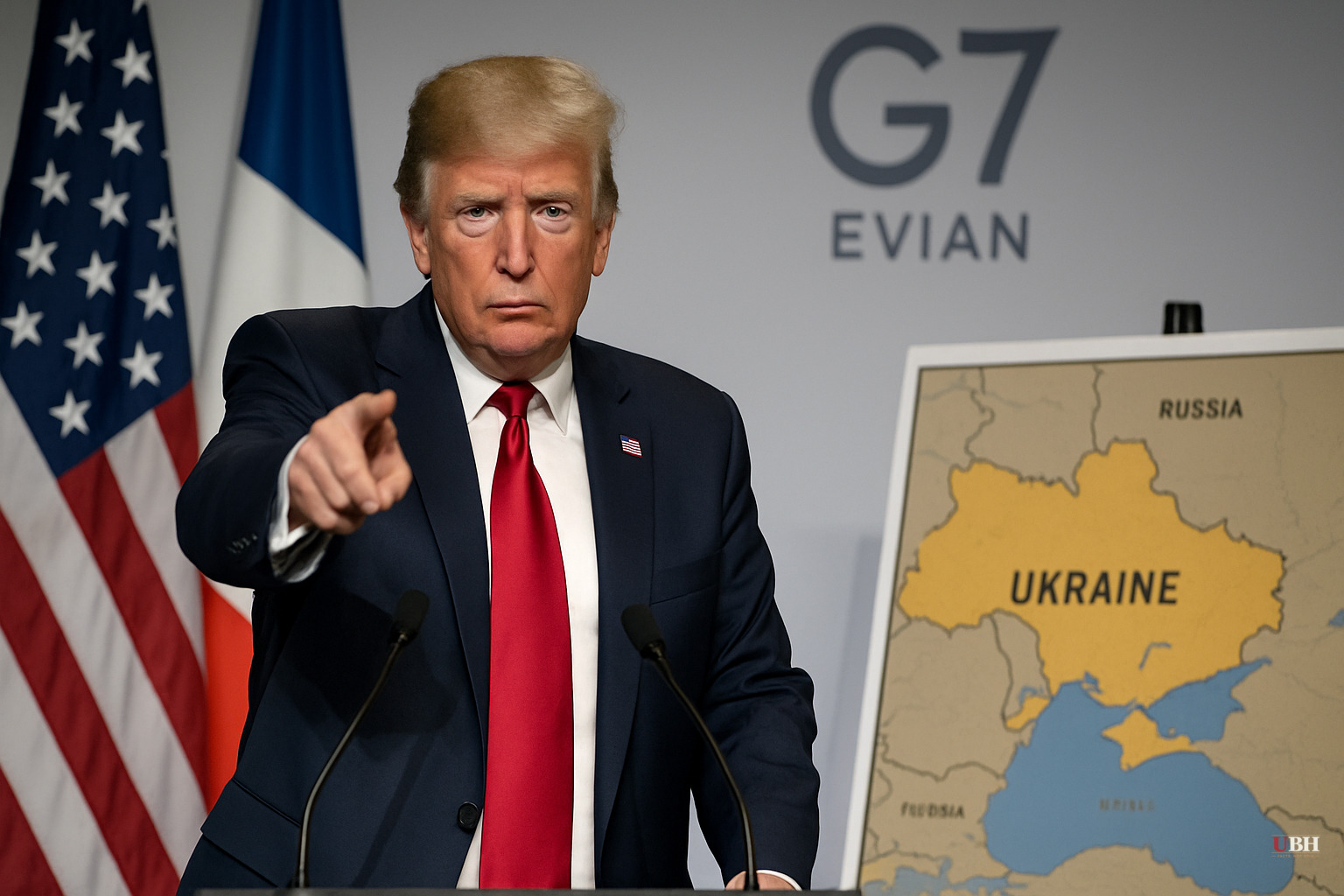
Since the U.S.-Iran interim agreement was announced Monday, the diplomatic fallout has landed squarely at the G7 summit in Evian-les-Bains, France, where world leaders are now sorting out what the deal actually means for the broader international order.
What Trump Said on Iran
Trump addressed the investment-fund reports directly on Tuesday, according to CNBC. "We are not investing any money in Iran, by the way, and with that rumor got out there yesterday was ridiculous," he told reporters on the sidelines of the summit.
The denial matters because the rumor has a source. Vice President JD Vance told CBS on Monday that a roughly $300 billion investment fund for Iran was "the sort of thing they could have access to, funded by the Gulf states, so long as they honor their end of the obligation." Vance framed it as Gulf money, not U.S. taxpayer money. Trump's wording Tuesday was more categorical: the U.S. is NOT putting in money, full stop, though he left open a vague future option: "We have the right to go in some day and do, if I want to do something."
The gap between Vance's conditional framing and Trump's flat denial remains unclear. No formal text of the MOU has been released publicly as of June 16, 2026.
Ukraine Gets Squeezed Back In
European leaders came to Evian with a clear goal: force Ukraine back onto Trump's radar after months of Iran dominating the conversation, according to NPR. French President Emmanuel Macron said he would seek to persuade Trump to continue supporting Ukraine and increase pressure on Russia to reach a peace agreement.
The working session with Ukrainian President Volodymyr Zelenskyy lasted only 75 minutes, per the French G7 presidency. Trump followed it by committing to a one-on-one meeting with Zelenskyy and saying Iran will soon be "back in the rearview mirror."
"The whole thing is ridiculous," Trump said of the Russia-Ukraine war, according to NPR. "So, yeah, I'm going to do whatever I can."
That is not exactly a rousing commitment to Kyiv's defense budget. As the U.S. has pulled back aid under Trump, France and European allies have become Ukraine's largest military and financial backers. This structural shift would have been unthinkable in 2022.
Hours before the G7 opened on Tuesday, Russia fired hundreds of drones and dozens of missiles at Ukrainian cities in a barrage that killed 11 people, according to NPR. The timing was not subtle.
The UK Moved Separately on Russian Oil
The United Kingdom announced a new round of sanctions targeting Russia's so-called "shadow fleet," the network of vessels Moscow uses to ship oil and gas around Western restrictions. The targeted ships include vessels recently purchased to carry liquefied natural gas from Russia's sanctioned Arctic LNG 2 project, per NPR. British troops seized a Russian shadow fleet vessel in the English Channel last weekend—the first such seizure.
None of that came from Washington. Britain acted on its own.
China's Export Surge Joins the Pile
AP News reported that surging Chinese exports are raising alarms at the G7, with European economies warning they cannot absorb the flood of cheap Chinese goods. The headline AP used—"China Shock 2.0"—frames it as a structural repeat of the 2001-era manufacturing displacement that gutted American and European industrial towns. Whether the G7 produces any coordinated response on China is unclear from the available sources.
Israel, Lebanon, and a Public Rebuke
Trump also used the G7 sidelines to publicly criticize Israel's handling of Lebanon, according to CNBC. "I've had a great relationship with Bibi, but now Bibi has to be more responsible with respect to Lebanon," he said, referring to Israeli Prime Minister Benjamin Netanyahu. Israel and Lebanon reached a ceasefire earlier this month, but Israel struck Hezbollah targets in Beirut's southern suburbs on Sunday.
Trump claimed to maintain a "great relationship" with Netanyahu even while breaking with him publicly on Lebanon. This tension is captured in the CNBC report but not resolved.
The Strongest Counter-Concern
Critics—including voices on both the European center-left and the American right—argue that the Iran deal's opacity is the real problem at this summit. If the MOU text has not been released, European allies are being asked to coordinate policy around a deal they have not read. Germany, France, and the U.K. previously had their own Iran nuclear framework (the JCPOA). They were not parties to this negotiation. For those allies, Trump's assurances about no U.S. investment in Iran carry limited verifiable weight until the document is public. That is a legitimate institutional concern, not partisan carping.
Trump's team would counter that operational secrecy during active negotiations protects the deal's integrity and that Vance's CBS statement was deliberately conditional, not a commitment.
Both positions are reasonable. The document itself would settle the argument. As of June 16, 2026, Vance told reporters the deal text may be released before Friday—and that specific deadline is the next concrete moment to watch.
Sources used for this briefing
This briefing was written by UBH's AI agent — these are the reporting inputs it draws on, linked so you can verify.


