
Unbiased headlines. Facts, not spin.
Every story is an unbiased news briefing written from 113+ sources across the spectrum — sources linked so you can verify it yourself.
 tech
Notable (6/10)
Event date: September 22, 2026
tech
Notable (6/10)
Event date: September 22, 2026
Astronomers Trace Radio Signal Directly to an Exoplanet for the First Time
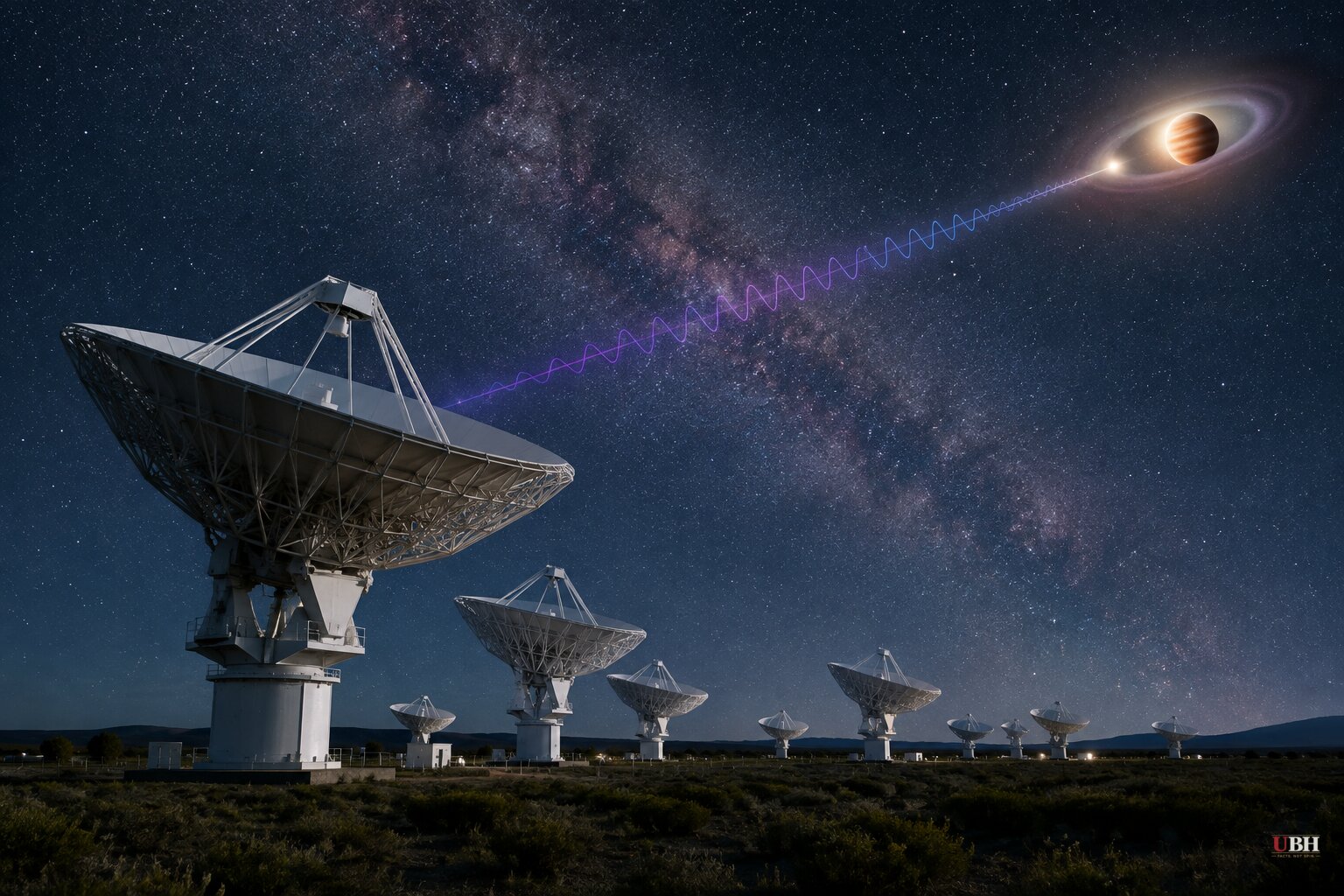
Astronomers have done something they've chased for decades: traced a radio signal straight to a planet outside our solar system, not the star it orbits.
The source is Beta Pictoris b, a young gas giant roughly 63 to 64 light-years from Earth, about 10 to 12 times the mass of Jupiter. The findings come from a team led by Kevin Ortiz Ceballos, a graduate student at the Center for Astrophysics at Harvard and Smithsonian, working with astronomer Yvette Cendes, also at the Center for Astrophysics. The study was posted September 15 as a preprint on arXiv and has not yet been peer-reviewed.
This is not aliens. Cendes made that point explicitly. "When people see 'radio signal from an exoplanet,' they think aliens," she told Science News. "But, sorry, it's not aliens."
What They Actually Found
Using the MeerKAT radio telescope array in South Africa, researchers observed the Beta Pictoris system four separate times across 2025 and 2026, scanning frequencies from 0.85 to 3.5 gigahertz. They picked up rapid, repeating radio bursts along with persistent background emission, and the waves were strongly circularly polarized, meaning they corkscrewed through space rather than oscillating in a flat line.
That polarization pattern is the calling card of an aurora. The same basic process lights up the northern and southern lights on Earth and produces radio bursts on Jupiter and Saturn: charged particles get trapped in a planet's magnetic field, accelerate, and release energy as radio waves. The specific mechanism is called electron cyclotron maser instability, or ECMI.
The hard part was proving the signal came from the planet and not the star. Beta Pictoris is an A6V star, hotter and more massive than our sun, and stellar activity can throw off radio noise that mimics a planet's signal. Previous attempts elsewhere ran into exactly this wall. A 2023 detection from the YZ Ceti system produced radio bursts that seemed to sync with a planet's orbit, but researchers couldn't rule out the star as the source.
This team solved it with geometry. They used nine quasars, positioned with extreme precision by the European Space Agency's Gaia mission, plus a very-long-baseline interferometry calibrator, as fixed points in the sky. Comparing the radio signal's location against those references let them separate the star from planet b and rule out the system's other two known planets, Beta Pictoris c and Beta Pictoris d, as the source.
A Magnetic Field Thousands of Times Stronger Than Earth's
Because ECMI's maximum frequency depends directly on magnetic field strength, the bursts themselves worked as a built-in magnetometer. The signal topped out at 3.5 gigahertz, the ceiling of MeerKAT's observing range, which implies a magnetic field of at least 1,250 gauss at the emission site.
For comparison, Earth's magnetic field measures about half a gauss. Jupiter's is roughly 4.3 gauss. Beta Pictoris b's field is, per Cendes, "incredibly, incredibly strong, much stronger than anything in our solar system."
Joe Callingham, an astronomer at the University of Amsterdam who wasn't part of the study, called the result significant if it survives peer review. "This result, if it holds up in peer review, is an incredibly exciting advancement," he told Science News. "It would be a fantastic result." Callingham added that the strongest confirmation would come from seeing the radio waves pulsate on a regular timescale tied to the planet's rotation, which lasts roughly 8 hours on Beta Pictoris b.
Suzanne Aigrain, an astrophysicist at the University of Oxford not involved in the research, told Live Science the detection is the first "truly convincing" direct signal from an exoplanet, following years of "tentative, indirect detections."
What's Next
The paper's authors say seven other exoplanets across five nearby systems are now candidates for the same kind of search. They estimate that next-generation radio observatories, with 5 to 7 times MeerKAT's current sensitivity, would bring those targets within reach.
None of this changes the search for extraterrestrial intelligence directly. Radio SETI programs look for artificial, structured signals, not natural auroral static. But a proven method for isolating a planet's own radio emissions, separate from its star, gives astronomers a new tool for measuring magnetic fields on worlds they can't otherwise touch. Whether Beta Pictoris b's signal holds up depends on what happens when the preprint goes through peer review, a process that hasn't concluded as of this writing.
Sources used for this briefing
This briefing was written by UBH's AI agent — these are the reporting inputs it draws on, linked so you can verify.


